

A bakery owner might spend weeks perfecting a page titled
“Artisanal Handcrafted Confections,” then wonder why nobody finds it. Her
customers aren’t searching for that phrase. They’re typing “birthday cakes near
me” or “gluten-free brownies delivery.”
That gap between how you describe your business and how
customers search for it is the problem keyword research solves. This guide
walks through a practical process for finding keywords that fit your business,
judging which ones are worth pursuing, and turning them into a working list.
What Keywords Actually Are
Keywords are the words and phrases people type into
search engines when they want something. They can be a single word (“plumber”),
a phrase (“emergency plumber in Leeds”), or a full question (“why is my water
heater leaking”).
Keywords matter because they connect what you publish to
what people want. When your page uses the language your customers use, search
engines can match you to their queries far more easily.
Key Point: The right keyword isn’t the one with the
most searches. It’s the one that brings people who actually need what you
offer.
Start With Your Customers, Not a Tool
Most people open a keyword tool first. A better starting
point is a blank page and what you already know about your customers.
Write down what you sell and the problems you solve
List your products or services, then list the problems they
fix. Customers often search for the problem long before they know the solution
exists. A software company might sell “inventory management,” but a customer’s
first search could be “how to stop running out of stock.”
Collect the exact words customers use

Your own records are a free source of real language:
- Emails
and contact-form messages
- Questions
asked in person, by phone, or in chat
- Reviews
of your business and your competitors
- Social
media comments and community forum threads
Copy phrases word for word. Customers rarely use your
industry’s terminology, and those differences are where useful keywords hide.
Understand Search Intent Before You Pick Anything
Search intent is the reason behind a search. Two
phrases can look alike and still need very different pages.
|
Intent type |
What the searcher wants |
Example search |
Best content |
|
Informational |
To learn something |
how to choose running shoes |
Guide or blog post |
|
Commercial |
To compare options |
best running shoes for flat feet |
Comparison or review page |
|
Transactional |
To buy or book |
buy trail running shoes size 10 |
Product or service page |
|
Navigational |
To reach a specific site |
[brand name] login |
Homepage or account page |
Matching intent matters as much as choosing the keyword. If
you target “how to choose running shoes” with a product page, searchers who
wanted a guide will leave. A simple check helps: search your candidate keyword
and look at what ranks. If the top results are all guides, a sales page is
unlikely to compete.
Build a Seed List of Keywords
Once you know your customers’ language, turn it into seed
keywords, the broad starting terms for your research.
- Write
10 to 20 short phrases describing your products, services, and customer
problems.
- Add
location terms if you serve a local area, such as a city or neighborhood.
- Add
modifiers customers commonly use, such as “cheap,” “best,” “near me,” “for
beginners,” or “same day.”
A small accounting firm, for example, might start with
“bookkeeping for freelancers,” “tax filing help,” and “small business
accountant.”
Expand Your List With Free Search Features
You don’t need a paid tool to find ideas. Search engines
show you what people look for.
- Autocomplete:
Start typing a seed keyword and note the suggestions that appear.
- “People
also ask”: These boxes show related questions real users have
searched.
- Related
searches: Found at the bottom of many results pages, they reveal
alternative phrasings.
- Community
sites and forums: Threads show how people describe problems in their
own words.
Google also offers free tools, including Google Search
Console, which shows which queries already bring visitors to your site if you
have one, and Google Trends, which helps you compare interest in terms over
time. Their features change occasionally, so check each tool’s current options.
Focus on Long-Tail Keywords
Long-tail keywords are longer, more specific phrases,
usually three words or more. They tend to have fewer searches each, but they
also face less competition and often show clearer intent.
Compare these two searches:
- “running
shoes” is broad, competitive, and unclear about what the person wants.
- “lightweight
running shoes for wide feet” is narrow, specific, and closer to a buying
decision.
For a new or small business, long-tail keywords are usually
the more realistic place to start. A smaller site rarely wins broad terms
against established brands, but it can win a specific phrase that larger sites
ignore.
Study What Your Competitors Rank For
Competitors have already done some of the testing for you.
Look at which businesses appear for your seed keywords, then study their sites:
- Which
pages and topics do they emphasize?
- What
phrases appear in their page titles and headings?
- What
do they cover that you haven’t?
- What
do they cover poorly, where you could do better?
Many keyword tools can show the terms a competitor’s pages
rank for. Treat this as a source of ideas, not a list to copy. Your goal is to
find gaps, such as topics your customers care about that nobody covers well.
Judge Each Keyword Before You Commit
A long list isn’t useful until you evaluate it. Check each
candidate against four questions.
1. Is it relevant?
Would the person searching this phrase be a good customer? A
high-volume keyword that attracts the wrong audience wastes effort.
2. How much interest does it have?
Search volume estimates how often a phrase is
searched. Treat these numbers as rough guides, since different tools report
different figures. A phrase with modest volume and high relevance often beats a
popular one that barely fits.
3. How hard is it to rank for?
Many tools give a keyword difficulty score. These
scores are tool-specific estimates, not guarantees. A manual check works well
too: search the phrase and see who ranks. If the first page is full of large,
established sites, consider a more specific version.
4. Does it match your goals?
A keyword that brings readers but no customers may still
help with awareness, but you should know which job each keyword does. Label
them as you go: learn, compare, or buy.
Turn Your Research Into a Working Plan
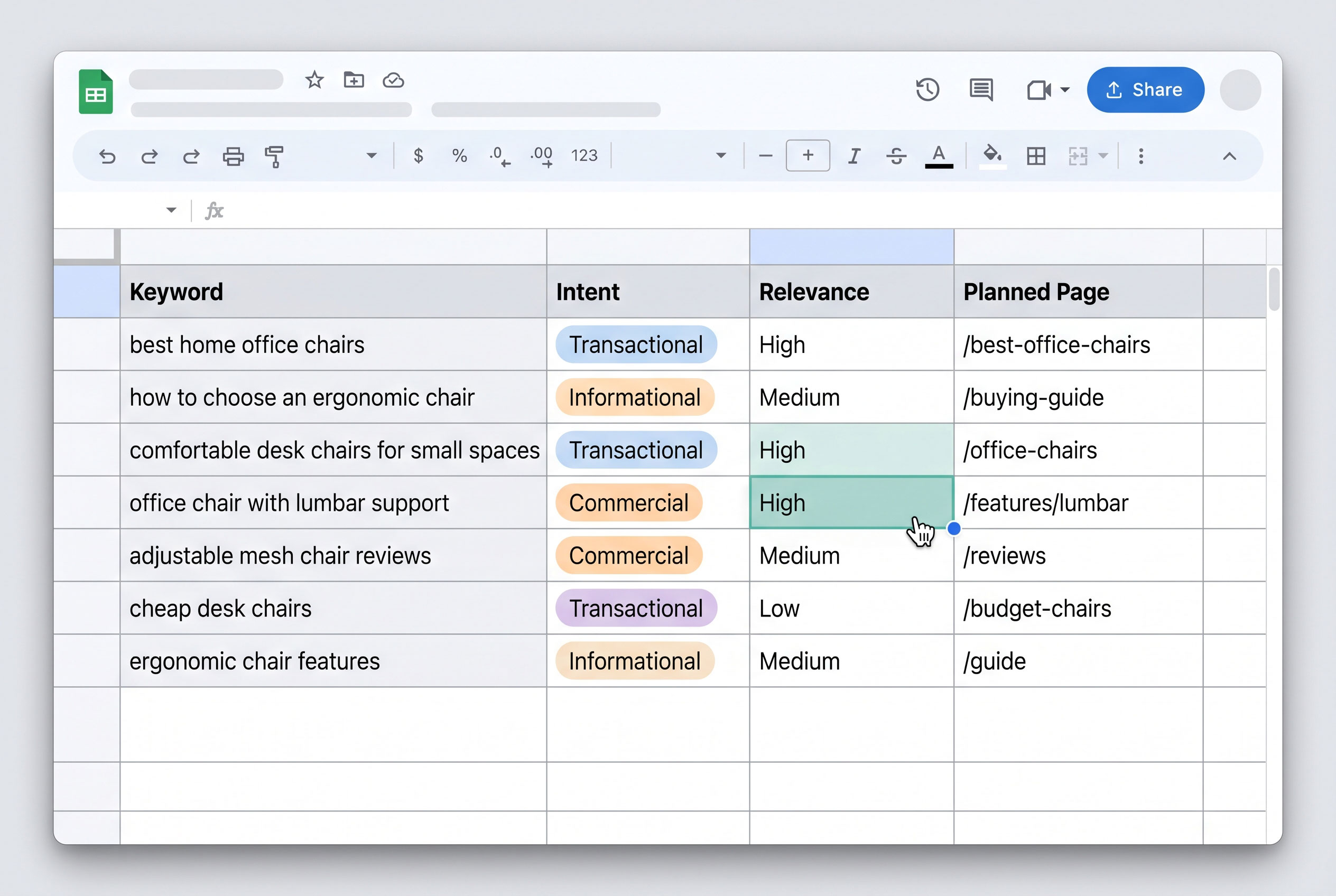
A spreadsheet is enough to organize everything. Use columns
like these:
|
Keyword |
Intent |
Relevance (1-3) |
Estimated difficulty |
Planned page |
|
bookkeeping for freelancers |
Commercial |
3 |
Medium |
Service page |
|
how to track business expenses |
Informational |
2 |
Low |
Blog post |
|
small business accountant near me |
Transactional |
3 |
Medium |
Local landing page |
Then follow a few simple rules:
- Give
each page one main keyword and a few closely related ones.
- Don’t
target the same keyword with several pages, because they compete with each
other.
- Start
with keywords that score high on relevance and low on difficulty.
- Place
the keyword naturally in the page title, headings, and opening paragraph,
then write for the reader.
Common Keyword Research Mistakes
Chasing volume alone. Big numbers look impressive but
often come with heavy competition and vague intent.
Ignoring intent. A page that doesn’t match what
searchers want will lose them quickly, however well it ranks.
Stuffing keywords. Repeating a phrase unnaturally
makes writing worse and doesn’t help. Search engines are designed to understand
natural language and related terms.
Treating research as a one-time job. Products change,
trends shift, and customers adopt new phrases. Review your list every few
months.
Skipping the data you own. Customer emails, support
tickets, and search-console queries are often more valuable than anything a
tool suggests.
Final Thoughts
Finding the right keywords is mostly a matter of listening.
Start with how your customers talk, check what they really want when they
search, and pick phrases you can realistically win. A short, well-matched list
of keywords will serve a business better than a huge one nobody acts on.