

A small logistics company used to spend two full days each
month reconciling invoices by hand. Today, that same task takes under an hour,
handled largely by software that reads documents, matches numbers, and flags
errors on its own. This shift, happening across industries at different speeds,
is what most people mean when they talk about AI automation.
This article looks at what AI automation actually involves,
how it works inside a business, where it delivers the most value, and what to
watch out for before adopting it. The goal is to give a grounded, practical
picture rather than a hype-driven one.
What Is AI Automation?
AI automation combines artificial intelligence with
automation software to complete tasks that once required constant human
judgment or manual effort. Traditional automation follows fixed rules ("if
X happens, do Y"). AI automation goes further by using models that can interpret
language, recognize patterns, and make context-based decisions.
For example, a rule-based system might automatically sort
emails into folders based on the sender's address. An AI-powered system can
instead read the content of an email, understand its intent, and route it to
the right department, even if the wording varies each time.
Key Point: AI automation is not about replacing every
human task. It is about handling repetitive, data-heavy, or predictable work so
people can focus on judgment, creativity, and relationship-building.
How Does AI Automation Work in a Business Setting?
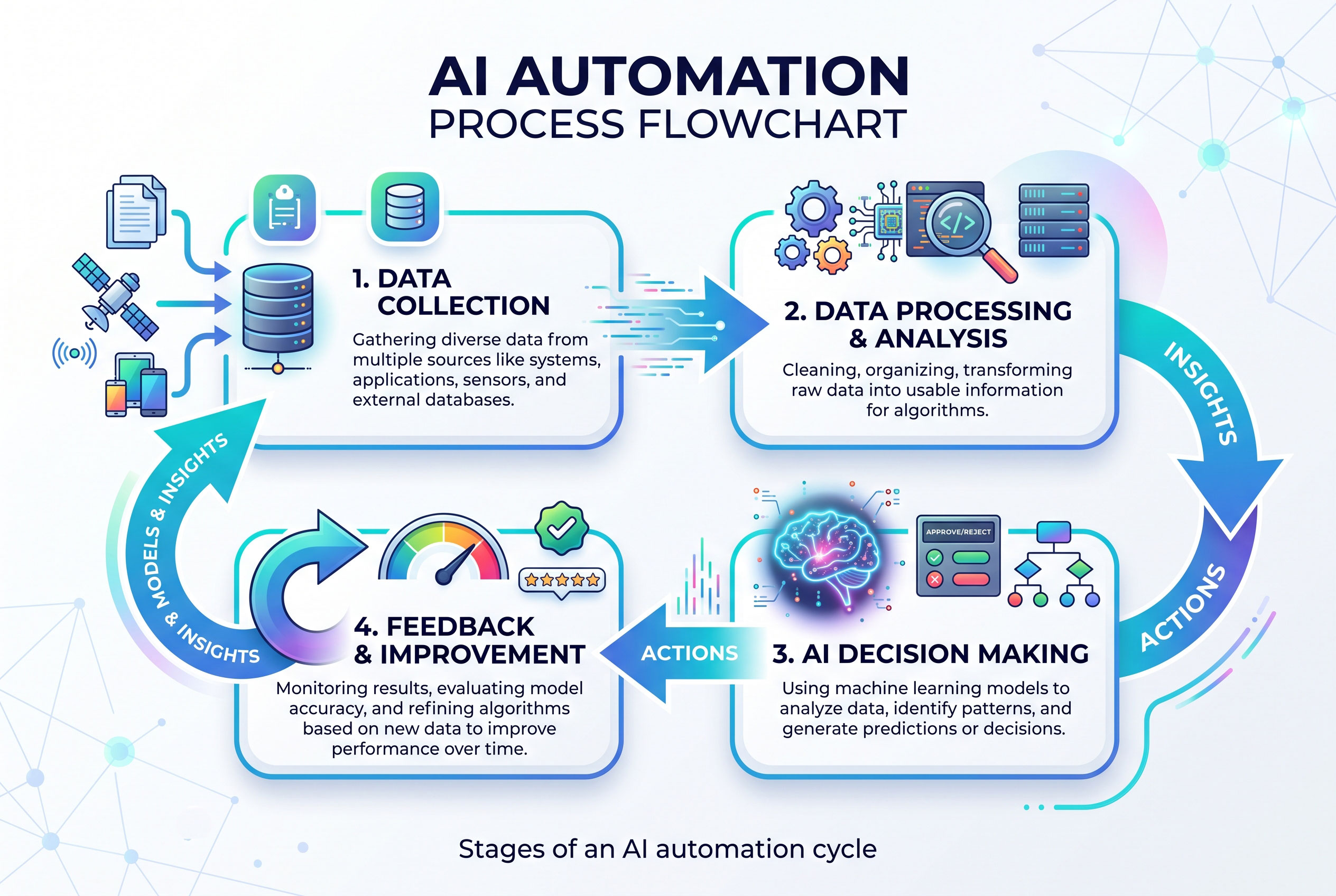
Most AI automation systems follow a similar general pattern,
even though the underlying technology varies by task.
- Data
collection – The system gathers information from emails, forms,
spreadsheets, sensors, or existing software.
- Processing
and analysis – AI models interpret that data, whether it's text,
numbers, or images.
- Decision
or action – Based on the analysis, the system performs a task, such as
generating a report, updating a record, or sending a notification.
- Feedback
and improvement – Many systems use ongoing results to refine future
performance, particularly when machine learning is involved.
This cycle allows a business to automate not just simple,
repetitive steps, but also more nuanced processes that previously required a
trained employee's attention.
Key Areas Where AI Automation Makes a Difference
Different departments benefit from AI automation in
different ways. Below is a breakdown of common applications.
|
Business Area |
Example Use of AI Automation |
Typical Benefit |
|
Customer Service |
Chatbots and AI ticket routing |
Faster response times |
|
Finance |
Automated invoice processing and fraud detection |
Fewer manual errors |
|
Marketing |
Personalized content and audience segmentation |
Higher engagement |
|
Human Resources |
Resume screening and onboarding workflows |
Reduced hiring time |
|
Operations |
Inventory forecasting and supply chain alerts |
Lower waste, better planning |
|
Sales |
Lead scoring and follow-up automation |
More efficient pipelines |
Customer Service and Support
AI-powered chatbots and virtual assistants can now handle a
large share of routine customer questions, such as order status or return
policies, without a human agent stepping in. More complex issues are typically
escalated to a live representative, which means staff spend their time on cases
that genuinely need human attention.
Finance and Accounting
Tasks like invoice matching, expense categorization, and
basic fraud detection are well-suited to AI automation because they involve
large volumes of structured data. Software can compare thousands of
transactions against expected patterns far faster than a person can, flagging
anomalies for review.
Marketing and Sales
AI tools can analyze customer behavior to personalize email
campaigns, recommend products, or score leads based on how likely they are to
convert. This allows marketing and sales teams to prioritize their effort where
it is most likely to pay off.
Human Resources
Screening resumes, scheduling interviews, and answering
common employee questions about benefits or policies are increasingly handled
through AI-assisted systems, which can shorten hiring cycles and reduce
administrative workload.
Benefits of Adopting AI Automation
Businesses that introduce AI automation thoughtfully tend to
see improvements across several areas:
- Time
savings – Repetitive tasks that once took hours can often be completed
in minutes.
- Reduced
errors – Automated systems apply the same logic consistently, reducing
the mistakes that come from fatigue or oversight.
- Cost
efficiency – Fewer manual hours spent on routine work can lower
operating costs over time.
- Better
use of employee skills – Staff can shift attention toward strategy,
creativity, and complex problem-solving.
- Faster
decision-making – Real-time data analysis allows managers to respond
to trends more quickly than manual reporting allows.
- Scalability
– Automated systems can typically handle increased workload without a
proportional increase in staff.
Key Point: The biggest gains usually come not from
automating everything at once, but from identifying the two or three processes
causing the most friction and addressing those first.
Challenges and Limitations to Consider
AI automation is a powerful tool, but it is not without real
limitations.
- Upfront
investment – Setting up AI systems, integrating them with existing
software, and training staff takes time and money before benefits appear.
- Data
quality issues – AI automation is only as reliable as the data it
works from; poor or inconsistent data can lead to flawed outcomes.
- Change
management – Employees may resist new systems, particularly if they
fear job displacement or find the transition confusing.
- Not
fully autonomous – Most AI systems still require human oversight,
especially for edge cases or decisions with legal or ethical implications.
- Ongoing
maintenance – AI models and workflows need periodic review and
adjustment as business needs change.
Understanding these limitations upfront helps businesses set
realistic expectations rather than assuming automation is a one-time fix.
How to Start Implementing AI Automation

Businesses considering AI automation generally benefit from
a structured, incremental approach rather than a sweeping overhaul.
1. Identify Repetitive, High-Volume Tasks
Start by mapping out processes that are time-consuming,
rule-based, or prone to human error. These are usually the best early
candidates for automation.
2. Evaluate Available Tools
Compare software options based on ease of integration with
existing systems, cost, scalability, and vendor support. Many tools now offer
no-code or low-code interfaces, making adoption more accessible for smaller
teams.
3. Start Small and Measure Results
Pilot the automation on a single process before expanding.
Track measurable outcomes, such as time saved or error reduction, to justify
further investment.
4. Train Staff and Communicate Clearly
Employees are more likely to embrace automation when they
understand how it will change their day-to-day work and how it benefits them
directly, rather than viewing it as a threat.
5. Review and Refine Regularly
AI automation is not "set and forget." Regularly
reviewing performance data allows a business to fine-tune workflows and adapt
as needs evolve.
AI Automation vs. Traditional Automation
It helps to understand how AI automation differs from the
automation many businesses have used for years.
|
Feature |
Traditional Automation |
AI Automation |
|
Logic |
Fixed rules |
Adaptive, pattern-based |
|
Flexibility |
Struggles with variation |
Handles varied inputs |
|
Learning |
Static |
Can improve with more data |
|
Best for |
Simple, repetitive tasks |
Complex, judgment-based tasks |
|
Setup complexity |
Generally lower |
Often higher initially |
Both approaches still have their place. A simple rule-based
automation may be perfectly sufficient for a straightforward task, while AI
automation adds value when a process involves interpreting unstructured
information or making context-sensitive decisions.
The Road Ahead for Businesses
As AI tools become more accessible and affordable, adoption
is likely to continue expanding beyond large enterprises into small and
medium-sized businesses. The businesses that benefit most tend to be the ones
that treat AI automation as a long-term capability to build, rather than a
single project to complete.
The direction is clear: routine, data-driven work is
increasingly handled by intelligent systems, while human effort shifts toward
tasks that require empathy, creativity, and complex judgment. Businesses that
plan for this shift thoughtfully, rather than reactively, are better positioned
to adapt as the technology continues to mature.