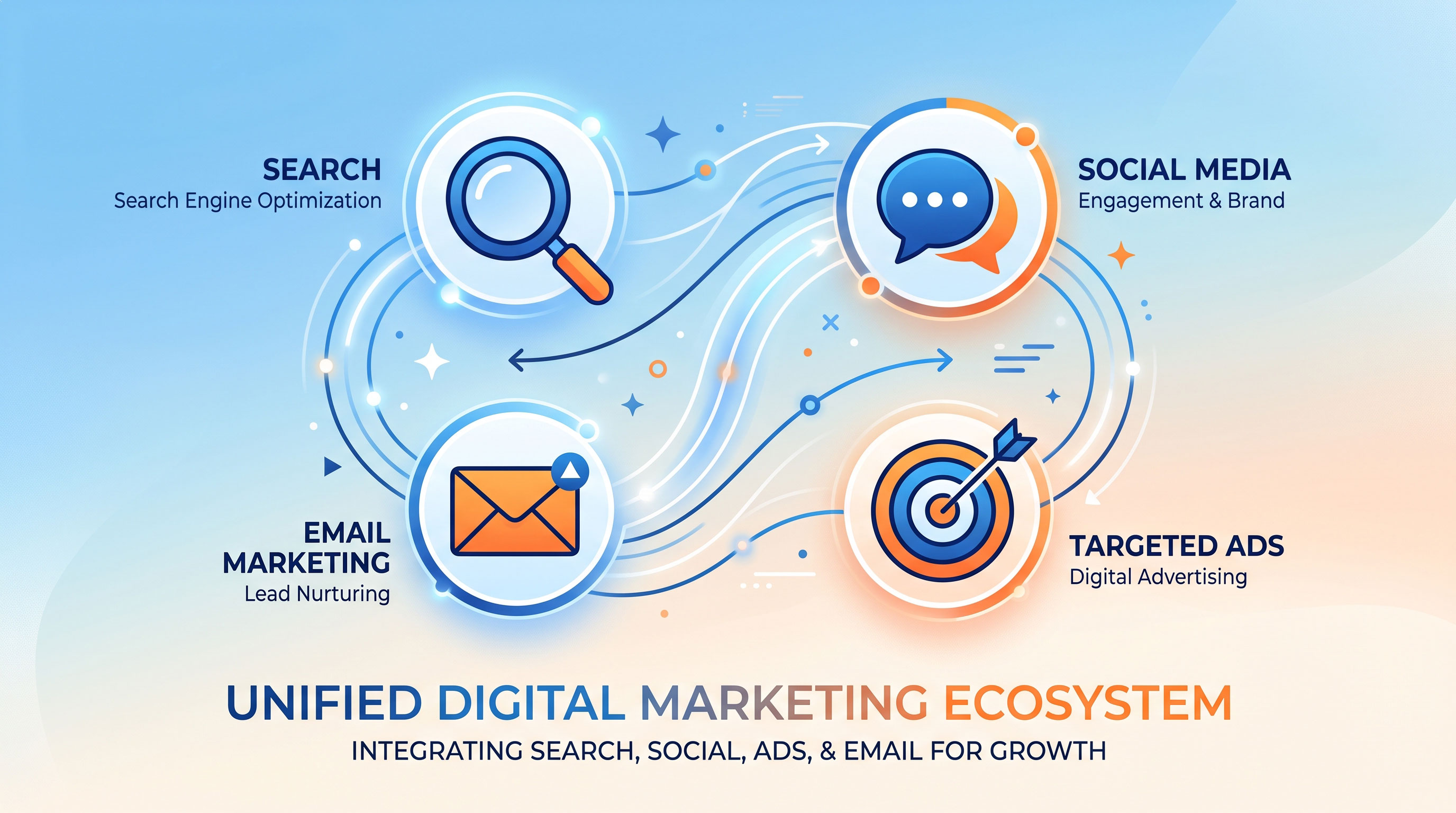

Most businesses don't fail at digital marketing because they
lack tools or budget. They fail because they never had a real strategy to begin
with—just a scattered mix of social posts, occasional ads, and hope. A strategy
changes that. It gives every marketing action a purpose and a way to measure
whether it's working.
This guide walks through the process of building a digital
marketing strategy from the ground up, even if you're starting with nothing but
an idea of what your business does.
What Is a Digital Marketing Strategy?
A digital marketing strategy is a documented plan
that defines who you're trying to reach, what you want them to do, and which
online channels and tactics will get you there. It's different from a marketing
tactic—posting on Instagram or running a Google ad is a tactic. A
strategy is the reasoning behind why you'd choose those actions in the first
place.
Key Point: A strategy answers "why" and
"what," while tactics answer "how." Without the strategy,
tactics tend to be random and hard to evaluate.
A solid strategy typically includes:
- Clear
business and marketing goals
- A
defined target audience
- Chosen
marketing channels
- A content
and messaging plan
- A
budget and timeline
- A way
to measure results
Step 1: Define Your Goals

Before choosing any channel or tool, get specific about what
you're trying to achieve. Vague goals like "get more customers" are
hard to act on.
Instead, use goals that are measurable and time-bound, such
as:
- Increase
website traffic by 30% in six months
- Generate
100 qualified leads per month
- Grow
email subscribers from 500 to 2,000 in a year
- Improve
online sales conversion rate by 2 percentage points
Key Point: Every channel and tactic you choose later
should trace back to one of these goals. If it doesn't support a goal, it
probably doesn't belong in the plan.
Step 2: Understand Your Target Audience
You can't market effectively to "everyone."
Building a clear picture of your ideal customer shapes every decision that
follows—which platforms to use, what tone to write in, and what problems to
address.
Building a Basic Customer Profile
Start with the essentials:
- Demographics:
age range, location, income level, occupation
- Pain
points: what problems does your product or service solve for them?
- Online
behavior: which platforms do they use, and how do they search for
solutions?
- Buying
triggers: what typically prompts them to make a purchase decision?
If you already have customers, look at your existing
data—purchase history, customer support questions, and reviews often reveal
patterns you can build on. If you're starting fresh, research competitors'
audiences and industry reports for your niche.
Step 3: Analyze Your Current Position
If your business already has any online presence—a website,
social accounts, past ad campaigns—review what's working and what isn't before
building anything new.
A simple SWOT analysis (Strengths, Weaknesses,
Opportunities, Threats) can help organize this:
|
Category |
Questions to Ask |
|
Strengths |
What are we already doing well online? |
|
Weaknesses |
Where are we underperforming compared to competitors? |
|
Opportunities |
Are there channels or trends we haven't tapped into? |
|
Threats |
What are competitors doing that could take market share? |
This step prevents you from repeating past mistakes or
duplicating effort in areas that already work.
Step 4: Choose Your Marketing Channels
Not every channel fits every business. Choosing the right
ones depends on where your audience spends time and what your goals require.
Common Digital Marketing Channels
- Search
Engine Optimization (SEO): improving organic visibility on search
engines over time
- Content
Marketing: blog posts, guides, videos, and other resources that
attract and educate an audience
- Social
Media Marketing: building presence and engagement on platforms like
Instagram, LinkedIn, or TikTok
- Email
Marketing: nurturing leads and retaining customers through direct
communication
- Paid
Advertising (PPC): search ads, social ads, and display ads that drive
immediate traffic
- Affiliate
or Partnership Marketing: collaborating with other brands or
individuals to expand reach
Key Point: It's usually better to do two or three
channels well than to spread thin across six. Depth beats breadth, especially
with limited budget or a small team.
Matching Channels to Goals
|
Goal |
Best-Fit Channels |
|
Brand awareness |
Social media, content marketing, display ads |
|
Lead generation |
SEO, email marketing, search ads |
|
Sales growth |
Paid search, retargeting ads, email |
|
Customer retention |
Email marketing, loyalty content, community building |
Step 5: Build Your Content and Messaging Plan
Once channels are chosen, decide what you'll actually say
and share. This is where strategy turns into visible action.
Core Elements of a Messaging Plan
- Brand
voice: consistent tone across all channels (formal, casual, technical,
playful, etc.)
- Key
messages: the two or three core ideas you want your audience to
associate with your brand
- Content
types: blog articles, videos, infographics, case studies, or social
posts
- Content
calendar: a schedule that maps out what gets published, where, and
when
A content calendar doesn't need to be complicated. Even a
simple spreadsheet listing topics, publish dates, and channels keeps a strategy
organized and consistent.
Step 6: Set a Budget
Budgets vary widely depending on business size and industry,
so there's no universal number that fits everyone. What matters is allocating
funds deliberately rather than spending reactively.
A reasonable starting approach:
- List
all channels you plan to use.
- Estimate
the cost of each (ad spend, tools, content production, freelance help).
- Allocate
a larger share to channels tied directly to your top goal.
- Leave
a small reserve for testing new tactics.
Key Point: Budgets should be revisited quarterly.
What works in month one may need adjustment as you gather more data.
Step 7: Set Up Measurement and Analytics

A strategy is only useful if you can tell whether it's
working. Before launching anything, decide how you'll track performance.
Metrics to Track by Channel
- Website/SEO:
organic traffic, keyword rankings, bounce rate
- Social
Media: engagement rate, follower growth, click-through rate
- Email:
open rate, click rate, unsubscribe rate
- Paid
Ads: cost per click, conversion rate, return on ad spend
Tools like Google Analytics, native platform dashboards
(Meta Business Suite, LinkedIn Analytics), and email marketing software
typically provide these numbers without additional cost.
Step 8: Launch, Review, and Adjust
Digital marketing strategies aren't meant to be static
documents. Launch your plan, but build in regular checkpoints—monthly or quarterly—to
review performance against your original goals.
Ask during each review:
- Are we
on track to meet our goals?
- Which
channels are underperforming, and why?
- Should
budget shift toward what's working?
- Has
anything changed in the market or audience that requires adjustment?
This ongoing cycle of reviewing and adjusting is often what
separates strategies that keep improving from ones that quietly stop working.
Common Mistakes to Avoid
- Skipping
audience research and marketing to a generic, undefined group
- Chasing
every new platform instead of focusing where your audience actually is
- Setting
vague goals that can't be measured
- Ignoring
data after launch instead of adjusting based on results
- Underestimating
content consistency—sporadic posting rarely builds momentum