
Picture a potential customer who needs what you sell. They
don’t ask a neighbor or flip through a directory. They pick up a phone, type a
few words, and decide within seconds which business looks trustworthy. If yours
doesn’t appear, or appears with outdated details, that customer is already
talking to a competitor.
That moment, repeated thousands of times, is why an online
presence is no longer a bonus for businesses. It’s part of how customers
find you, judge you, and decide whether to contact you at all.
This article explains what an online presence actually includes,
why it matters, and how to build one without wasting time or money.
What Does “Online Presence” Actually Mean?
Short answer: A business’s online presence is
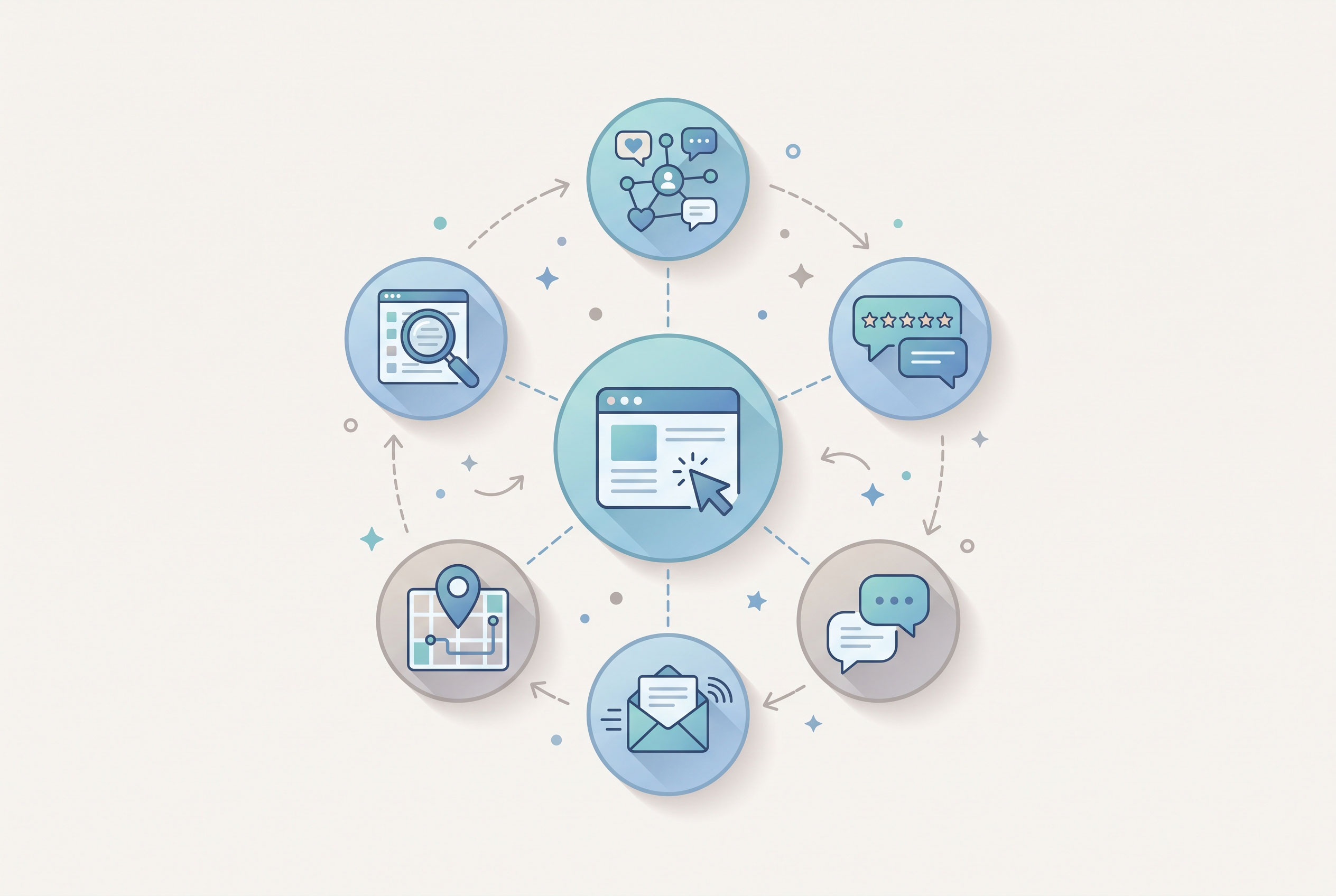
everything people can find about it on the internet. That includes your
website, search listings, social media profiles, customer reviews, and any
mentions on other sites. Together, these shape how customers discover and judge
your business before they ever contact you.
Many owners think “online presence” means “having a
website.” A website is the foundation, but the full picture is wider:
- Your
website: the one place you fully control.
- Search
listings: how you appear on Google, Bing, and map apps.
- Social
media profiles: places where customers see your personality and
activity.
- Reviews
and ratings: what other people say about you.
- Third-party
mentions: directories, news articles, partner sites, and community
pages.
Customers see all of these together, whether you planned it
or not. If you don’t shape your presence, other people’s opinions and outdated
listings will shape it for you.
Customers Check You Online Before They Contact You
Think about your own habits. Before visiting an unfamiliar
restaurant, booking a repair service, or hiring a consultant, you probably look
them up first. Your customers do the same.
This changes how a business gets found. In the past,
reputation spread mostly through word of mouth and local advertising. Today,
word of mouth often ends with a search. A friend recommends your
business, and the customer looks you up to confirm. What they find either
supports the recommendation or undermines it.
Key Point: Your online presence often works as your
first impression and your reference check at the same time.
Five Reasons a Strong Online Presence Matters
1. It Builds Trust and Credibility
A professional website, accurate contact details, and
consistent branding signal that a business is real and reliable. A business
with no website, or one that looks abandoned, raises questions. Is it still
open? Is it legitimate? Can I trust it with my money?
You don’t need a large budget to look credible. You need accurate
information, clear writing, and a design that works properly on a phone.
2. It Makes You Easy to Find
If people can’t find you, they can’t buy from you. Search
engines are one of the main ways customers discover local and online
businesses. Showing up when someone searches for what you offer puts you in
front of people who are already interested.
For local businesses, a complete Google Business Profile
is one of the most practical steps. It lets you list your address, opening
hours, phone number, photos, and services directly in search results and maps.
Keeping it accurate costs nothing but time.
3. It Works While You’re Closed
A physical shop closes at night. A website doesn’t.
Customers can read about your services, check prices, browse products, or send
an inquiry at any hour. Even if you never sell online, a website can answer the
questions that would otherwise cost you phone calls and missed opportunities.
4. It Lets You Compete With Larger Businesses
Large companies have bigger advertising budgets, but search
results and social platforms give smaller businesses real openings. A small
business with helpful content, strong reviews, and accurate local information
can outperform a bigger competitor in a specific area or niche.
Smaller businesses can often move faster, too. You can
answer customer messages personally, show real behind-the-scenes content, and
adapt quickly. These are things large organizations often struggle to do.
5. It Gives You a Direct Line to Your Customers
Social media, email newsletters, and your own website let
you communicate with customers directly. You can announce new products, share
useful tips, respond to questions, and gather feedback. Over time, this builds
relationships that don’t depend on paying for every single click.
The Building Blocks of a Strong Online Presence
Not every business needs every channel. This table shows
what each element does and who benefits most from it.
|
Element |
What It Does |
Best For |
|
Website |
Central hub for information, credibility, and sales |
Every business |
|
Google Business Profile |
Shows your location, hours, reviews, and photos in search
and maps |
Local and service-based businesses |
|
Social media profiles |
Builds awareness and lets you engage with customers |
Businesses with visual or community-driven offerings |
|
Customer reviews |
Provides social proof that influences decisions |
Almost all businesses |
|
Email list |
Lets you contact interested customers directly |
Businesses with repeat customers or regular updates |
|
Blog or resource content |
Answers questions and attracts search traffic |
Businesses where customers research before buying |
How to Build an Online Presence Step by Step
You don’t have to do everything at once. A steady, practical
approach works better than a rushed one.
- Start
with a simple, accurate website. Include who you are, what you offer,
where you operate, and how to contact you. Make sure it loads quickly and
reads well on a phone.
- Claim
and complete your business listings. Fill in every field on your
Google Business Profile and make sure your name, address, and phone number
match across the web.
- Choose
one or two social platforms. Pick the platforms where your customers
actually spend time, rather than trying to be everywhere.
- Ask
satisfied customers for reviews. A polite request after a good
experience is usually enough. Never buy fake reviews, since they damage
trust and break the rules of most platforms.
- Publish
useful content regularly. Answer the questions customers ask you most
often. Helpful content earns attention and gives search engines more to
understand about your business.
- Check
and update everything on a schedule. Opening hours, prices, and
contact details change. Outdated information frustrates customers and
costs you business.
Consistency Matters More Than Volume
A common mistake is launching several social media accounts
and then abandoning them. An inactive profile can look worse than none at all.
It’s better to maintain two channels well than six poorly.
Common Mistakes That Weaken Your Online Presence
Even businesses that make the effort often stumble in
predictable ways:
- Outdated
information: wrong hours, old phone numbers, or discontinued services
listed as available.
- A
website that doesn’t work on mobile: many visitors browse on phones,
and awkward layouts drive them away.
- Ignoring
reviews: unanswered complaints suggest you don’t care. A calm, helpful
reply shows other readers how you handle problems.
- Inconsistent
branding: different names, logos, or descriptions across platforms
make a business look disorganized.
- Treating
it as a one-time project: an online presence needs ongoing attention,
not a single launch.
Handling Negative Reviews

Every business eventually receives a bad review. What
matters is the response. Reply politely, acknowledge the issue, and offer to
resolve it. Future customers reading the exchange often judge you more by your
reply than by the complaint itself. Avoid arguing, and never reveal private
customer details in a public response.
Key Point: A thoughtful reply to criticism can
strengthen trust more than a page of perfect reviews.
How to Know It’s Working
You don’t need complicated analytics to measure progress.
Start with a few simple signals:
- Are
more people finding your website or listing through search?
- Are
inquiries, calls, or direction requests increasing?
- Are
customers mentioning that they found you online?
- Is
your review rating stable or improving?
Free tools such as Google Analytics and the insights built
into Google Business Profile and social platforms can show you where visitors
come from and what they do. Review them occasionally and adjust based on what
you learn.
Building Your Presence Is a Long-Term Investment
An online presence isn’t a campaign with an end date. It
grows slowly and compounds over time: each accurate listing, helpful page, and
positive review adds to the picture customers see.
The most important step is to start. Make sure your basic information
is correct, give people a clear way to reach you, and keep improving from
there. Customers will look you up either way, so the real choice is whether
they find a business that looks ready to serve them.