
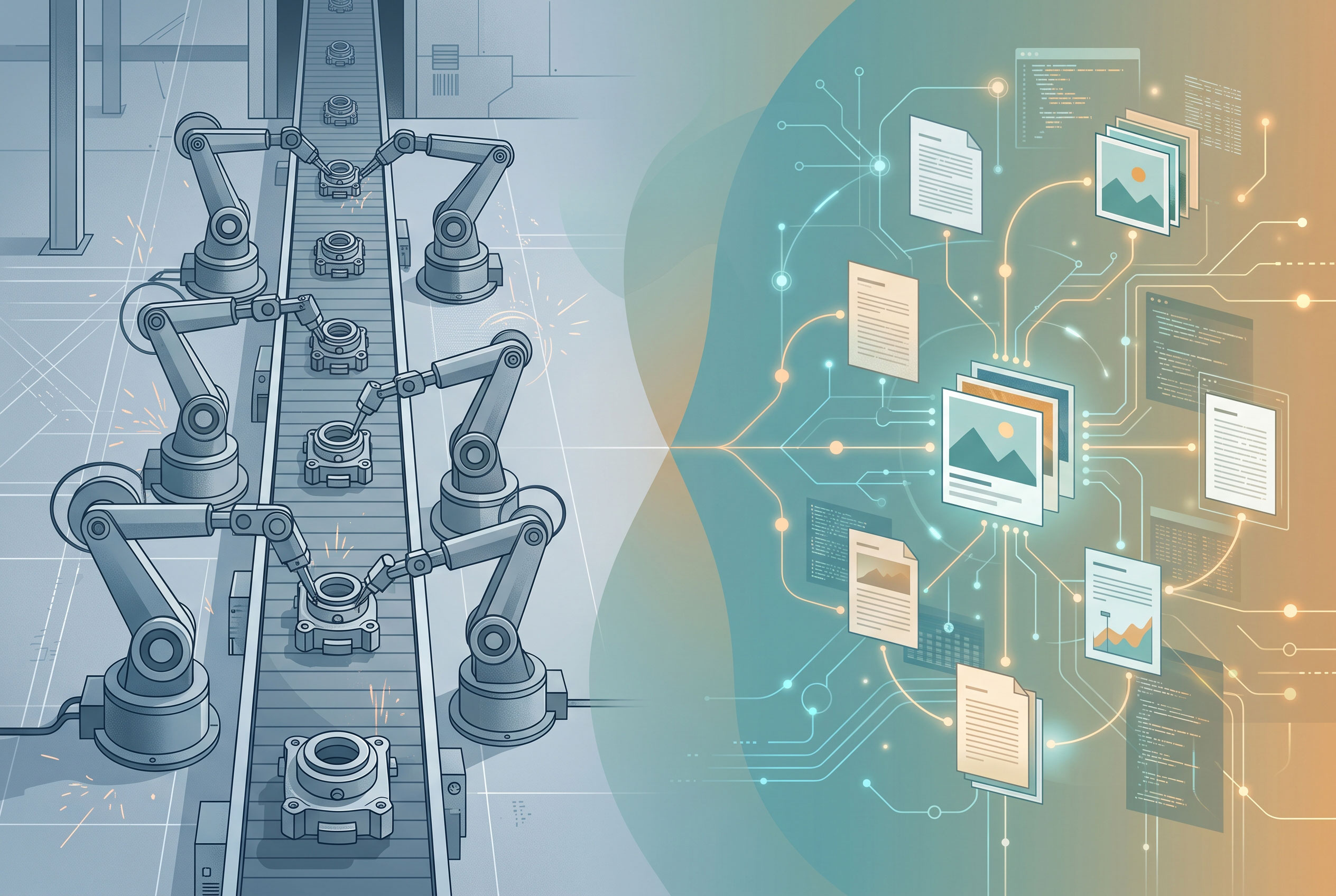
A thermostat and a self-driving car both
"automate" something, but nobody would call them the same technology.
One follows a single instruction. The other interprets a constantly changing
world and makes decisions about it.
That gap is the heart of the difference between traditional
automation and artificial intelligence (AI). The two terms often get
mixed together, which leads to confused expectations and poor technology
choices. This guide explains how each one works, where each shines, and how to
decide which fits a given job.
Short answer: Traditional automation follows fixed,
pre-written rules to repeat the same task the same way every time. AI learns
patterns from data and makes decisions in situations that were not explicitly
programmed. Automation executes instructions. AI interprets information and
adapts.
What Is Traditional Automation?
Traditional automation uses predefined rules and
logic to complete tasks without human involvement. A person (or team) decides
in advance exactly what should happen, and the system carries it out. If the
input matches the rule, the output is predictable.
The logic is often described as "if this, then
that." If an invoice arrives from a known supplier, file it in a specific
folder. If a machine's temperature passes a set limit, shut it down.
Common Examples
- Factory
assembly lines where robots perform the same weld or placement
repeatedly
- Email
auto-responders that send a set reply to every incoming message
- Scheduled
data transfers that copy records between systems every night
- Payroll
processing that applies fixed formulas to hours worked
- Thermostats
that switch heating on or off at a set temperature
Why It Remains So Useful
Traditional automation is predictable, transparent, and
easy to audit. When something goes wrong, you can trace the exact rule that
caused it. For stable, repetitive work, this reliability is hard to beat.
Its weakness is rigidity. When the situation changes in a
way the rules did not anticipate, the system either fails or produces a wrong
result. Someone must then update the rules by hand.
What Is AI?
Artificial intelligence refers to systems that perform
tasks that normally require human judgment, such as recognizing images,
understanding language, or making predictions. Most modern AI relies on machine
learning, where a system learns patterns from large amounts of example data
instead of following hand-written rules.
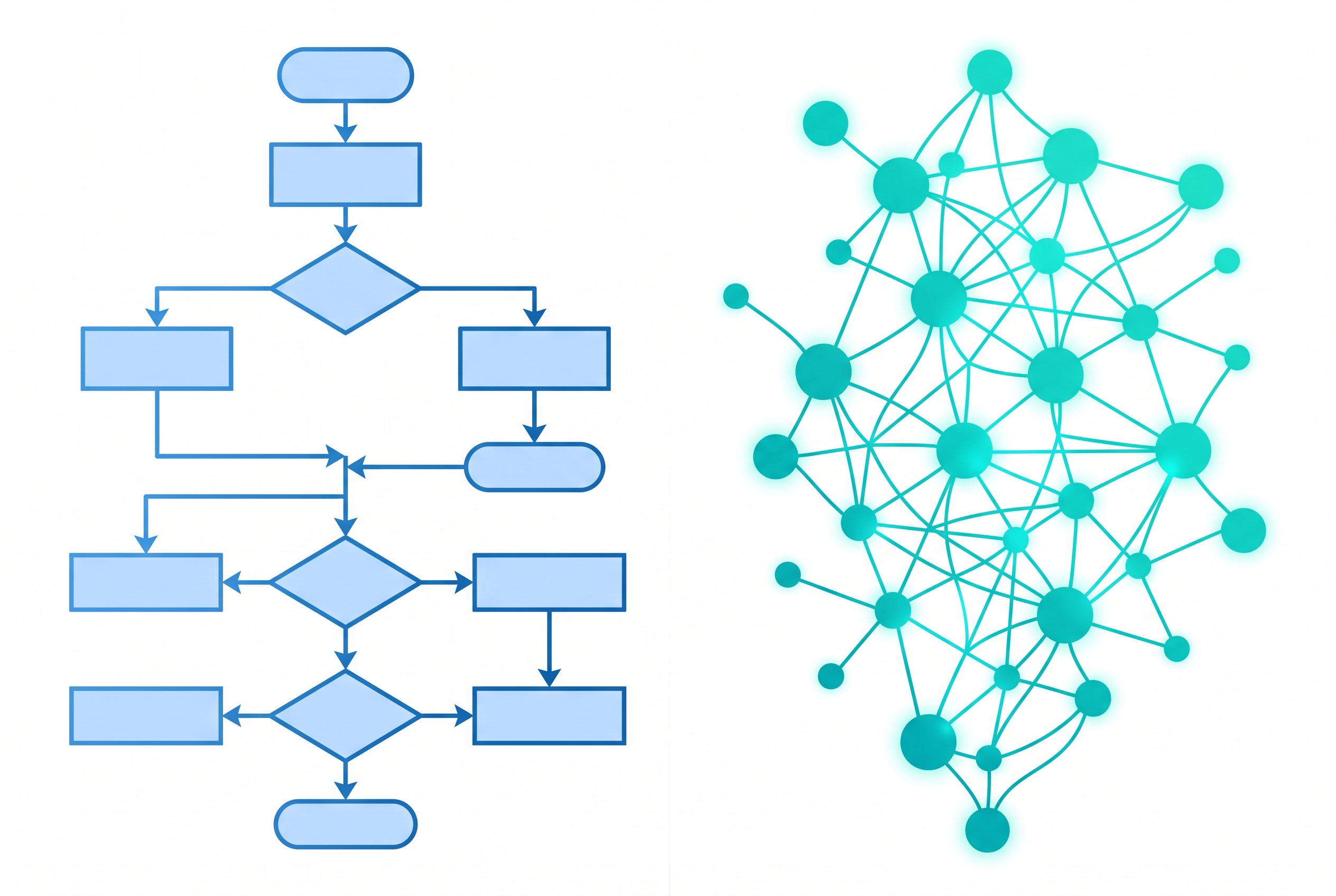
Rather than being told "if the email contains these
five words, mark it as spam," a machine learning model studies many
examples of spam and legitimate email, then learns for itself which signals
matter.
Common Examples
- Spam
filters that adapt as scammers change tactics
- Voice
assistants that interpret spoken requests in many accents and
phrasings
- Recommendation
systems that suggest videos, products, or music
- Medical
imaging tools that help flag unusual patterns for a clinician to
review
- Chatbots
and writing assistants that generate and interpret natural language
Strengths and Trade-Offs
AI handles messy, unstructured, and variable information
such as text, speech, photos, and sensor data. It can improve with more data
and cope with situations nobody wrote a rule for.
The trade-off is that AI is probabilistic. It deals
in likelihoods rather than certainties, so it can be confidently wrong. Its
reasoning is also harder to inspect, which matters in regulated or high-stakes
settings.
Key Differences at a Glance
|
Feature |
Traditional Automation |
AI |
|
Decision basis |
Fixed, human-written rules |
Patterns learned from data |
|
Handles new situations |
Poorly; needs a rule for each case |
Often well, within its training |
|
Data type |
Structured (forms, fields, numbers) |
Structured and unstructured (text, images, audio) |
|
Predictability |
High and consistent |
Variable; outputs can differ or err |
|
Transparency |
Easy to trace and explain |
Often harder to explain |
|
Setup effort |
Define rules clearly |
Gather data, train, test, monitor |
|
Maintenance |
Update rules manually |
Retrain or adjust as data changes |
|
Best for |
Stable, repetitive processes |
Complex, variable, judgment-based tasks |
How Each One Handles the Same Problem
A practical example makes the distinction clearer. Imagine a
company that receives thousands of customer emails every day.
With traditional automation, you might write rules:
if the subject line contains "refund," send it to the billing team;
if it contains "password," send it to IT support. This works until a
customer writes "I was charged twice and need my money back" with no
keyword you listed. The email goes unrouted.
With AI, a language model reads the whole message,
understands that it describes a billing problem, and routes it correctly even
though no exact keyword matched. It can also draft a suggested reply or flag an
angry tone for priority handling.
The AI approach handles variety better, but a person should
still review a sample of its decisions, because it will occasionally misread a
message.
Key Point: The question is rarely "which is
better?" It is "does this task need fixed rules or flexible
judgment?"
Where the Two Overlap
The line between them is blurrier than it first appears, and
the two are often combined.
Robotic Process Automation (RPA)
RPA uses software "bots" to mimic human
actions on a computer, such as copying data between applications or filling in
forms. Classic RPA is rule-based, so it counts as traditional automation. When
teams add AI to read scanned documents or understand free-form text, the result
is often called intelligent automation.
Hybrid Workflows

Many effective systems split the work. AI handles the part
that requires interpretation, and rules handle the part that requires
precision. For example, an AI model might extract the total from a photographed
receipt, and a rule-based workflow then checks it against a spending limit and
routes it for approval.
This pairing plays to each technology's strengths: AI for
understanding, rules for enforcement.
Common Misunderstandings
"All automation is AI." It is not. A
scheduled script that backs up files each night uses no intelligence at all,
and it does the job perfectly.
"AI always beats rule-based systems." Not
necessarily. For simple, stable tasks, rules are cheaper, faster, and more
dependable. Using AI where a rule would do adds cost and risk without adding
value.
"AI understands things the way people do."
AI systems detect statistical patterns. They can appear to reason, but they
have no human-style understanding, which is one reason human oversight still
matters.
"Once built, AI runs itself." Models need
monitoring. If real-world data drifts away from what the model learned,
accuracy can decline over time.
Challenges and Limitations
Traditional Automation
- Breaks
when inputs or processes change unexpectedly
- Requires
manual rule updates as the business evolves
- Struggles
with unstructured data like free text or images
AI
- Needs
quality data, and biased or poor data leads to biased or poor results
- Can
produce confident but incorrect outputs
- Can be
difficult to explain, which complicates auditing
- Often
requires more technical expertise and ongoing monitoring
- Raises
privacy considerations when personal data is involved
How to Choose the Right Approach
Ask these questions about the task you want to improve:
- Is
the process stable and well defined? If the steps rarely change,
rule-based automation is usually the simplest answer.
- Is
the input structured or messy? Clean fields suit rules. Free text,
images, and speech suit AI.
- How
costly is a mistake? For high-stakes decisions, favor predictable
systems or keep a human in the loop.
- Do
you need to explain every decision? If an audit trail is required,
rules offer clearer traceability.
- Do
you have enough relevant data? AI depends on it. Without good
examples, a model will perform poorly.
When the answer is mixed, a hybrid design is often the most
practical path.
The Takeaway
Traditional automation and AI solve different problems.
Automation excels at doing the same thing reliably, again and again. AI excels
at interpreting variety and handling situations no one fully planned for.
Neither replaces the other, and the strongest solutions frequently use both.
Before adopting any new tool, define the task first. If you can write the rules down, automate it. If the task depends on judgment across unpredictable inputs, AI may be worth the added complexity. Matching the technology to the problem matters far more than choosing whichever one sounds more advanced.