
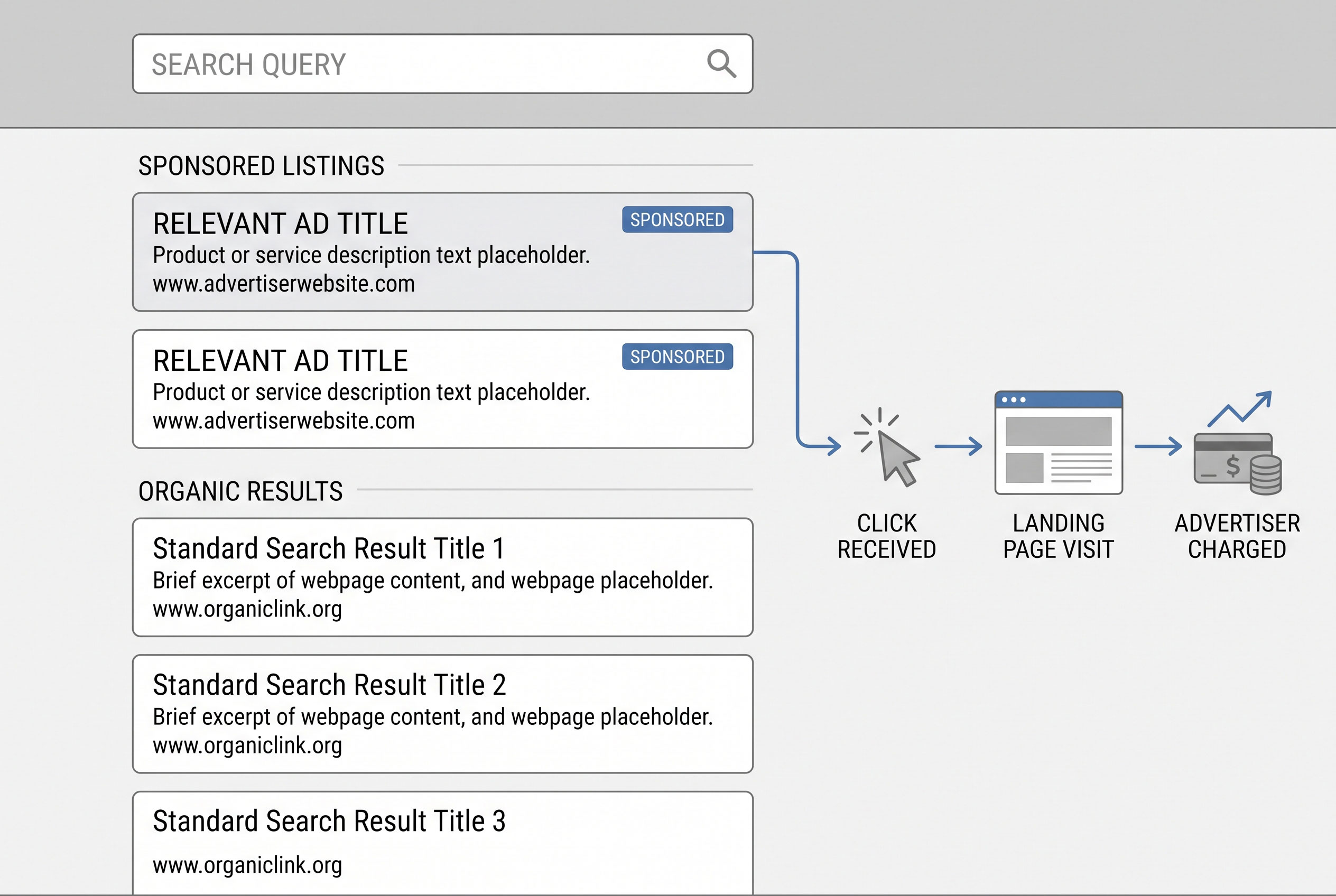
Cost per click (CPC), also called pay per
click (PPC) when used as a pricing model, is an online advertising
model and metric in which an advertiser pays a fee each time a user clicks an
advertisement. It is calculated by dividing total advertising cost by the
number of clicks received. It is used to budget, price, and compare digital
advertising campaigns.
CPC is one of several pricing models in digital advertising,
alongside cost per thousand impressions (CPM) and cost per acquisition (CPA).
It is widely used in search advertising, social media advertising, and display
networks. Because charges occur only when a click is recorded, the model ties
expenditure to a measurable user action rather than to exposure alone.
|
Field |
Value |
|
Type |
Advertising pricing model and performance metric |
|
Also known as |
Pay per click (PPC); cost per click |
|
Basic formula |
Total cost ÷ number of clicks |
|
Commonly used in |
Search, social, display, and shopping ads |
|
Related metrics |
CPM, CPA, CTR, ROAS |
|
Popularized |
Late 1990s (search advertising) |
Calculation
The basic formula is:
CPC = total ad cost ÷ total clicks
For example, a campaign that spends 500 currency units and
receives 250 clicks has an average CPC of 2.00. The figure is expressed in the
currency of the advertising account.
Platforms distinguish between several related values:
- Maximum
CPC (max CPC): the highest amount an advertiser is willing to pay per
click, set manually or by an automated bidding system.
- Actual
CPC: the amount charged for an individual click, which is often lower
than the maximum.
- Average
CPC: total cost divided by total clicks over a reporting period.
Note: A "click" as counted by an
advertising platform may differ from a "visit" recorded by a website
analytics tool. Filtering of invalid clicks, redirects, and users leaving before
a page loads can produce differences between the two figures.
How CPC is determined
Auction-based pricing
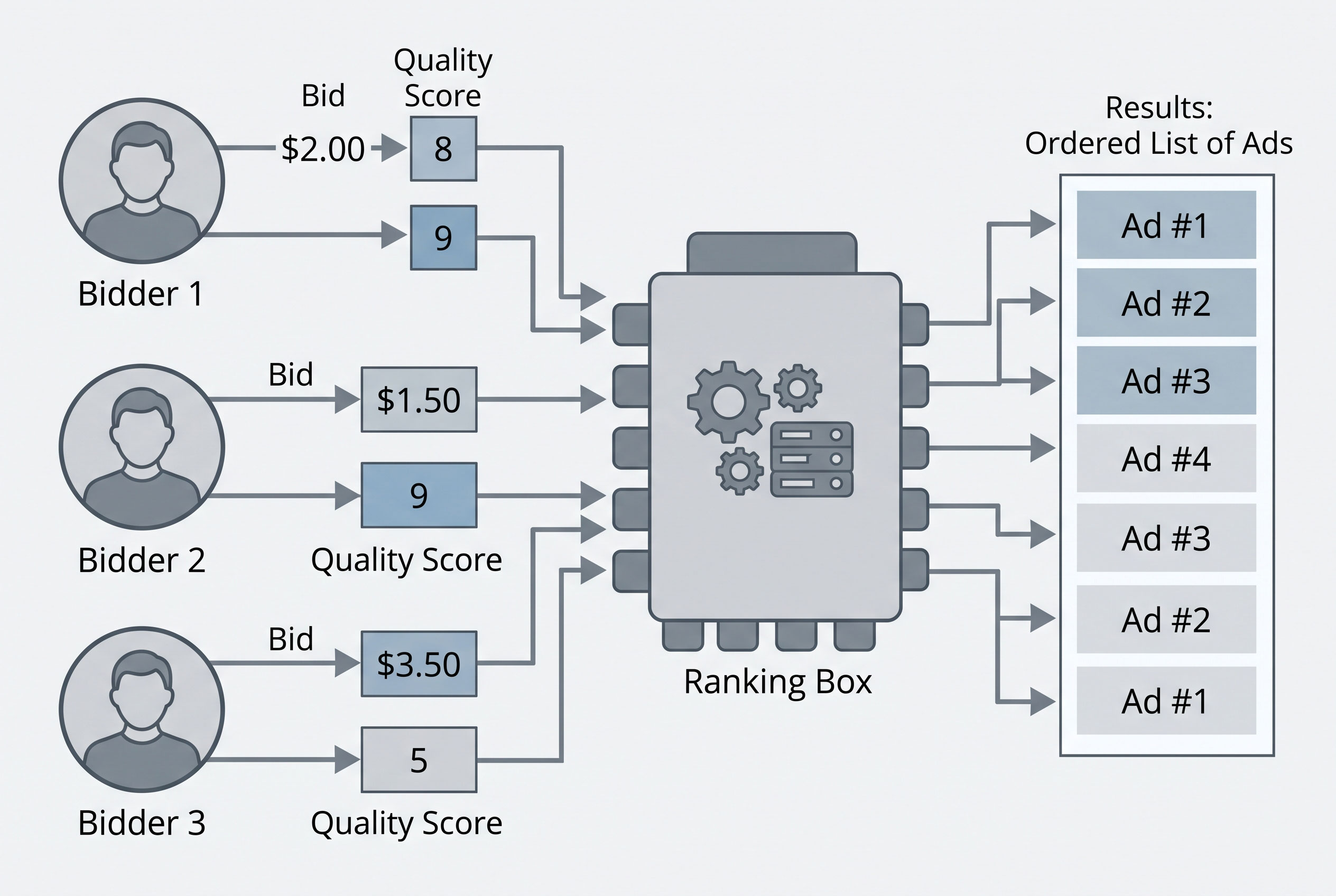
On major platforms, CPC is set through an auction
that runs each time an ad opportunity arises, such as a search query.
Advertisers submit bids, and the platform ranks eligible ads using both the bid
and estimates of ad quality. Google Ads, for instance, describes a metric
called Ad Rank that combines bid, expected click-through rate, ad
relevance, landing page experience, and other factors.
Under this approach, an advertiser with a lower bid can
outrank a competitor if its ad is judged more relevant. Google Ads
documentation states that the amount charged is typically the minimum needed to
keep the ad's position, so actual CPC is often below the maximum bid. Platforms
differ in their auction rules, and details change over time.
Academic background
Economists have studied these mechanisms, often described as
generalized second-price auctions. Papers by Benjamin Edelman, Michael
Ostrovsky, and Michael Schwarz (2007) and by Hal Varian (2007) analyzed the
properties of position auctions used in search advertising. Real-world systems
include quality adjustments and other rules beyond the simplified models in
these studies.
Factors influencing CPC
Observed CPC varies widely. Commonly cited influences
include:
- Competition:
keywords or audiences that many advertisers target tend to command higher
prices.
- Industry:
sectors such as insurance, legal services, and finance are frequently
reported to have high average CPCs, though figures vary by year and data
source.
- Ad
quality and relevance: higher estimated relevance can lower the price
needed for a given position.
- Geography,
device, and time: prices may differ by location, device type, season,
or time of day.
- Platform:
search, social, and display networks report different typical CPC ranges.
Published industry benchmarks are compiled by advertising
agencies and software vendors, and methodologies differ. Benchmarks are
therefore best treated as indicative rather than definitive.
Bidding strategies
Advertisers can set CPC bids in several ways.
- Manual
CPC bidding: the advertiser sets bids directly for keywords, ad
groups, or audiences.
- Automated
bidding: the platform adjusts bids using machine learning to pursue a
stated goal, such as maximizing clicks or reaching a target cost per
conversion.
- Enhanced
CPC: a hybrid in which manual bids are adjusted upward or downward
based on the estimated likelihood of conversion. Google announced in 2024
that it would phase out this option for some campaign types, so its
availability depends on the platform and date.
Automated strategies may cause the actual CPC to differ from
what an advertiser might set manually, because the system optimizes toward a
goal rather than a fixed price per click.
Comparison with other pricing models
|
Model |
Advertiser pays for |
Typical use |
|
CPC |
Each click |
Search ads, traffic-focused campaigns |
|
CPM (cost per mille) |
Every 1,000 impressions |
Brand awareness, display, video |
|
CPA (cost per acquisition) |
A defined action, such as a purchase or sign-up |
Performance and affiliate marketing |
|
CPV (cost per view) |
A video view meeting a threshold |
Video advertising |
CPC is often confused with click-through rate (CTR),
which is the percentage of impressions that result in clicks (clicks ÷
impressions). CTR measures response to an ad, whereas CPC measures cost. A low
CPC does not by itself indicate a profitable campaign, since the value of each
click depends on what users do afterward. Metrics such as conversion rate,
cost per acquisition, and return on ad spend (ROAS) are used to
assess that outcome.
History
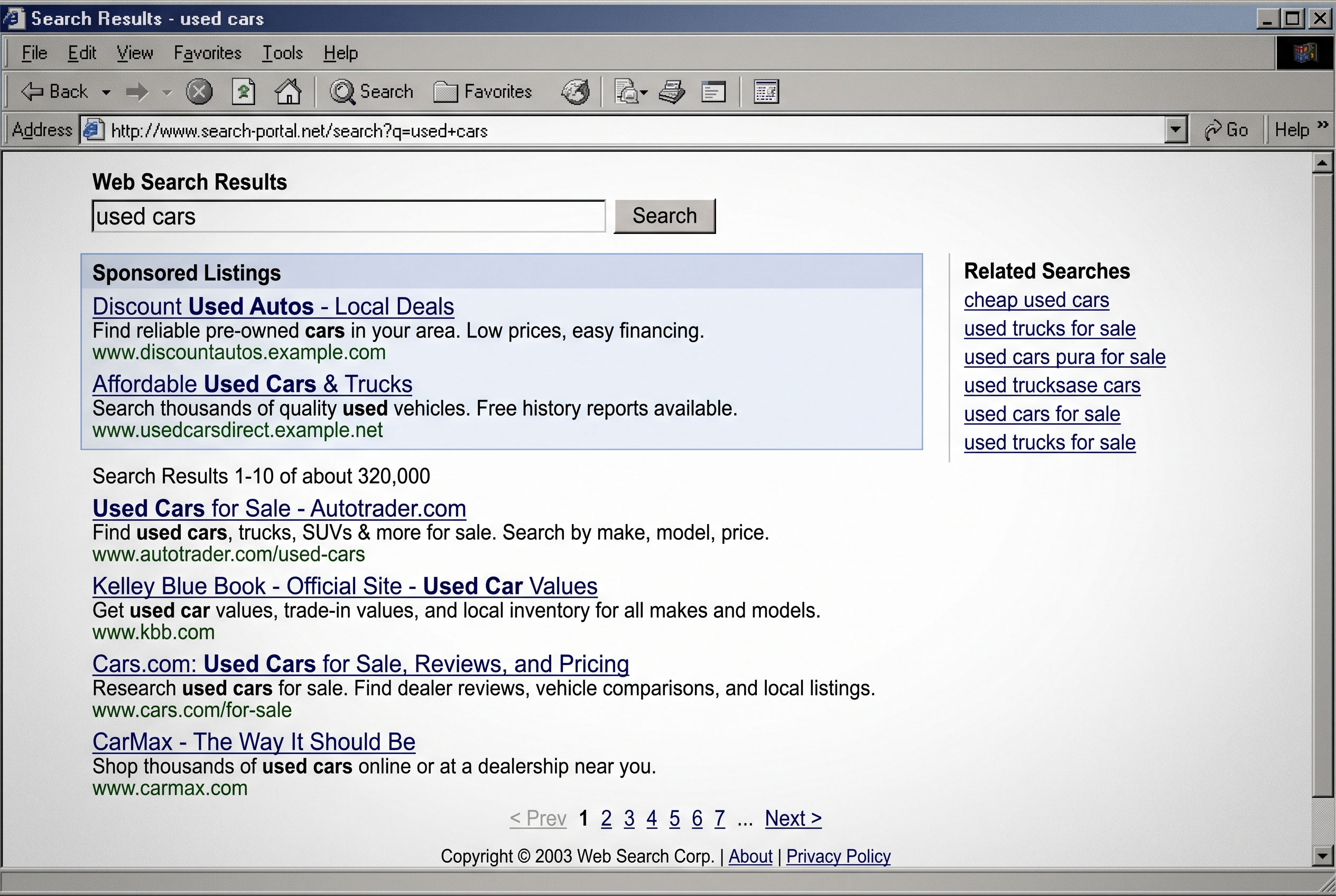
Pay-per-click pricing for search results is commonly
credited to Bill Gross and his company GoTo.com, later renamed Overture
and acquired by Yahoo in 2003. GoTo launched its model around 1998, letting
advertisers bid for placement in search results and pay when users clicked.
Google introduced AdWords in October 2000, initially
charging by impressions. It moved to CPC pricing in February 2002 and
incorporated click-through rate into ad ranking, an approach that influenced
later systems. Microsoft Advertising, formerly Bing Ads, and social platforms
such as Facebook and LinkedIn later adopted CPC options. Jansen and Mullen
(2008) provide a scholarly overview of sponsored search history.
Exact launch dates and attributions vary slightly between
sources, so the years above should be read as commonly cited approximations for
early events.
Criticism and controversy
Click fraud
Click fraud refers to clicks generated with no
genuine interest in the advertiser's offering, whether by automated bots,
competitors, or publishers seeking revenue. Platforms state that they filter
invalid clicks and credit affected advertisers. The scale of the problem is
disputed: estimates come from security vendors and advertisers and are
difficult to verify independently. In 2006, Google agreed to a reported $90
million settlement in a US class action (Lane's Gifts and Collectibles
v. Google) alleging inadequate handling of invalid clicks, without
admitting wrongdoing.
Transparency concerns
Some advertisers and researchers have questioned how much
control advertisers retain over pricing given automated bidding and auction
rules the platforms do not fully disclose. Platforms respond that auction
opacity protects against manipulation. The debate remains unresolved.
Current status
CPC remains a core pricing model for search and social
advertising. Advertisers increasingly combine it with automated bidding and
conversion-based goals, and platform features and metric definitions continue
to change.