A tech stack (short for technology stack),
also called a software stack or solution stack, is the
combination of programming languages, frameworks, libraries, databases, and
tools used together to build, run, and maintain a software application or
system. A stack typically spans multiple layers of a system, from the visual
interface a user interacts with to the servers and databases that store and
process data behind the scenes.
The concept of a tech stack is central to software
engineering because it defines the technical foundation on which an application
is built. Choices made at the start of a project—such as which programming
language, framework, or database to use—affect an application's performance,
scalability, security, cost, and how easily it can be maintained or expanded
over time. A tech stack is not a single product but an assembled set of
components, often mixing open-source and proprietary technologies, chosen to
work together.
What is a tech stack? In brief, it is the collection
of technologies—languages, frameworks, servers, and databases—combined to
create a working software product. Most modern applications rely on several
interacting layers rather than a single tool, and the specific combination
chosen is referred to as that application's stack.
Infobox
|
Field |
Description |
|
Term |
Tech stack (technology stack) |
|
Field |
Software engineering, web development |
|
Also known as |
Software stack, solution stack, application stack |
|
Typical components |
Front-end framework, back-end framework, database,
server/hosting environment |
|
Common examples |
LAMP, MEAN, MERN, JAMstack |
|
Related concepts |
Full-stack development, front-end, back-end, DevOps |
Overview
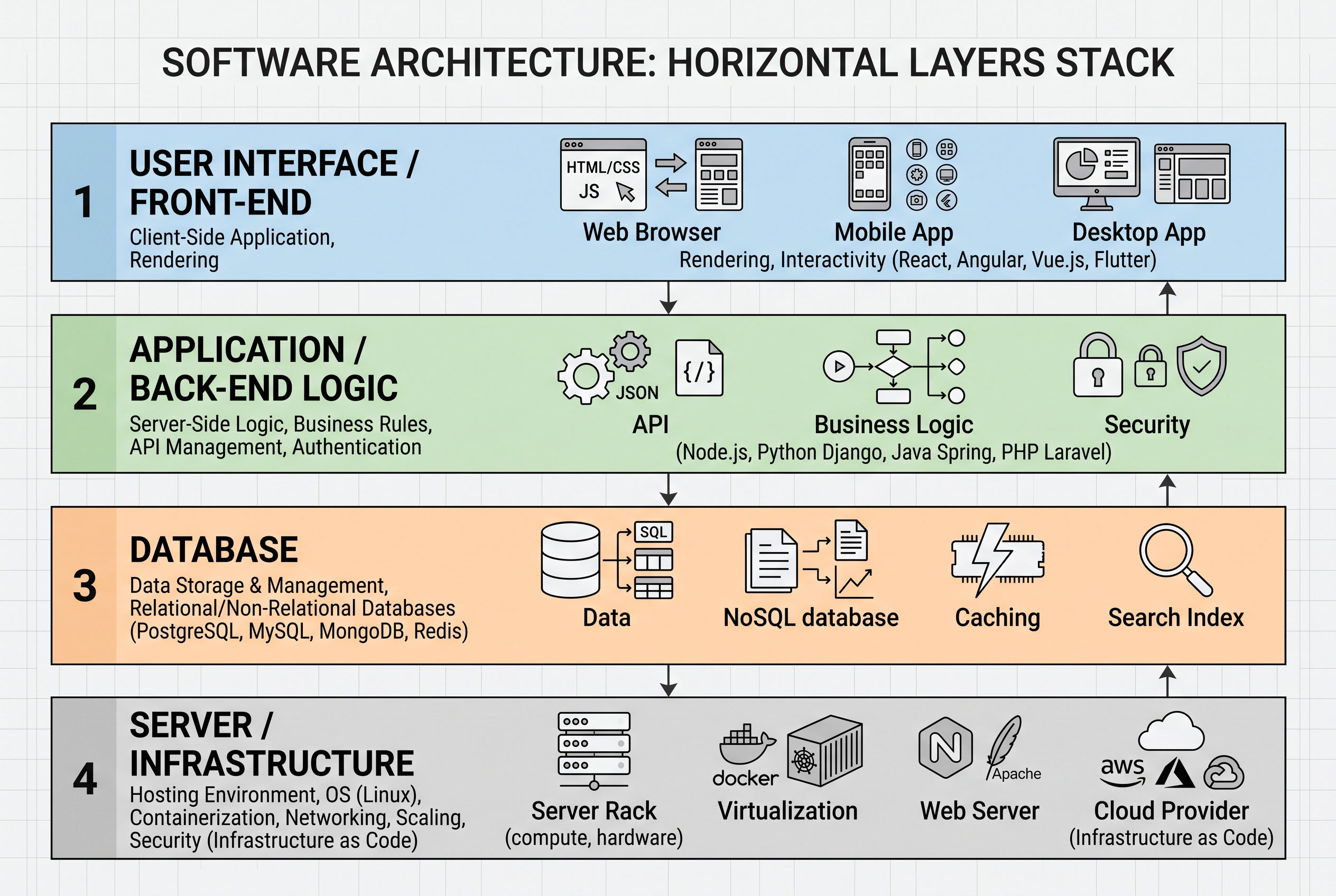
A tech stack is generally organized into layers that
correspond to different responsibilities within a software system. Although the
exact composition varies by project, most stacks include a front-end (or
client-side) layer, a back-end (or server-side) layer, and a database
layer, often supported by additional infrastructure and deployment tools.
The front-end layer governs what users see and interact with
directly, such as buttons, forms, and page layouts. The back-end layer handles
the logic that runs on a server, including processing requests, enforcing
business rules, and communicating with a database. The database layer stores
and retrieves the application's data. Beyond these three core layers, a stack
may also include tools for hosting, monitoring, version control, and automated
testing, all of which support the development and operation of the application
without being part of its user-facing functionality.
History and Origins
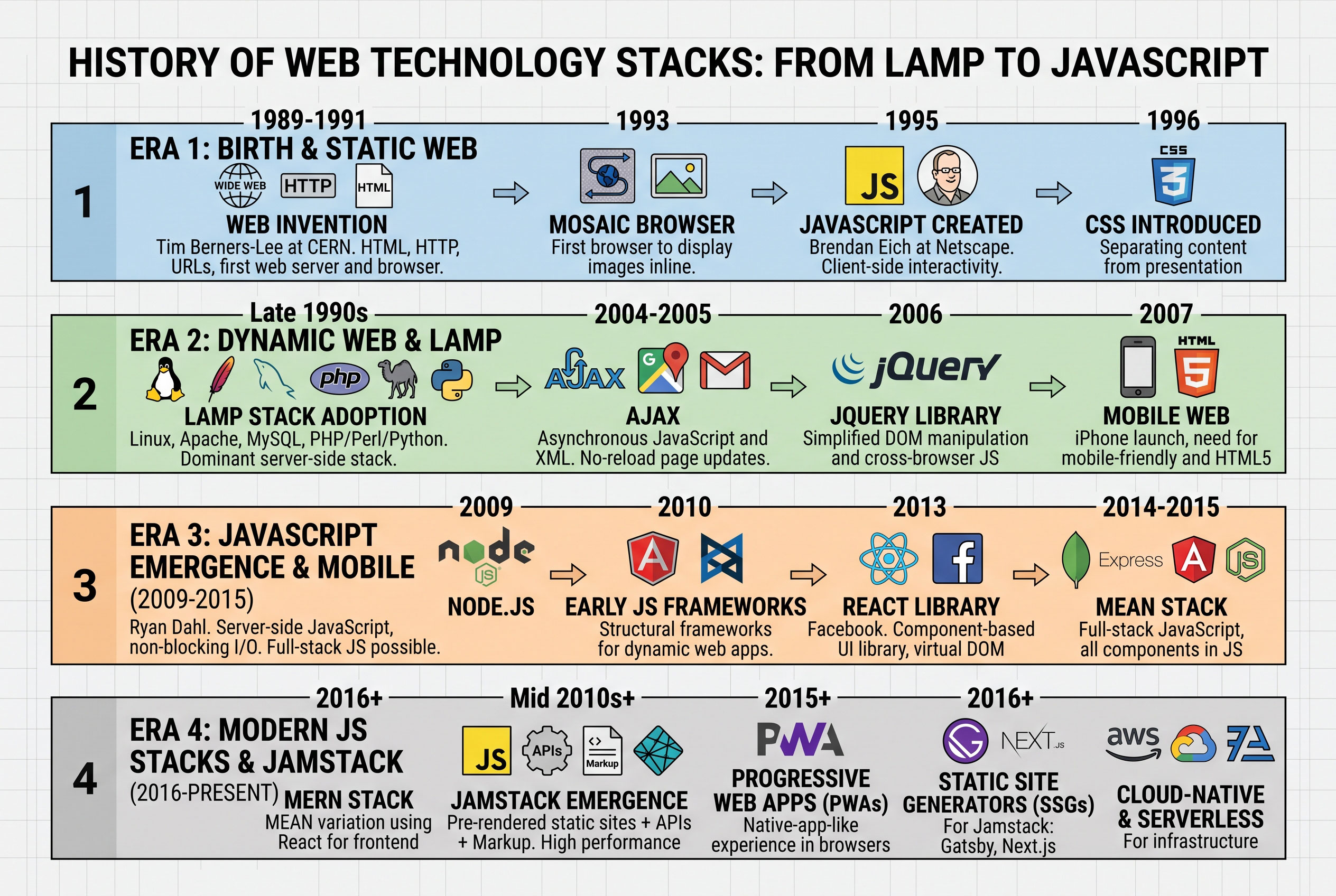
The term "stack" in computing has long referred to
a layered arrangement of components, drawing on the general computer-science
meaning of a stack as an ordered structure. Its application to combinations of
web technologies became widespread during the early 2000s, as web applications
increasingly required multiple interoperating technologies rather than a single
monolithic program.
One of the earliest widely recognized examples was the LAMP
stack, an acronym referring to Linux (operating system), Apache
(web server), MySQL (database), and PHP (programming language).
LAMP became popular because each component was open-source, freely available,
and could be combined without licensing costs, which made it attractive for
early web hosting providers and independent developers. As web development
matured, other named stacks emerged to describe common combinations, including
the MEAN stack (MongoDB, Express.js, Angular, Node.js) and later the MERN
stack (MongoDB, Express.js, React, Node.js), both of which reflected the
rise of JavaScript as a language usable across both front-end and back-end
development.
Note: Although many named stacks are associated with
specific technology combinations, the term "tech stack" itself is
generic and can describe any set of technologies used together, regardless of
whether that combination has a commonly recognized name.
Core Components of a Tech Stack
Front-End (Client-Side)
The front-end layer includes the languages and frameworks
used to build the parts of an application that run in a user's web browser or
on a device. HTML, CSS, and JavaScript form the
foundational languages of front-end web development, while frameworks and
libraries such as React, Vue.js, and Angular provide
structured tools for building interactive interfaces more efficiently.
Back-End (Server-Side)
The back-end layer handles logic that executes on a server
rather than a user's device. Common back-end programming languages include Python,
Java, Ruby, PHP, and JavaScript (via the Node.js
runtime environment). Back-end frameworks, such as Django (Python), Ruby
on Rails (Ruby), or Express.js (Node.js), provide pre-built
structures for handling requests, managing sessions, and connecting to databases.
Database
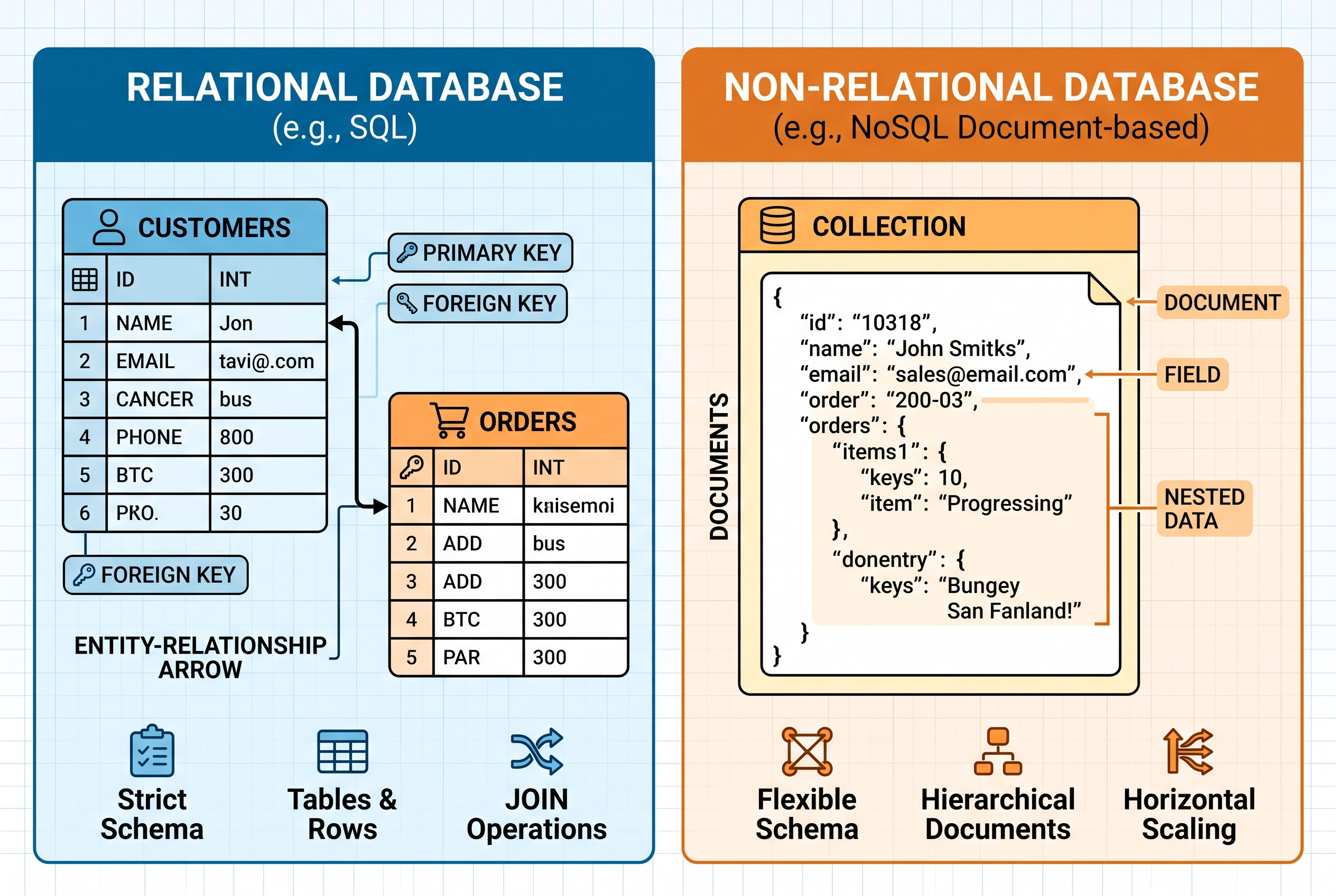
The database layer stores an application's data in a
structured or semi-structured form. Databases are broadly divided into two
categories:
- Relational
databases (SQL-based), such as MySQL, PostgreSQL, and Microsoft
SQL Server, which organize data into tables with defined
relationships.
- Non-relational
databases (NoSQL), such as MongoDB and Redis, which
store data in more flexible formats, including documents or key-value
pairs.
The choice between relational and non-relational databases
typically depends on the structure of the data involved and the application's
performance requirements.
Infrastructure and DevOps Tools
Beyond the three core layers, many stacks include supporting
infrastructure such as web servers (for example, Nginx or Apache),
cloud hosting platforms (such as Amazon Web Services, Microsoft Azure,
or Google Cloud Platform), containerization tools (such as Docker),
and version control systems (such as Git). These tools are not always
described as part of the "stack" in casual usage, but they are
frequently included in more comprehensive discussions of an application's
technology environment.
Types of Tech Stacks
|
Stack Name |
Components |
Primary Use Case |
|
LAMP |
Linux, Apache, MySQL, PHP |
Traditional web applications |
|
MEAN |
MongoDB, Express.js, Angular, Node.js |
JavaScript-based web applications |
|
MERN |
MongoDB, Express.js, React, Node.js |
JavaScript-based web applications with React |
|
JAMstack |
JavaScript, APIs, Markup |
Static sites with dynamic functionality via APIs |
|
.NET stack |
C#, ASP.NET, SQL Server |
Enterprise applications on Microsoft infrastructure |
These named combinations serve as shorthand references
rather than fixed requirements; developers frequently substitute individual
components (for example, replacing MySQL with PostgreSQL within a broadly
"LAMP-style" architecture) while still describing the result
informally by the original acronym.
Choosing a Tech Stack
The selection of a tech stack for a given project depends on
multiple factors, including:
- Project
requirements, such as expected traffic volume, real-time data needs,
or mobile compatibility.
- Team
expertise, since developers are generally more productive working with
languages and frameworks they already know.
- Scalability
needs, as some technologies are better suited to handling rapid growth
in users or data.
- Community
and ecosystem support, including the availability of libraries,
documentation, and third-party integrations.
- Cost,
including licensing fees for proprietary software and the operational cost
of hosting infrastructure.
Because these factors often involve trade-offs, there is
generally no single "best" tech stack; the appropriate choice depends
on the specific goals and constraints of a project. Sources disagree on the
extent to which stack choice affects long-term project success compared with
factors such as team skill and project management practices.
Full-Stack Development
A full-stack developer is a person with the skills to
work across both the front-end and back-end layers of a tech stack, as opposed
to a specialist who works exclusively on one side. The term
"full-stack" has become common in job postings and developer titles
since the mid-2010s, reflecting demand for versatility, particularly at smaller
organizations or startups where a limited number of developers must cover
multiple areas of a project.
Criticism and Debate
Discussions around tech stacks sometimes involve
disagreement over how much weight stack choice should carry in a project's
success. Some practitioners argue that stack selection is a significant
strategic decision affecting long-term maintainability and scaling; others
contend that execution, code quality, and team discipline matter more than the
specific technologies chosen, and that popular stacks are sometimes selected
based on trend or familiarity rather than objective technical fit. Similarly,
the practice of naming stacks with acronyms (such as LAMP or MEAN) has been
noted by some commentators as an oversimplification, since real-world
applications frequently combine components from multiple named stacks or
substitute individual pieces.
Current Relevance
As of the mid-2020s, tech stack discussions increasingly
account for cloud-based and serverless architectures, in which some traditional
stack layers—particularly server management—are handled by third-party
platforms rather than configured manually by developers. The rise of managed
database services, containerization, and platform-as-a-service offerings has
led some observers to suggest that the boundaries of a "stack" are
becoming less fixed than in earlier eras of web development, though the
underlying concept of combining complementary technologies to build an
application remains unchanged.