

AI automation refers to the use of artificial
intelligence (AI) technologies — including machine learning, natural
language processing, and computer vision — to perform tasks, make decisions, or
manage workflows with reduced or no human intervention. Unlike traditional
automation, which follows fixed, pre-programmed rules, AI automation systems
can learn from data, adapt to new situations, and handle tasks that involve
variability or uncertainty.
In brief: AI automation combines artificial
intelligence with automation technology to let software systems perform tasks
that would otherwise require human judgment, such as interpreting documents,
responding to customer inquiries, or optimizing logistics, often by learning
patterns from data rather than following fixed instructions.
The term is used across industries including manufacturing,
finance, healthcare, software development, and customer service. It is closely
related to, but distinct from, robotic process automation (RPA),
which automates repetitive digital tasks using rule-based scripts rather than
adaptive learning.
|
Field |
Details |
|
Field of study |
Artificial intelligence, computer science, operations
management |
|
Key technologies |
Machine learning, natural language processing, computer
vision, robotic process automation |
|
First notable applications |
Industrial robotics (1960s–1980s); rule-based expert
systems (1980s) |
|
Modern resurgence |
2010s–present, driven by deep learning and large-scale
data availability |
|
Common uses |
Customer service, manufacturing, finance, healthcare,
logistics, software development |
|
Related terms |
Intelligent automation, cognitive automation,
hyperautomation |
Overview
AI automation systems generally combine two components: an
automation layer, which executes tasks or workflows, and an intelligence layer,
which uses AI models to interpret information, make predictions, or decide how
the workflow should proceed. This combination allows systems to handle tasks
involving unstructured data, such as free-text customer messages, images, or
audio, which traditional rule-based automation struggles to process.
A distinction is often drawn between three related concepts:
- Traditional
automation, which executes fixed sequences of steps without adapting
to new inputs.
- Robotic
process automation (RPA), which automates structured, repetitive
digital tasks (such as copying data between systems) using predefined
rules.
- AI
automation, which incorporates machine learning or other AI methods so
that a system can handle variable inputs, improve over time, or make
context-dependent decisions.
Note: AI automation is sometimes used
interchangeably with intelligent automation or cognitive
automation in industry literature; while these terms overlap
substantially, some sources use them to emphasize different combinations of AI
and process automation technologies.
History and Development
Early Automation (1950s–1980s)
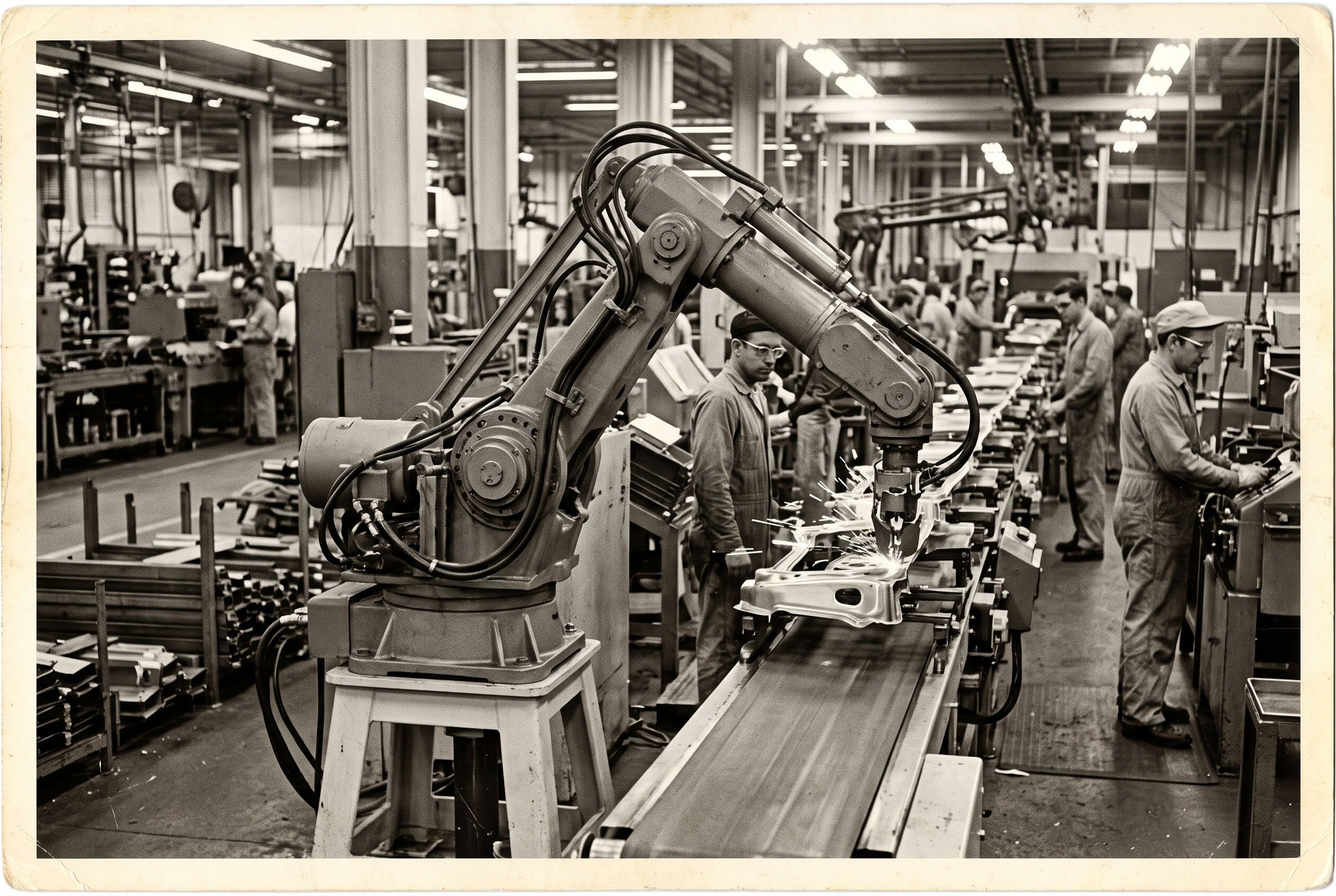
Automation predates artificial intelligence by decades.
Industrial automation, including programmable machinery and early robotics,
became widespread in manufacturing during the mid-20th century. The
introduction of the Unimate, generally cited as the first
industrial robot, in a General Motors plant in 1961 is
commonly referenced as an early milestone in automated manufacturing, though it
relied on fixed programming rather than learning.
Expert Systems and Rule-Based AI (1980s)
During the 1980s, expert systems — software
designed to emulate human decision-making within narrow domains using
pre-defined rule sets — represented an early attempt to combine automation with
a form of artificial intelligence. These systems were limited by their reliance
on manually encoded rules and struggled to handle situations outside their
programmed scope.
Machine Learning and Data-Driven Automation (1990s–2010s)
The growth of machine learning techniques, along with
increased computing power and data availability, gradually shifted automation
from rule-based systems toward data-driven models capable of learning patterns
rather than following explicit instructions. Advances in natural
language processing and computer vision during this
period expanded the range of tasks that automated systems could handle.
Deep Learning Era (2010s–Present)
The resurgence of deep learning, particularly
following breakthroughs in neural network architectures in the early 2010s,
significantly expanded the capabilities of AI automation. Applications such as
automated document processing, conversational chatbots, and predictive
maintenance systems became more widely adopted by businesses during this
period. The emergence of large language models in the early 2020s further
broadened AI automation's application to tasks involving text generation,
summarization, and complex reasoning.
How AI Automation Works
AI automation systems typically follow a general workflow,
though implementations vary by application:
- Data
collection — Information is gathered from sources such as
sensors, documents, databases, or user interactions.
- Data
processing and interpretation — AI models, such as machine
learning classifiers or language models, analyze the data to extract
meaning, detect patterns, or generate predictions.
- Decision-making —
Based on the analysis, the system determines an appropriate action, which
may range from a simple rule-based response to a more complex,
model-generated decision.
- Execution —
The automation layer carries out the determined action, such as updating a
database, routing a request, or controlling physical machinery.
- Feedback
and learning — Many systems incorporate feedback loops that allow
the underlying AI models to be refined over time based on outcomes or
corrections.
Underlying Technologies
- Machine
learning (ML): Enables systems to identify patterns in data and
improve performance without being explicitly reprogrammed for each new
scenario.
- Natural
language processing (NLP): Allows systems to interpret and generate
human language, used in applications such as chatbots and document
analysis.
- Computer
vision: Enables systems to interpret visual information, used in
applications such as quality inspection and autonomous navigation.
- Robotic
process automation (RPA): Often combined with AI to automate
structured digital tasks, forming what some sources term "intelligent
RPA."
Types of AI Automation
|
Type |
Description |
Example Use Case |
|
Cognitive automation |
Combines AI with automation to interpret unstructured data
and make context-aware decisions. |
Automated invoice processing that reads and classifies
scanned documents. |
|
Robotic automation |
Physical automation in manufacturing or logistics,
increasingly enhanced with AI for adaptability. |
Warehouse robots that navigate dynamically changing
environments. |
|
Conversational automation |
Uses NLP to automate customer interactions. |
AI-driven chatbots and virtual assistants. |
|
Predictive automation |
Uses machine learning to forecast outcomes and trigger
preemptive actions. |
Predictive maintenance systems in industrial equipment. |
|
Hyperautomation |
A broader strategy combining multiple automation and AI
technologies across an organization. |
End-to-end automation of business processes spanning
several departments. |
Applications
AI automation has been adopted across numerous sectors:

- Customer
service: Automated chatbots and virtual assistants handle routine
inquiries, escalating complex cases to human agents.
- Manufacturing: AI-enhanced
robotics adjust to variations on production lines and detect defects using
computer vision.
- Finance: Automated
systems assist with fraud detection, credit risk assessment, and
algorithmic trading.
- Healthcare: AI
automation supports administrative tasks such as medical coding, as well
as diagnostic support tools that assist clinicians.
- Software
development: Automated code review, testing, and deployment
pipelines increasingly incorporate AI-based suggestions and anomaly
detection.
- Logistics: Route
optimization and demand forecasting systems use machine learning to
improve supply chain efficiency.
Benefits and Significance
Organizations commonly cite several potential benefits of AI
automation, including increased efficiency, reduced operational costs, and the
ability to process large volumes of unstructured data that would be impractical
to review manually. Proponents also note that AI automation can reduce human
error in repetitive tasks and free workers to focus on higher-value activities.
However, the extent of these benefits varies significantly
by implementation, industry, and task complexity, and outcomes reported in case
studies are not necessarily representative of all deployments.
Criticism and Controversy
AI automation has drawn scrutiny and debate from
researchers, policymakers, and labor organizations. Commonly raised concerns
include:
- Workforce
displacement: Economists and labor researchers disagree on the
extent to which AI automation will displace jobs versus transform them;
estimates of job impact vary widely across studies and depend heavily on
underlying assumptions.
- Bias
and fairness: Machine learning models used in automated
decision-making can reproduce or amplify biases present in training data,
a concern raised in areas such as automated hiring and credit assessment.
- Transparency: Some
AI automation systems, particularly those based on complex models, are
criticized for lacking interpretability, making it difficult to explain
why a particular automated decision was made.
- Accountability: Questions
remain, and are actively debated in legal and regulatory circles, about
who bears responsibility when an AI automation system causes harm or makes
a costly error.
These concerns are presented differently by various
stakeholders; industry groups often emphasize productivity gains, while labor
advocates and some academic researchers emphasize risks to employment and
fairness. Regulatory approaches to AI automation also differ by jurisdiction
and continue to evolve.
Comparisons and Related Topics
AI automation is frequently discussed alongside related but
distinct concepts:
- Robotic
process automation (RPA): Automates structured, rule-based
digital tasks without adaptive learning; AI automation extends this by
incorporating machine learning or other AI methods to handle variability.
- Artificial
general intelligence (AGI): A hypothetical form of AI with
human-level reasoning across domains; AI automation, by contrast,
typically involves narrow AI applied to specific tasks.
- Business
process automation (BPA): A broader category encompassing any
technology-driven automation of business workflows, which may or may not
involve AI.
Current Status
As of the mid-2020s, AI automation continues to expand in
scope, driven in part by advances in large language models and generative AI,
which have broadened automation into tasks involving content generation,
summarization, and complex reasoning. Adoption levels, regulatory frameworks,
and workforce impacts continue to vary across industries and regions, and remain
subjects of ongoing research and policy discussion.