

In brief: SEO is the process of optimizing digital
content and website infrastructure to increase visibility in organic search
results, typically by aligning with the ranking criteria used by search engine
algorithms. It is distinct from paid search advertising, though the two are
often used together as part of a broader search engine marketing strategy.
The discipline emerged in the mid-1990s alongside the growth
of commercial search engines and has since evolved into a specialized field
involving web development, content strategy, data analysis, and user experience
design. Because search engines periodically change how they evaluate and rank
pages, SEO practices are continually revised, and some historical techniques
are now considered ineffective or penalized.
Infobox
|
Field |
Detail |
|
Field of study |
Digital marketing / Web development |
|
Also known as |
Search engine optimization |
|
First recognized use of term |
Mid-to-late 1990s |
|
Primary goal |
Improve organic (unpaid) search visibility |
|
Related fields |
Search engine marketing (SEM), content marketing, web analytics |
|
Major influencing entities |
Google, Bing, Yandex, Baidu |
|
Common sub-disciplines |
Technical SEO, on-page SEO, off-page SEO, local SEO |
Overview
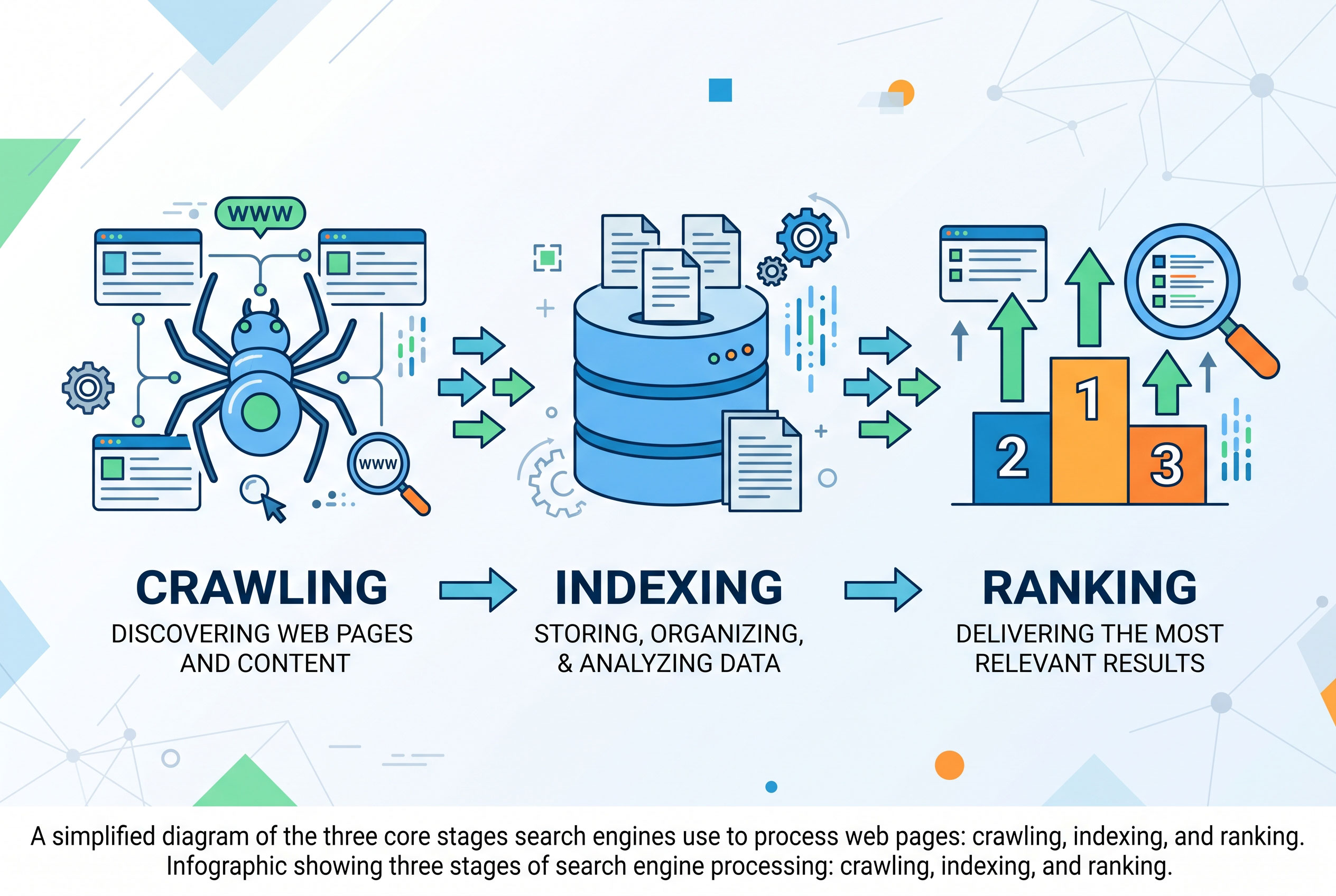
Search engines use automated software, commonly called crawlers
or spiders, to discover and read web pages across the internet. The
information gathered is stored in an index, a large database the search
engine consults when a user submits a query. When a search is performed, a ranking
algorithm evaluates indexed pages against hundreds of signals to determine
the order in which results are displayed on the search engine results page
(SERP).
SEO practitioners attempt to align a website with the
signals that ranking algorithms use to evaluate relevance and quality. Because
search engines generally do not publish the complete details of their
algorithms, SEO knowledge is built through a combination of official guidance
from search engine companies, independent testing, and industry observation.
History and Development

The origins of SEO are closely tied to the early development
of web search engines. In the mid-1990s, search engines such as AltaVista,
Lycos, and Excite ranked pages primarily using simple factors like keyword
frequency, which led to widespread abuse through repetitive keyword stuffing.
The launch of Google in 1998 introduced PageRank,
an algorithm that evaluated a page's importance partly based on the number and
quality of other pages linking to it. This shifted SEO practice toward
link-building strategies and elevated the importance of a site's reputation
across the wider web, not just its own content.
Over the following two decades, Google and other search
engines introduced numerous algorithm updates addressing manipulative
practices. Notable examples commonly cited in industry literature include:
- Panda
(2011): targeted low-quality or "thin" content.
- Penguin
(2012): targeted manipulative or spammy link-building practices.
- Hummingbird
(2013): improved the algorithm's handling of conversational and
intent-based queries.
- BERT
(2019) and later language-model-based updates: improved natural
language understanding of search queries.
Sources within the SEO industry frequently discuss these
updates, though search engine companies do not always confirm every detail
publicly, so some interpretations of specific update effects remain debated
among practitioners.
How Search Engines Work
Crawling
Search engines use automated bots to navigate the web by
following hyperlinks from page to page. Website owners can guide this process
using a robots.txt file, which specifies which sections of a site
crawlers may or may not access.
Indexing
Once a page is crawled, the search engine analyzes its
content, including text, images, and structural elements, and determines
whether and how to store it in its index. Pages that are blocked, duplicate, or
of very low quality may be excluded from the index entirely.
Ranking
For any given search query, the ranking algorithm compares
indexed pages using numerous signals, which may include keyword relevance, page
loading speed, mobile compatibility, the security of the connection (HTTPS),
the presence of authoritative backlinks, and measures of user experience such
as how long visitors remain on a page.
Core Components of SEO
SEO is generally divided into several overlapping
categories.
On-Page SEO
On-page SEO refers to optimizations made directly within a
webpage's content and code. Common elements include:
- Title
tags and meta descriptions, which summarize a page's content in
search results.
- Header
tags (H1, H2, H3) that organize content hierarchically.
- Keyword
placement within body text, though modern practice emphasizes natural
language over repetitive keyword insertion.
- Internal
linking, connecting related pages within the same site.
- Image
optimization, including descriptive alt text and compressed file
sizes.
Off-Page SEO

Off-page SEO involves actions taken outside a website to
influence its reputation and authority, most notably through backlinks—links
from other websites pointing to the site in question. Search engines generally
treat backlinks from established, topically relevant sites as a signal of
credibility, although the specific weighting of this factor is not publicly
disclosed in full.
Technical SEO

Technical SEO addresses the underlying infrastructure of a
website, including:
- Site
speed and performance
- Mobile-friendliness
and responsive design
- Secure
connections (HTTPS)
- Structured
data (schema markup) that helps search engines interpret page content
- XML
sitemaps, which list a site's pages for easier crawling
Local SEO
Local SEO focuses on improving visibility for geographically
specific searches, such as "restaurants near me." It typically
involves managing business listing profiles, ensuring consistent business
information across directories, and gathering customer reviews.
Common Techniques and Practices
|
Technique |
Category |
Purpose |
|
Keyword research |
On-page |
Identify terms users search for |
|
Content creation |
On-page |
Provide relevant, comprehensive information |
|
Link building |
Off-page |
Build site authority through external references |
|
Site speed optimization |
Technical |
Improve user experience and crawlability |
|
Schema markup |
Technical |
Help search engines interpret content type |
|
Business listing management |
Local |
Improve visibility in local search results |
Note: SEO is often confused with search engine
marketing (SEM), which more broadly includes paid advertising placements
such as pay-per-click campaigns, in addition to organic optimization efforts.
Measurement and Tools
SEO performance is commonly measured using metrics such as organic
traffic (visits originating from unpaid search results), keyword
rankings, click-through rate, and conversion rate.
Practitioners frequently use analytics and diagnostic tools, including those
provided directly by search engines, to monitor indexing status, crawl errors,
and search performance data.
Criticism and Controversy
SEO practice has drawn criticism from multiple perspectives.
Some critics argue that optimization pressures can lead content creators to
prioritize algorithmic preferences over reader usefulness, a practice sometimes
described as writing "for the algorithm" rather than for a human
audience. Others note that search engines' lack of full algorithmic
transparency creates an uneven playing field, since large organizations often
have more resources to test and adapt to changes than smaller website
operators.
Certain historical techniques, including excessive keyword
repetition, hidden text, and large-scale artificial link schemes—commonly
referred to as "black hat" SEO—are explicitly discouraged by
major search engines and can result in a site being penalized or removed from
search results. In contrast, "white hat" SEO refers to
practices considered compliant with search engine guidelines, while "gray
hat" SEO describes techniques that fall in an ambiguous or disputed
middle ground. The precise boundary between these categories is a matter of
ongoing discussion within the industry rather than a fixed, universally agreed
standard.
Current Status and Ongoing Relevance
SEO continues to evolve alongside changes in how people
search, including the growing use of voice search, image search, and
AI-generated search summaries. Some industry commentary suggests that the rise
of AI-powered answer engines may shift portions of search behavior away from
traditional ranked result lists, though the extent and permanence of this shift
remains a subject of active discussion rather than settled fact. Search engines
have generally indicated that core principles—producing relevant, trustworthy,
and well-structured content—remain central to visibility, even as the technical
methods for achieving it continue to change.