
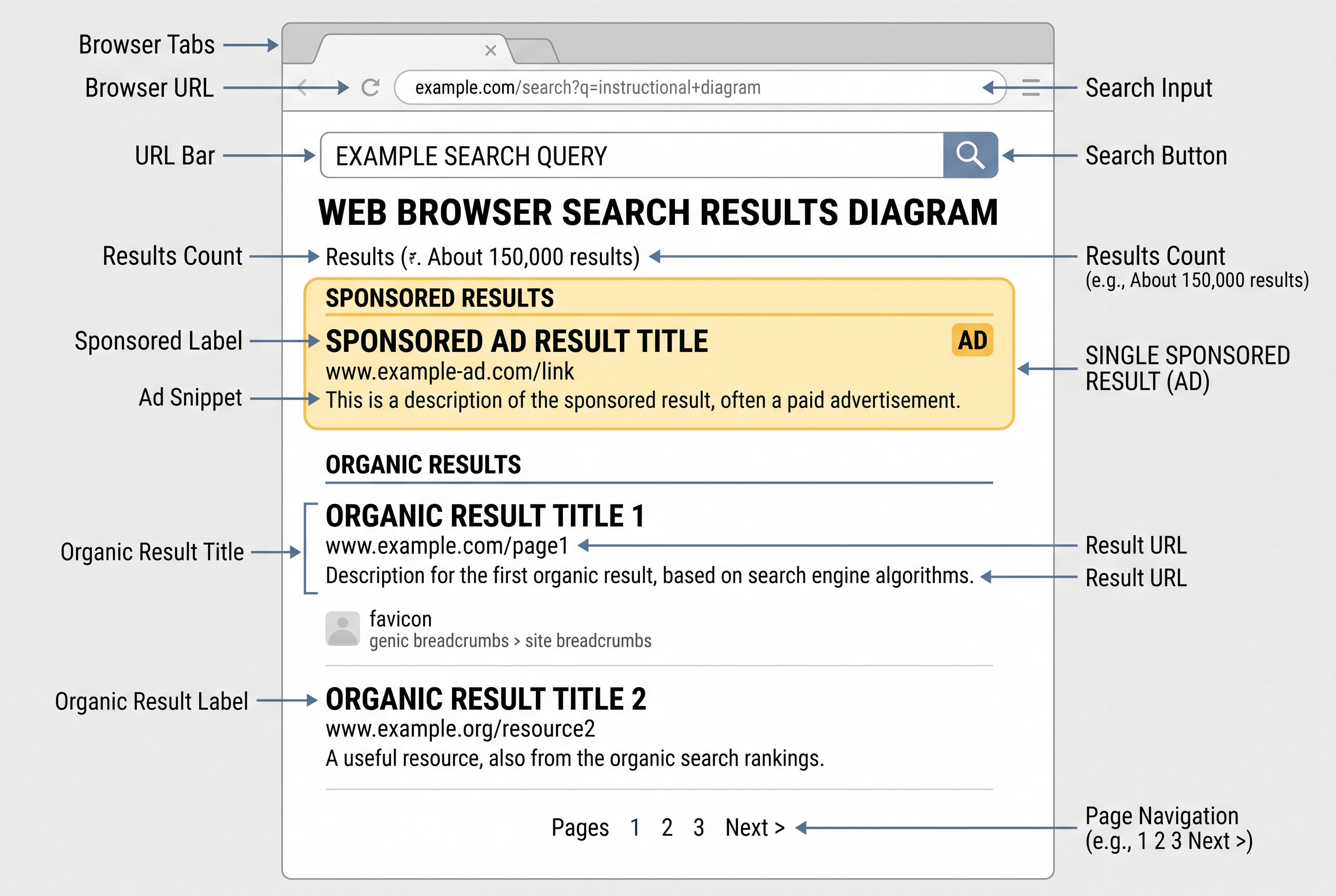
Pay-per-click (PPC) is an online advertising model in
which an advertiser pays a fee only when a user clicks on their advertisement,
rather than paying a flat rate for exposure. It is one of the most widely used
methods of search engine marketing (SEM) and is also applied across
social media platforms, display networks, and other digital channels. In brief,
PPC works through an automated auction: advertisers bid on placements tied to keywords
or audience characteristics, and an ad platform's algorithm selects which ads
to display based on bid amount and ad relevance.
The model allows advertisers to reach users actively
searching for related products or services, and it provides measurable data on
cost, clicks, and conversions. PPC is distinct from traditional advertising in
that cost is tied directly to user interaction rather than impressions or
airtime, although related billing models such as cost-per-thousand-impressions
(CPM) and cost-per-acquisition (CPA) are also used within the broader digital
advertising ecosystem.
Infobox
|
Field |
Detail |
|
Type |
Digital advertising / online marketing model |
|
Also known as |
Cost-per-click (CPC) advertising, paid search |
|
Primary mechanism |
Keyword or audience-targeted auction bidding |
|
Major platforms |
Google Ads, Microsoft Advertising, Meta Ads, Amazon
Advertising |
|
First notable use |
Late 1990s, commercialized widely in early 2000s |
|
Billing basis |
Per click received, not per impression shown |
|
Common metrics |
Click-through rate (CTR), cost-per-click (CPC), quality
score, conversion rate |
Overview
In a PPC arrangement, an advertiser creates an ad and
associates it with specific triggers — most commonly search keywords,
but also demographic data, browsing behavior, or interests, depending on the
platform. When a user's search or browsing activity matches those triggers, the
platform's system determines whether and where to display the ad through a
real-time auction process. The advertiser is charged only if the user clicks
the ad, not simply for its display.
The amount charged per click is typically influenced by two
main factors: the advertiser's bid (the maximum amount they are willing
to pay) and a relevance or quality assessment of the ad and its landing page.
This dual weighting is intended to prevent advertisers from securing top
placement through high bids alone if their ads are considered low-quality or
irrelevant to users.
History and Development
The origins of PPC are commonly traced to the late 1990s.
Early web directories and search engines experimented with pay-based listings,
and the search engine GoTo.com (later renamed Overture Services) is
widely credited with popularizing a bid-based, pay-per-click model around 1998,
allowing advertisers to bid for placement in search results. According to most
accounts, Overture's model directly influenced the advertising systems later
adopted by larger search engines.
Google launched its own advertising platform, initially
called Google AdWords, in 2000, and by 2002 had incorporated a
quality-based ranking system alongside bid amount, refining the auction model
that remains foundational to modern PPC. Google AdWords was later rebranded as Google
Ads in 2018. Over the following two decades, PPC expanded beyond search
engines into social media advertising, e-commerce platforms, and mobile app
ecosystems, as platforms such as Facebook (now Meta), Amazon, and Microsoft's
Bing developed comparable auction-based ad systems.
How PPC Auctions Work
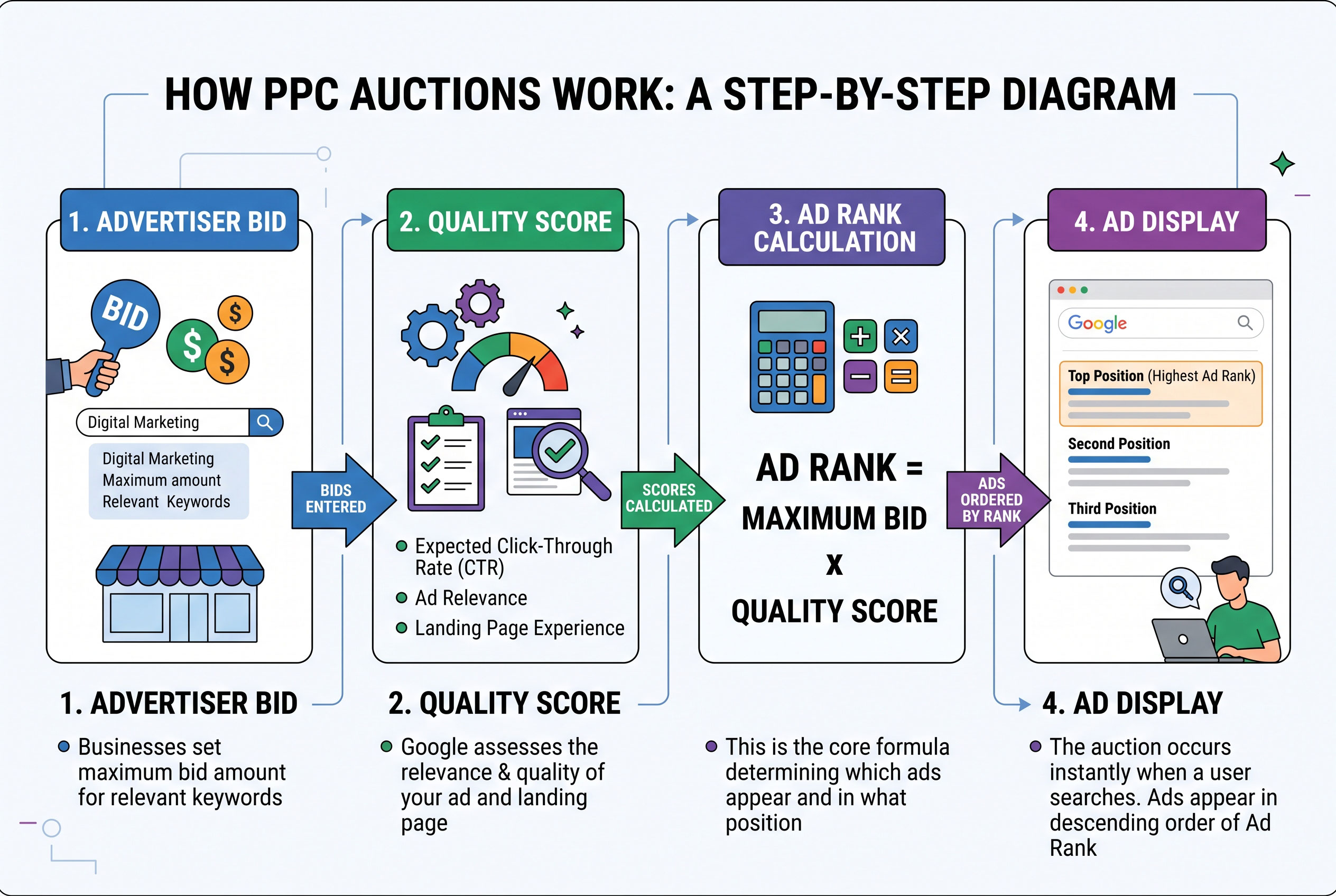
Most PPC systems operate through a variation of a second-price
auction model, in which the winning advertiser typically pays slightly more
than the next-highest bidder rather than their own maximum bid. The general
process includes the following steps:
- An
advertiser selects targeting criteria, such as keywords, audience
demographics, or placement categories.
- The
advertiser sets a maximum bid, or in some cases an average daily budget
managed by automated bidding tools.
- When a
matching search or browsing event occurs, the platform runs an
instantaneous auction among eligible ads.
- An ad
rank or equivalent score is calculated, generally combining bid amount
with a relevance or quality measure.
- The
platform displays the winning ad(s), and the advertiser is charged only
when a user clicks.
Quality and Relevance Scoring
Search platforms such as Google Ads use a metric commonly
referred to as a Quality Score, which factors in expected click-through
rate, ad relevance, and landing page experience. A higher quality score can
lower the effective cost-per-click needed to achieve a given ad position, while
a lower score can increase costs or reduce visibility even for high bids.
Types of PPC Advertising
PPC spans several distinct advertising formats, which vary
by platform and targeting method.
- Search
advertising — Text-based ads shown alongside organic search results,
typically triggered by keyword queries.
- Display
advertising — Visual or banner ads shown across a network of partner
websites, often targeted by audience interest or browsing history rather
than active search intent.
- Social
media advertising — Ads integrated into social platform feeds,
targeted using demographic, interest, or behavioral data.
- Shopping
ads — Product-based listings, often including images and prices,
commonly used in e-commerce contexts.
- Remarketing/retargeting
ads — Ads shown to users who previously visited a website or app,
intended to re-engage prior visitors.
- Video
advertising — Ads served before, during, or alongside video content,
billed on a per-click or per-view basis depending on platform rules.
Major Platforms
|
Platform |
Primary Ad Types |
Notable Feature |
|
Google Ads |
Search, display, shopping, video |
Largest global search ad network |
|
Microsoft Advertising |
Search (Bing network) |
Often lower average CPC than Google |
|
Meta Ads (Facebook/Instagram) |
Social feed, display |
Detailed audience/interest targeting |
|
Amazon Advertising |
Product/shopping ads |
Direct integration with e-commerce purchase intent |
Sources disagree on precise market share figures at any
given time, as these shift frequently and are usually estimated by third-party
analytics firms rather than published directly by the platforms themselves.
Metrics and Terminology
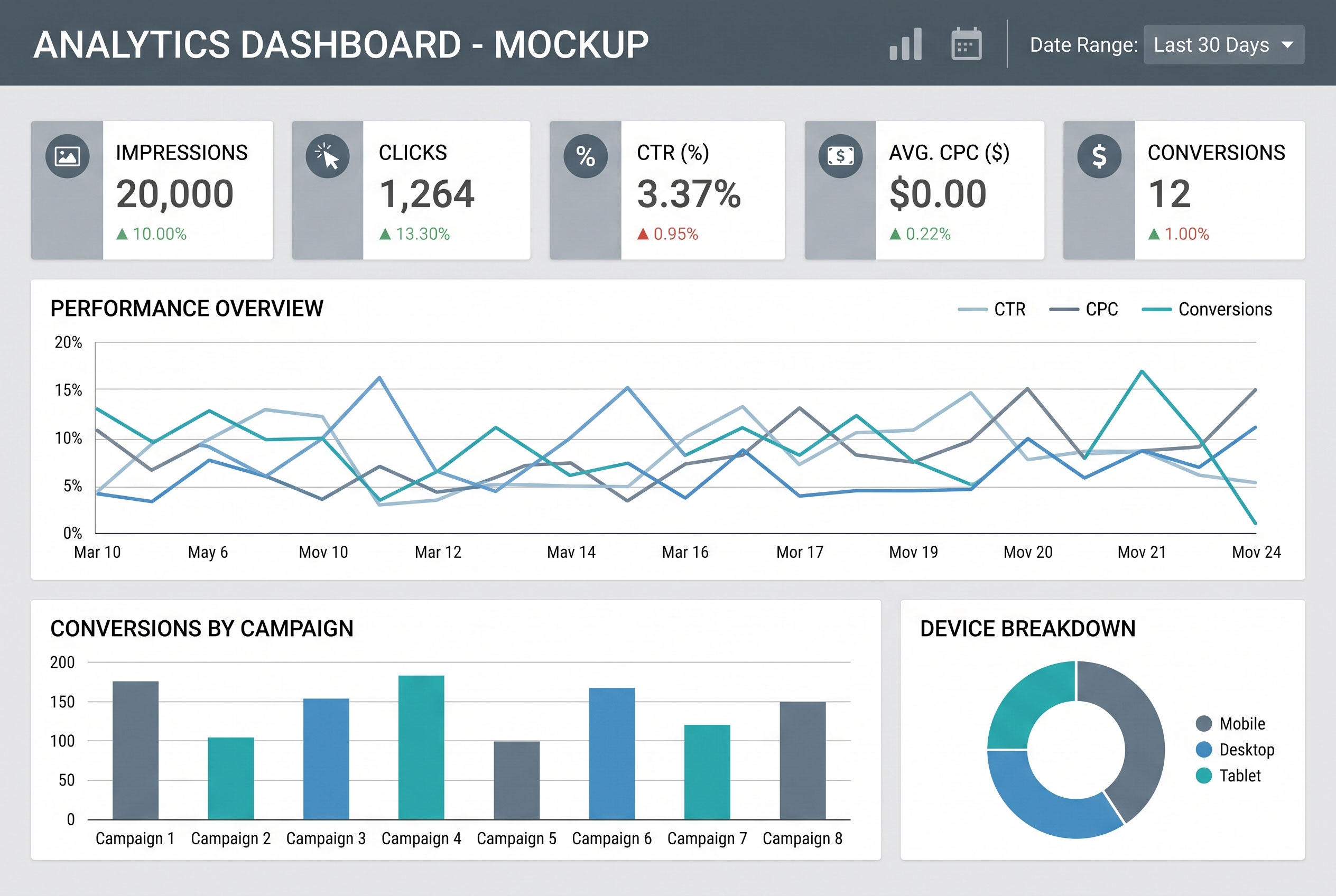
Advertisers commonly evaluate PPC campaigns using several
standard metrics:
- Click-through
rate (CTR) — the percentage of people who click an ad after seeing it.
- Cost-per-click
(CPC) — the amount paid for each click.
- Cost-per-acquisition
(CPA) — the cost associated with a completed desired action, such as a
purchase.
- Return
on ad spend (ROAS) — revenue generated relative to advertising
expenditure.
- Impressions
— the number of times an ad is displayed, regardless of clicks.
Significance and Impact
PPC advertising has become a central component of the
digital economy, providing a substantial share of revenue for major internet
platforms. It enables businesses of varying sizes to advertise with flexible
budgets, since campaigns can often be started, paused, or adjusted with relatively
low upfront cost compared to traditional advertising formats such as television
or print. The measurable nature of PPC — including real-time data on clicks,
costs, and conversions — has also contributed to the broader growth of
data-driven marketing practices.
Criticism and Controversy
PPC advertising has faced several recurring criticisms,
presented here without endorsing any particular position:
- Click
fraud — the practice of generating illegitimate clicks, whether
through automated bots or competitors, to drain an advertiser's budget or
inflate publisher revenue. Platforms have implemented detection systems,
though the scale of undetected fraud is difficult to independently verify.
- Rising
costs in competitive industries — some industries, such as legal services
and insurance, have reported high cost-per-click rates due to intense
bidding competition, though exact figures vary by source and time period.
- Ad
blindness and ad blocking — increased use of ad-blocking software and
general user skepticism toward sponsored content has been cited as a
challenge to PPC effectiveness, though its overall impact on the industry
remains debated among analysts.
- Privacy
concerns — audience targeting based on browsing behavior and personal
data has drawn regulatory scrutiny in various jurisdictions, contributing
to changes in data collection practices by major platforms.
Common Misconceptions
A frequent misconception is that the highest bidder always
secures the top ad position; in practice, quality and relevance scoring can
allow lower bids to outrank higher ones. Another common confusion involves
conflating PPC with search engine optimization (SEO), which involves
improving organic (unpaid) search rankings rather than paying for placement.
Note: PPC (pay-per-click) should not be confused with
CPM (cost-per-thousand-impressions) advertising, which charges based on
ad views rather than clicks, or with affiliate marketing, which
typically compensates based on completed sales or leads.
Current Status
PPC remains a foundational advertising format across the
internet, with ongoing developments including increased use of automated and
AI-assisted bidding strategies, expanded targeting options, and adjustments
driven by evolving privacy regulations and browser policies affecting tracking
technologies such as third-party cookies.