

Front-end development is the practice of building the
parts of a website or application that users directly see and interact with,
commonly referred to as the client side. It relies primarily on three
core technologies: HTML (structure), CSS (presentation), and JavaScript
(behavior and interactivity). Front-end development is distinct from back-end
development, which handles server logic, databases, and data processing
that occur away from the user's view.
In brief: front-end development is the discipline of
translating visual designs and user requirements into functioning interfaces
that run in a web browser, encompassing layout, styling, interactivity,
accessibility, and performance on the client device.
The field emerged alongside the World Wide Web in the early
1990s and has expanded considerably as browsers, devices, and user expectations
have grown more sophisticated. Modern front-end development often involves
specialized frameworks, build tools, and testing practices that did not exist
in the web's early years, though the underlying three-technology foundation
remains constant.
Infobox
|
Field |
Detail |
|
Field of study |
Computer science / Web development |
|
Core technologies |
HTML, CSS, JavaScript |
|
Also known as |
Client-side development |
|
Related fields |
Back-end development, full-stack development, UI/UX design |
|
Common tools |
Text editors/IDEs, browser developer tools, version control
systems |
|
Notable frameworks |
React, Angular, Vue.js |
|
Emerged |
Early 1990s, alongside the World Wide Web |
Overview
Front-end development concerns everything a person
experiences directly while using a website or web application inside a browser:
the layout of a page, the fonts and colors, buttons and forms, animations, and
how the interface responds to clicks, scrolls, and keystrokes. Front-end
developers write code that browsers can interpret and render, working closely
with designers to implement visual specifications and with back-end developers
to connect interfaces to data and services.
The discipline sits at the intersection of software
engineering and visual design. A front-end developer must understand not only
how to write functional code but also how that code affects usability,
accessibility, and performance across a wide range of devices, screen sizes,
and network conditions.
Note: The term "front end" is sometimes
used more broadly in software engineering to describe any user-facing layer of
a system, including desktop or mobile applications, but in most contexts it
refers specifically to web-based interfaces.
History and Development
The origins of front-end development trace to the creation
of the World Wide Web by Tim Berners-Lee in 1989–1991, when HTML was
introduced as a simple markup language for structuring documents. Early web
pages consisted almost entirely of static text and hyperlinks, with little
visual styling and no client-side interactivity.
CSS was introduced by the World Wide Web Consortium
(W3C) in 1996 to separate visual presentation from document structure, allowing
developers to control layout, color, and typography independently of content. JavaScript,
created by Brendan Eich in 1995 while at Netscape, added the ability for pages
to respond to user actions without requiring a full page reload, laying the
groundwork for interactive web applications.
Through the 2000s, techniques such as AJAX
(Asynchronous JavaScript and XML) enabled pages to update content dynamically,
contributing to the rise of more application-like websites. The following
decade saw the emergence of JavaScript frameworks and libraries—including jQuery,
and later AngularJS, React, and Vue.js—that provided
structured approaches to building complex, interactive interfaces at scale.
More recently, front-end development has incorporated build
tooling, component-based architecture, and responsive design practices to
accommodate the growing diversity of devices, from desktop monitors to smartphones
and tablets.
Core Technologies
HTML
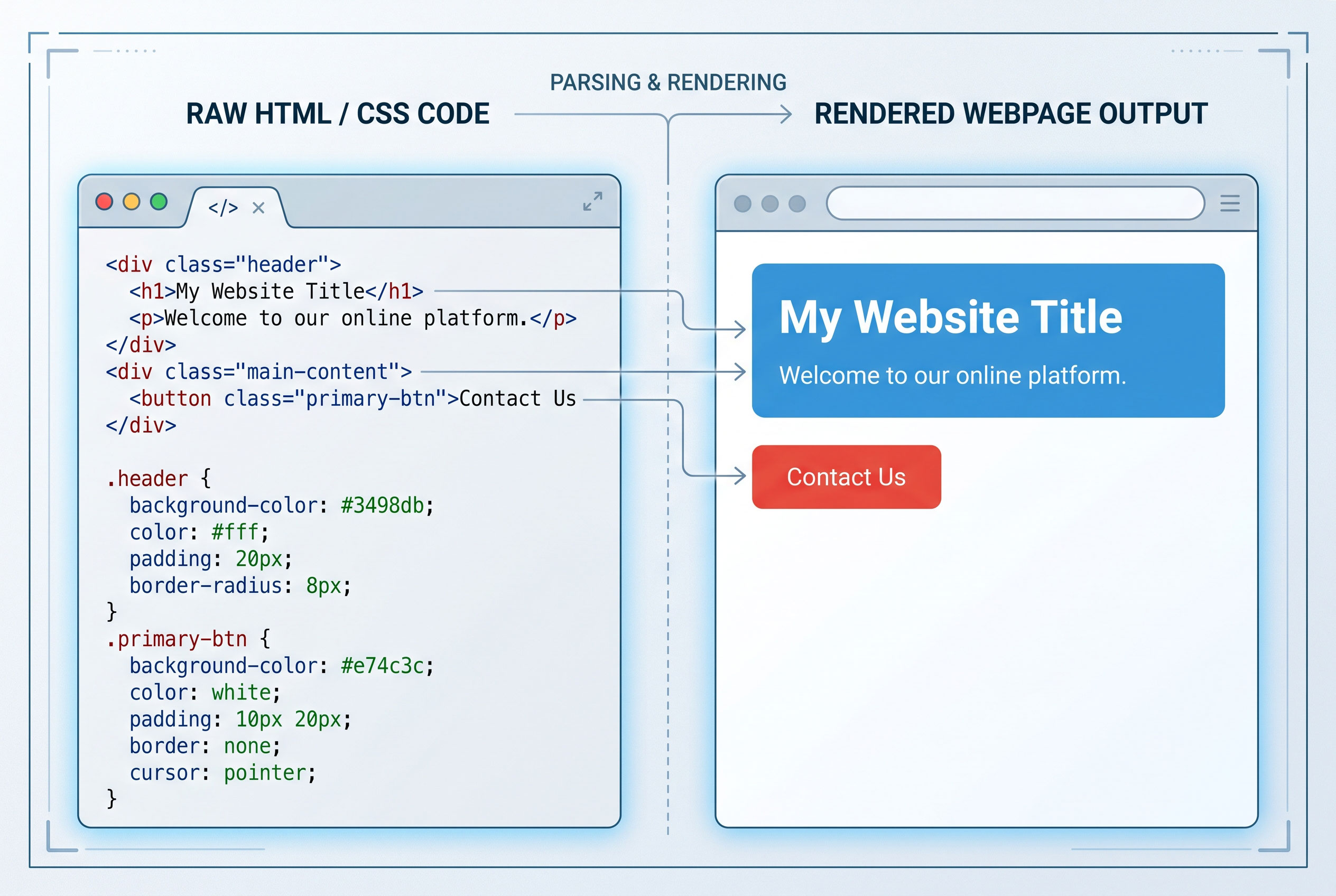
HTML (HyperText Markup Language) provides the
structural foundation of a web page, defining elements such as headings,
paragraphs, images, links, and forms. It is maintained as a living standard by
the WHATWG (Web Hypertext Application Technology Working Group) in
coordination with the W3C.
CSS
CSS (Cascading Style Sheets) governs the visual
presentation of HTML elements, including layout, spacing, color, and
typography. Modern CSS includes layout systems such as Flexbox and Grid,
which allow developers to build responsive designs that adapt to different
screen sizes.
JavaScript
JavaScript adds interactivity and dynamic behavior to
web pages, enabling features such as form validation, animations, and real-time
content updates. It is standardized under the ECMAScript specification,
with new versions released periodically to add language features.
Frameworks and Libraries
As web applications grew more complex, developers began
adopting frameworks and libraries to manage code more efficiently. These tools
generally fall into a few categories:
- Component-based
libraries, such as React (maintained by Meta), which structure
interfaces as reusable, self-contained components.
- Full-featured
frameworks, such as Angular (maintained by Google), which
provide built-in tooling for routing, state management, and form handling.
- Progressive
frameworks, such as Vue.js, designed to be adopted
incrementally within existing projects.
- CSS
frameworks, such as Bootstrap and Tailwind CSS, which
provide pre-built styling systems to speed up interface development.
It is commonly reported that framework popularity shifts
relatively quickly within the industry, and sources disagree on which tools
represent current "best practice" at any given time, as adoption
varies by company, project size, and developer preference.
How Front-End Development Works
A typical front-end development workflow involves several
stages:
- Design
translation — Converting visual mockups (often created in design
tools) into functional HTML and CSS.
- Component
or page construction — Building reusable interface elements or full
pages using markup, styles, and scripts.
- Interactivity
implementation — Adding JavaScript logic to handle user input,
animations, and dynamic content.
- Integration
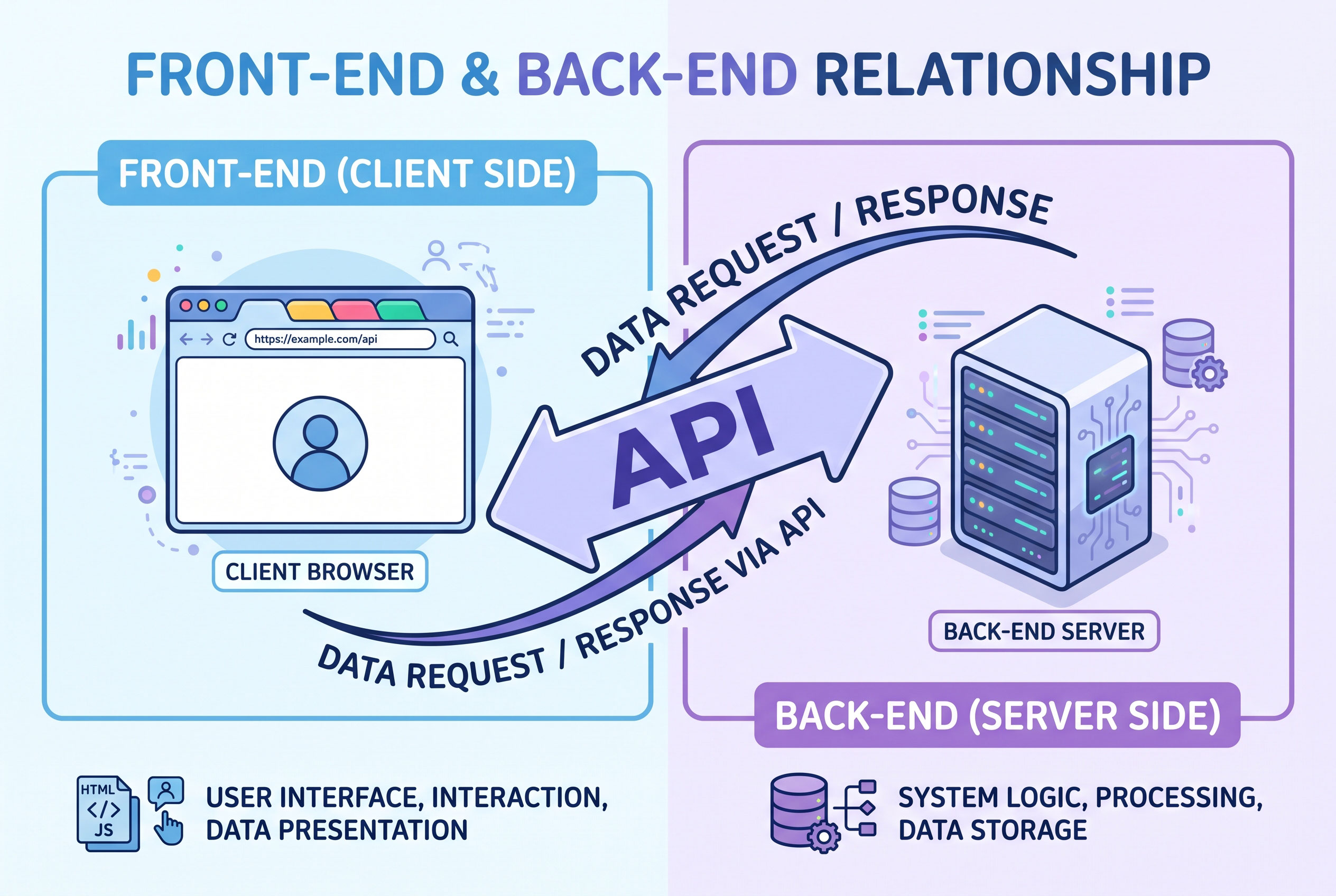
— Connecting the interface to back-end services via APIs
(Application Programming Interfaces) to retrieve or submit data.
- Testing
and optimization — Verifying that the interface functions correctly
across browsers and devices, and optimizing for load speed and
accessibility.
Front-end developers commonly use browser developer tools to
inspect and debug code, along with version control systems such as Git
to manage changes collaboratively.
Front-End vs. Back-End Development
|
Aspect |
Front-End Development |
Back-End Development |
|
Runs on |
User's browser/device |
Server |
|
Core languages |
HTML, CSS, JavaScript |
Varies (e.g., Python, Java, PHP, Node.js) |
|
Primary concern |
User interface, interactivity, presentation |
Data storage, business logic, security |
|
Visible to users |
Yes |
No |
|
Common outputs |
Rendered web pages, interactive elements |
APIs, databases, server responses |
A developer who works across both areas is typically
described as a full-stack developer.
Skills and Practices
Front-end development commonly involves competencies beyond
the three core languages, including:
- Responsive
design, ensuring layouts adapt to different screen sizes.
- Accessibility
(a11y), making interfaces usable for people with disabilities, often
guided by standards such as the Web Content Accessibility Guidelines
(WCAG).
- Performance
optimization, minimizing page load times and resource usage.
- Cross-browser
compatibility, ensuring consistent behavior across different web
browsers.
- Version
control, typically using Git-based systems for collaborative code
management.
Impact and Significance
Front-end development has played a central role in the
transition of the web from static documents to interactive applications capable
of rivaling desktop software in functionality. E-commerce, social media, online
banking, and productivity tools all depend heavily on front-end engineering to
deliver usable, responsive experiences.
The growing prevalence of mobile devices has further shaped
the field, driving widespread adoption of responsive and mobile-first design
approaches. As of the mid-2020s, front-end development continues to evolve
alongside browser capabilities, with ongoing developments in areas such as web
performance standards and component-based architecture.
Common Misconceptions
A frequent misconception is that front-end development is
purely about visual design; in practice, it also requires substantial
programming logic, performance considerations, and technical problem-solving.
Another common confusion involves equating front-end development with UI/UX
design, which focuses on research, wireframing, and user experience
strategy rather than implementation.