

Artificial intelligence (AI) is a branch of computer
science concerned with building systems capable of performing tasks that
typically require human intelligence, such as reasoning, learning, perception,
and language understanding. In brief, AI refers to computational methods that
allow machines to process information, recognize patterns, and make decisions
or predictions, often by learning from data rather than following only
explicit, hand-written instructions.
The term encompasses a wide range of techniques, from simple
rule-based systems developed in the mid-20th century to modern machine
learning and deep learning approaches that power tools such as voice
assistants, recommendation systems, and generative text and image models. AI is
not a single technology but a broad field that draws on mathematics,
statistics, neuroscience-inspired computing, linguistics, and philosophy.
AI systems are generally classified according to their
capability and scope. Most AI in current use is described as narrow AI (or
weak AI), designed to perform a specific task, such as translating languages or
identifying objects in images. This is distinct from the hypothetical concept
of artificial general intelligence (AGI), which would match or exceed
human cognitive ability across a broad range of tasks; as of the mid-2020s, AGI
remains a subject of research and debate rather than an achieved technology,
and experts disagree on its timeline or feasibility.
|
Category |
Key Facts |
|
Field |
Computer science, mathematics, cognitive science |
|
Coined |
Term "artificial intelligence" attributed to the
1956 Dartmouth Workshop |
|
Key figures (early field) |
John McCarthy, Marvin Minsky, Alan Turing (foundational
theoretical work) |
|
Major subfields |
Machine learning, natural language processing, computer
vision, robotics |
|
Common applications |
Search engines, virtual assistants, recommendation
systems, autonomous vehicles, generative AI tools |
|
Notable milestone |
Deep Blue defeats world chess champion Garry Kasparov
(1997) |
Note: The term "AI" is sometimes used
loosely in marketing and media to describe any automated software feature, even
when it does not involve learning or adaptive behavior. This has led to
disagreement over what should properly be labeled artificial intelligence
versus conventional automation.
Overview
At its core, artificial intelligence involves designing
algorithms that allow a computer system to take in information (data), identify
patterns or relationships within it, and produce an output such as a prediction,
classification, or generated content. Early AI research relied heavily on
symbolic reasoning, where knowledge was represented as explicit rules and
logical statements. Since the 2010s, the field has been dominated by statistical
and data-driven methods, particularly machine learning, in which a system
improves its performance on a task by being exposed to large amounts of example
data rather than being explicitly programmed with rules for every scenario.
AI research is typically organized around specific
capabilities, including:
- Learning
– improving performance through experience or data exposure
- Reasoning
– drawing logical conclusions from available information
- Perception
– interpreting sensory input such as images, audio, or text
- Language
processing – understanding and generating human language
- Planning
and decision-making – selecting actions to achieve goals
History and Development
Early Foundations (1940s–1950s)
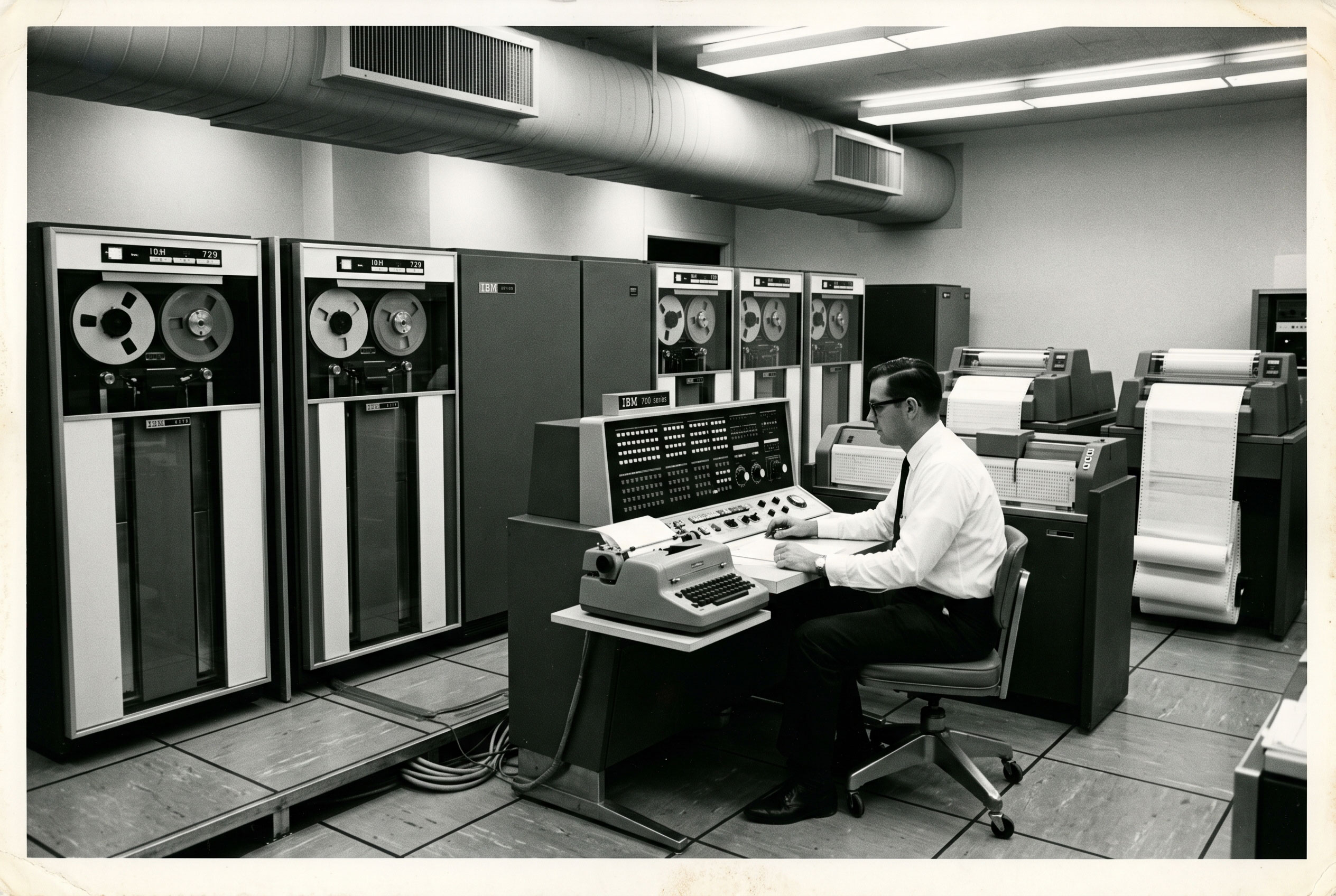
The theoretical groundwork for AI predates the term itself.
British mathematician Alan Turing proposed in a 1950 paper a method for
evaluating machine intelligence, later popularized as the "Turing
Test," which assessed whether a human evaluator could distinguish a
machine's responses from a human's. The field was formally named at the 1956
Dartmouth Summer Research Project, organized by researchers including John
McCarthy and Marvin Minsky, where the term "artificial
intelligence" was adopted to describe the study of machines that could
simulate aspects of human intelligence.
Early Optimism and the "AI Winters"
(1950s–1980s)
Initial progress in areas like symbolic logic and simple
problem-solving programs led to optimistic predictions about rapid advances.
However, limitations in computing power and the complexity of real-world
problems led to periods of reduced funding and interest, commonly referred to
as "AI winters," occurring roughly in the mid-1970s and again
in the late 1980s and early 1990s.
Expert Systems and Renewed Interest (1980s)
During the 1980s, expert systems—programs designed to
emulate the decision-making of human specialists in narrow domains such as
medical diagnosis—saw commercial adoption, temporarily reviving interest in AI
before their limitations again became apparent.
Machine Learning and Big Data (1990s–2010s)
A shift toward statistical machine learning gained momentum
through the 1990s and 2000s, aided by growing computational power and the
availability of large datasets. A widely cited milestone occurred in 1997,
when IBM's Deep Blue system defeated reigning world chess champion Garry
Kasparov, demonstrating the potential of specialized computing systems in
structured tasks.
Deep Learning and Generative AI (2010s–present)
The 2010s saw major advances driven by deep learning,
a subset of machine learning using multi-layered artificial neural networks.
This period included the development of systems capable of outperforming humans
in specific tasks, such as DeepMind's AlphaGo defeating a top-ranked Go player
in 2016, according to widely reported accounts. In the early 2020s, generative
AI systems capable of producing human-like text, images, audio, and
code—such as large language models—became widely accessible to the public,
prompting rapid commercial adoption alongside debate about their societal
implications.
Types and Classification
AI can be classified along several dimensions. One common
distinction is by capability:
- Narrow
AI (Weak AI): Systems designed for a specific task, such as spam
filtering or facial recognition. This describes virtually all AI systems in
practical use today.
- General
AI (AGI): A theoretical system with human-level reasoning and
adaptability across diverse tasks. No system meeting this definition is
known to currently exist, and researchers disagree on whether or when it
might be achieved.
- Superintelligence:
A hypothetical AI surpassing human intelligence across all domains,
discussed primarily in theoretical and philosophical contexts rather than
as a near-term engineering goal.
Another common classification is by underlying method:
|
Approach |
Description |
Example Use |
|
Symbolic AI |
Rule-based systems using explicit logic |
Early expert systems |
|
Machine Learning |
Systems that learn patterns from data |
Spam detection, recommendation engines |
|
Deep Learning |
Machine learning using layered neural networks |
Image recognition, language models |
|
Reinforcement Learning |
Learning through trial and reward-based feedback |
Game-playing agents, robotics control |
How It Works: Core Techniques
Machine Learning
Machine learning involves training algorithms on
datasets so that the system can identify patterns and make predictions on new,
unseen data. Common categories include supervised learning (learning
from labeled examples), unsupervised learning (finding structure in
unlabeled data), and reinforcement learning (learning through feedback
from actions taken in an environment).
Neural Networks and Deep Learning
Artificial neural networks are computing structures
loosely inspired by the interconnected neurons of biological brains, consisting
of layers of nodes that process and transform input data. Deep learning
refers to neural networks with many such layers, enabling them to model complex
patterns in data such as images, audio, and text. This approach underlies most
prominent AI systems developed since the 2010s, including image classifiers and
large language models.
Natural Language Processing
Natural language processing (NLP) is the subfield
focused on enabling computers to understand, interpret, and generate human
language. Applications include machine translation, sentiment analysis, and
conversational agents.
Notable Applications
AI techniques are applied across numerous sectors:
- Search
and recommendation: Ranking search results and suggesting content on
platforms based on user behavior patterns.
- Healthcare: Assisting in medical image analysis and identifying patterns in patient data, though such tools are generally used to support rather than replace clinical judgment

- Transportation:
Enabling driver-assistance features and autonomous vehicle research, with
varying levels of autonomy achieved commercially.
- Finance:
Detecting fraudulent transactions and informing algorithmic trading
strategies.
- Creative
tools: Generating text, images, and audio through generative AI
models, a rapidly growing application area since the early 2020s.
Impact and Significance
The proliferation of AI has had wide-reaching economic and
social effects. Proponents point to productivity gains, scientific research
acceleration, and new categories of tools and services. At the same time, the
technology has raised concerns among researchers, policymakers, and the public
regarding job displacement, algorithmic bias, privacy, and
the concentration of AI development among a small number of
well-resourced organizations. Sources disagree on the net long-term economic
and labor market effects, with estimates varying based on assumptions about the
pace of adoption and regulatory response.
Criticism and Controversy
Several areas of AI development remain contested:
- Bias
and fairness: Studies have found that AI systems trained on historical
data can reproduce or amplify existing societal biases, prompting ongoing
research into fairness-aware system design.
- Transparency:
Many deep learning systems function as "black boxes," making
their internal decision-making processes difficult to interpret, which has
raised concerns in high-stakes applications such as healthcare and
criminal justice.
- Existential
and safety concerns: Some researchers and public figures have
expressed concern about long-term risks associated with highly capable AI
systems, while others consider such concerns speculative or premature;
this remains an area of active and unresolved debate.
- Intellectual
property and data use: The practice of training AI models on large
volumes of text, images, and other content scraped from the internet has
led to legal disputes and public debate over copyright and consent, with
outcomes varying by jurisdiction and still evolving as of the mid-2020s.
Comparisons and Related Concepts
AI is sometimes confused with related but distinct concepts.
Automation broadly refers to any process performed without human
intervention and does not necessarily involve learning or adaptation, whereas
AI systems are generally capable of improving or adjusting behavior based on
data. Robotics is a related but separate field concerned with the
physical design and control of machines, which may or may not incorporate AI
for decision-making. Data science overlaps with AI in its use of
statistical methods but is more broadly concerned with extracting insights from
data rather than building autonomous decision-making systems.
Current Status
As of the mid-2020s, AI development continues to accelerate,
particularly in the area of generative AI and large-scale language and
multimodal models. Governments in multiple regions have begun introducing or
debating regulatory frameworks aimed at addressing safety, transparency, and
accountability, though approaches vary significantly by jurisdiction and the
field continues to evolve rapidly.