
On-page SEO (also called on-site SEO) refers
to the practice of optimizing individual web pages to improve their visibility
in search engine results and to enhance the experience of visitors who reach
them. It encompasses both the content of a page—such as text, images, and
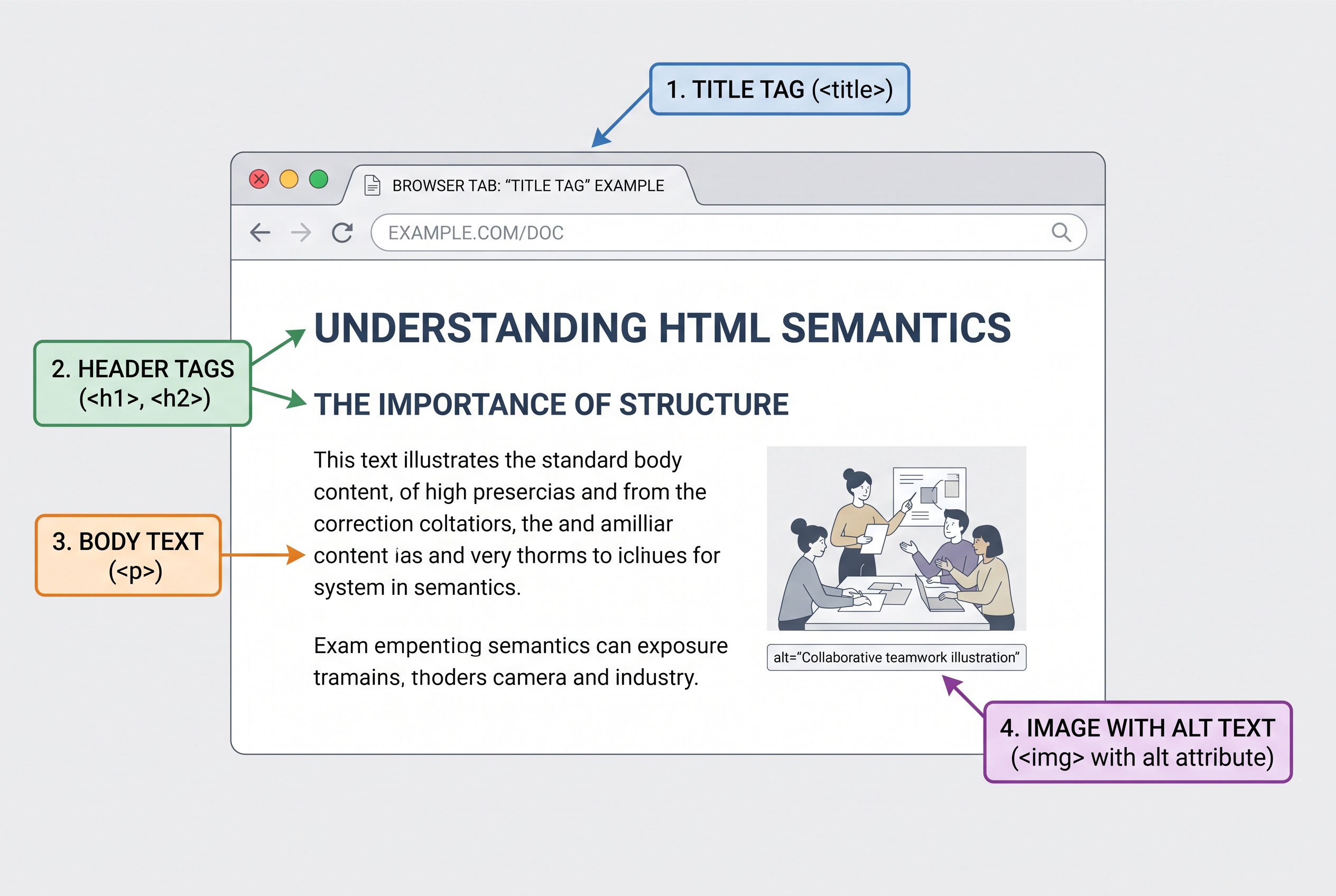
structure—and specific HTML elements, including title tags, meta
descriptions, and header tags. On-page SEO is one of the three broad
categories of search engine optimization, alongside off-page SEO
(activities conducted outside a website, such as acquiring backlinks) and technical
SEO (infrastructure-level factors like site speed and crawlability).
In short: on-page SEO is the set of adjustments made
directly to a webpage's content and code to help search engines understand it
and rank it appropriately for relevant queries. It has been a core
component of search engine optimization since the early days of commercial
search engines in the 1990s, and its specific techniques have evolved
considerably as search algorithms have grown more sophisticated.
|
Category |
Details |
|
Field |
Search Engine Optimization (SEO) |
|
Also known as |
On-site SEO |
|
Related disciplines |
Off-page SEO, Technical SEO |
|
Primary goal |
Improve page relevance, crawlability, and user experience |
|
Key elements |
Title tags, meta descriptions, headers, content, internal
links, images |
|
First relevant since |
Mid-to-late 1990s (early search engines) |
Overview
On-page SEO operates on the principle that search engines
evaluate the content and structure of a webpage to determine what it is about
and how well it might satisfy a searcher's query. Search engines such as
Google, Bing, and others use automated programs called crawlers (or
spiders) to scan web pages, followed by algorithms that index and rank the
content. On-page factors give search engines and users clear signals about a
page's topic, quality, and relevance.
Unlike off-page SEO, which depends on external factors like
the number and quality of websites linking back to a page, on-page SEO is
entirely within a website owner's control. This makes it a common starting
point for individuals and organizations seeking to improve organic (non-paid)
search visibility.
History and Development
Search engine optimization as a practice emerged alongside
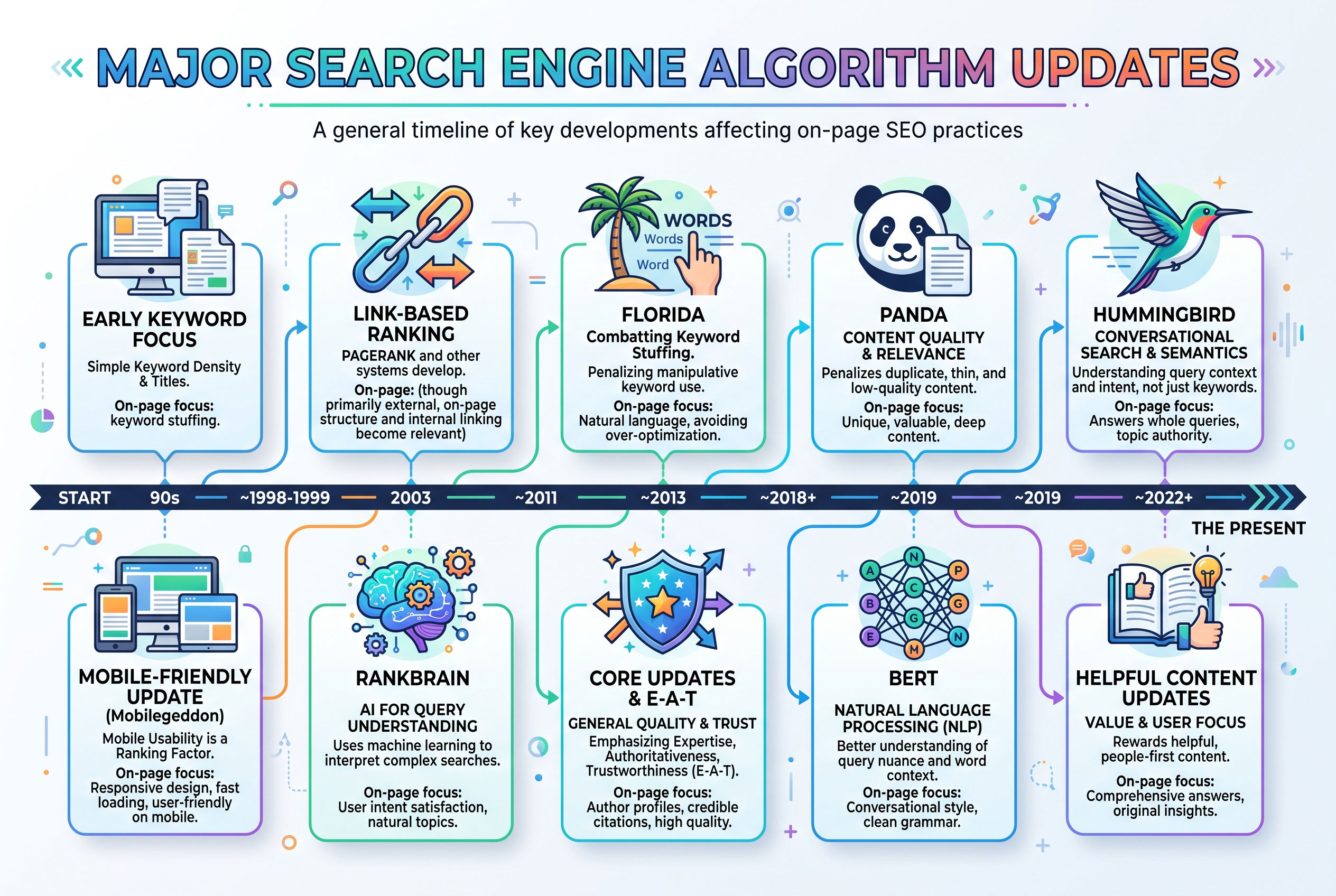
the growth of commercial web search engines in the mid-1990s. Early search
engines relied heavily on straightforward on-page signals, such as how often a
keyword appeared on a page, a practice that led to widespread keyword
stuffing—repeating terms excessively in an attempt to manipulate rankings.
As search engines matured, particularly following Google's
rise to prominence in the late 1990s and early 2000s, ranking algorithms began
incorporating more sophisticated methods, including link analysis (notably
Google's PageRank algorithm) and, later, natural language processing.
Over time, search engines introduced updates specifically targeting
manipulative on-page practices. It is commonly reported that Google's Panda
update (2011) targeted low-quality and thin content, while later updates
emphasized user experience signals and content depth. Sources generally agree
that this shift moved on-page SEO away from mechanical keyword repetition and
toward comprehensive, user-focused content.
Core Elements of On-Page SEO
On-page SEO consists of several interrelated components.
These are typically grouped into content-related factors and HTML/structural
factors.
Title Tags
The title tag is an HTML element that specifies the
title of a webpage, displayed as the clickable headline in search engine
results and in browser tabs. Title tags are widely regarded as one of the most
influential on-page elements, as they concisely communicate a page's topic to
both search engines and users.
Meta Descriptions
A meta description is a brief HTML snippet, typically
150–160 characters, summarizing a page's content. While meta descriptions are
not generally considered a direct ranking factor, they influence click-through
rate by helping users decide whether a search result matches their intent.
Header Tags
Header tags (H1 through H6) structure a page's
content hierarchically. The H1 tag typically denotes the main heading, while H2
and H3 tags organize subsections. Proper use of headers improves readability
for users and helps search engines parse the logical structure of a page's
content.
Content Quality and Keyword Usage
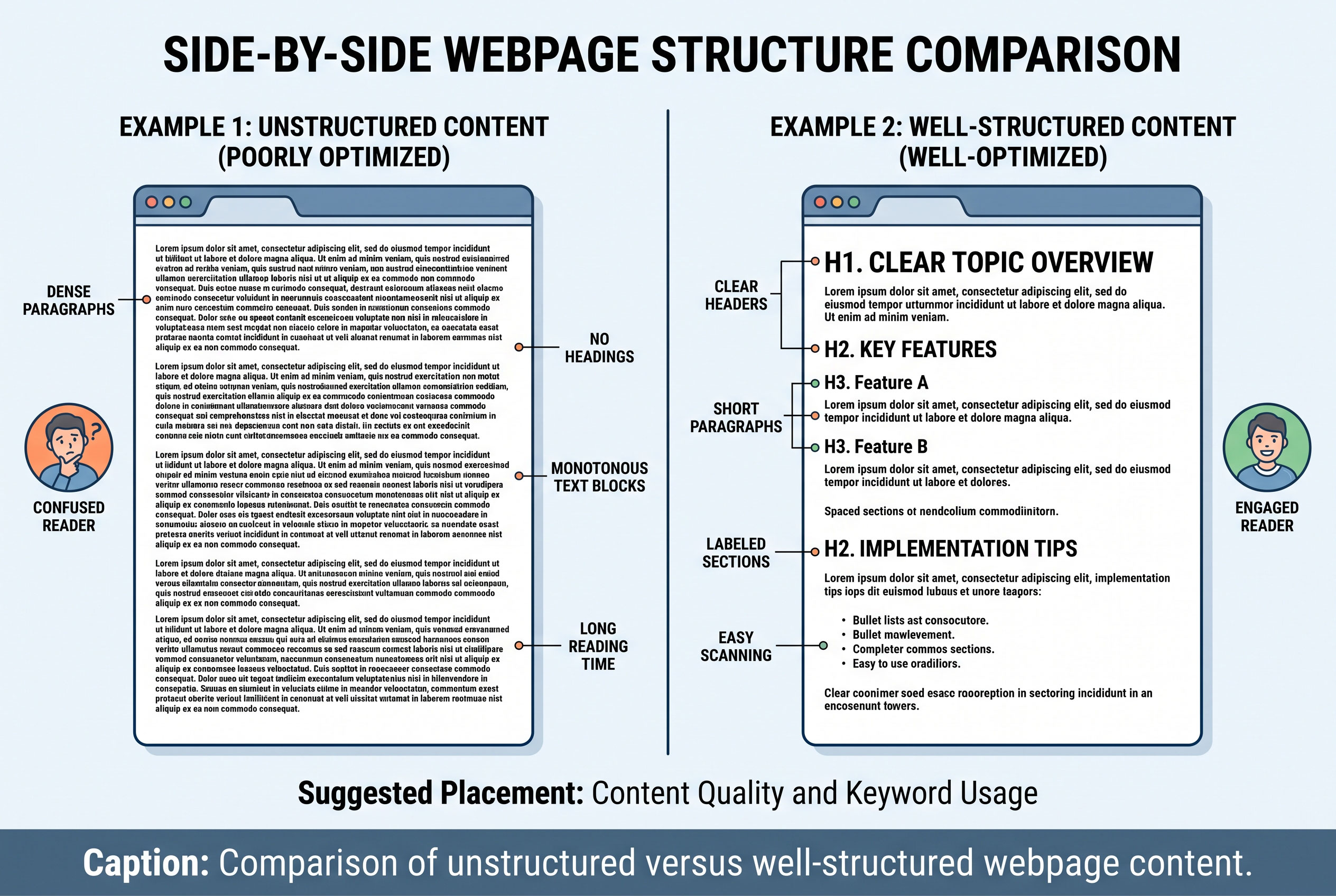
Content is generally regarded as the foundation of on-page
SEO. This includes:
- Relevance
to the target search query or topic
- Depth
and comprehensiveness of information
- Originality,
as opposed to duplicated content
- Natural
use of relevant keywords and related terms, rather than forced repetition
- Readability,
including sentence structure and formatting
URL Structure
A page's URL (web address) is considered an on-page
factor when it is descriptive, concise, and reflective of the page's content,
as opposed to long strings of numbers or unrelated characters.
Internal Linking
Internal links connect one page on a website to
another. They help distribute authority across a site, guide users to related
content, and assist search engine crawlers in discovering and understanding the
relationships between pages.
Image Optimization
Optimizing images includes providing descriptive file names,
appropriately sized files for faster loading, and alt text, a written
description of an image's content that also serves accessibility purposes for
visually impaired users relying on screen readers.
On-Page vs. Off-Page vs. Technical SEO
Note: On-page SEO is often discussed alongside, and
sometimes confused with, off-page and technical SEO. While related, each
addresses different aspects of search visibility.
|
Aspect |
On-Page SEO |
Off-Page SEO |
Technical SEO |
|
Location of control |
Within the page itself |
External to the website |
Site infrastructure |
|
Examples |
Title tags, content, headers |
Backlinks, social signals |
Site speed, mobile-friendliness, crawlability |
|
Primary focus |
Content relevance and structure |
Authority and reputation |
Accessibility to search engines |
Common Practices and Techniques
Practitioners of on-page SEO commonly focus on the following
techniques:
- Conducting
keyword research to identify terms an audience searches for
- Aligning
content with search intent—the underlying goal behind a search
query
- Structuring
content with clear headings and short paragraphs
- Ensuring
each page targets a distinct topic to avoid content overlap
- Optimizing
page loading speed, which overlaps with technical SEO
- Using
descriptive, keyword-relevant anchor text for internal links
- Updating
and refreshing older content to maintain accuracy and relevance
Criticism and Controversy
Some on-page SEO practices have drawn criticism,
particularly historical techniques that prioritized search engine algorithms
over user experience. Keyword stuffing, hidden text, and other
manipulative tactics were common in earlier eras of SEO and are now generally
classified as violations of search engine guidelines, which can result in
penalties or reduced visibility.
There is also ongoing discussion within the SEO community
regarding the extent to which specific on-page factors, such as keyword density
or exact-match keyword usage, still meaningfully influence rankings, given that
search engines have increasingly emphasized broader measures of content quality
and user satisfaction. Sources differ on the precise weight given to individual
on-page signals, and search engines generally do not disclose the exact
mechanics of their ranking algorithms.
Significance and Current Relevance
On-page SEO remains a foundational aspect of search engine
optimization, even as search algorithms have grown more advanced and incorporate
machine learning and natural language understanding. Because on-page elements
are fully within a publisher's control, they continue to serve as an accessible
entry point for improving a website's discoverability, distinct from the
comparatively more variable and time-intensive work of off-page link
acquisition.