
Machine learning (ML) is a field of study
within artificial intelligence in which computer systems improve at a task by
identifying patterns in data, rather than by following only explicitly programmed
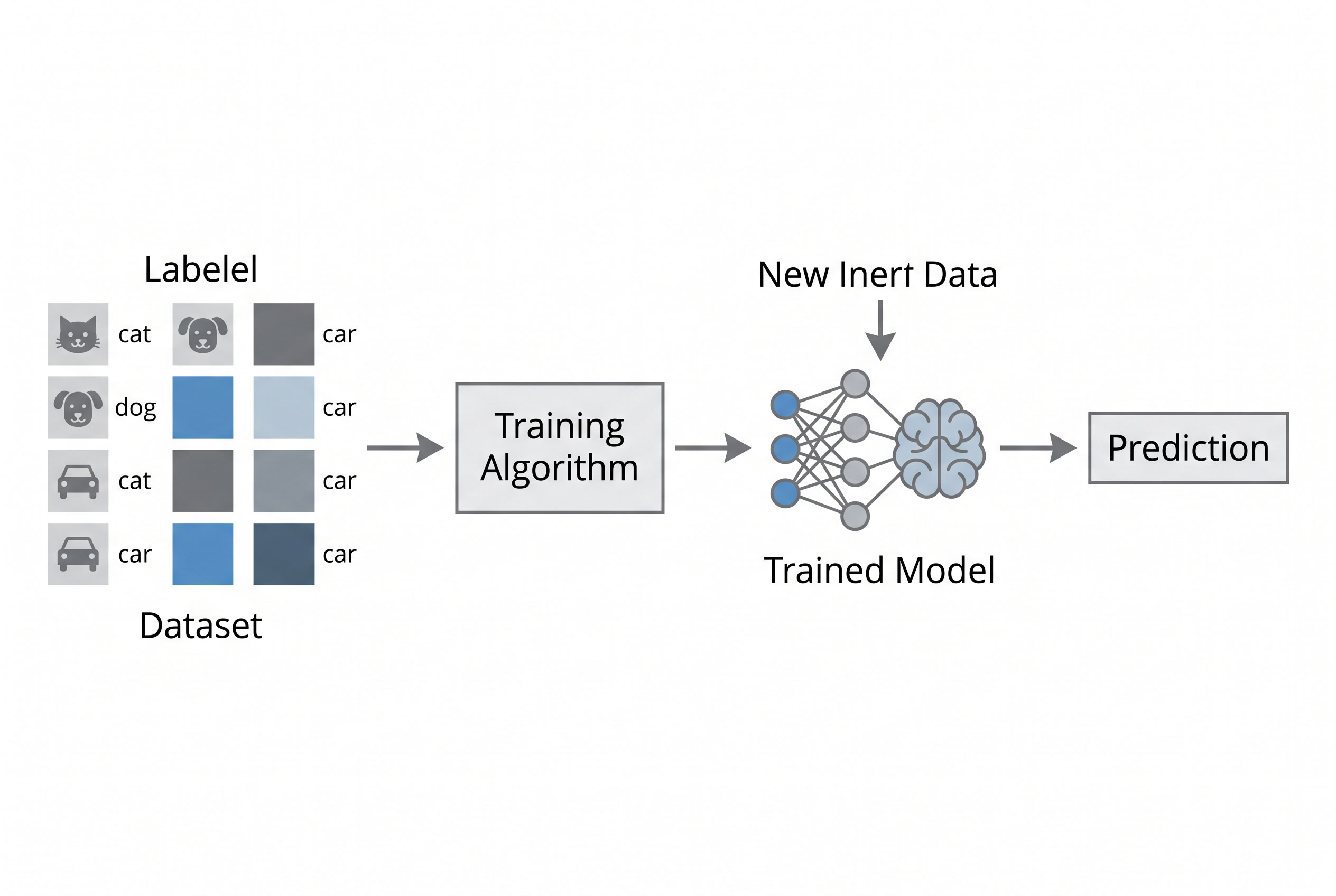
rules. A machine learning system is typically built by supplying an algorithm
with example data. The algorithm produces a model that can then make
predictions or decisions about new, unseen data.
Machine learning draws on statistics, optimization, and
computer science. It is used in areas such as image and speech recognition,
language translation, recommendation systems, fraud detection, and scientific
research. The term is often used interchangeably with "artificial
intelligence" in popular media, although machine learning is generally
considered one subfield of the broader discipline.
|
Infobox |
|
|
Field |
Artificial intelligence; computer science; statistics |
|
Term popularized by |
Arthur Samuel (1959) |
|
Main paradigms |
Supervised, unsupervised, semi-supervised,
self-supervised, reinforcement learning |
|
Common model families |
Linear models, decision trees, ensembles, support vector
machines, neural networks |
|
Related fields |
Data mining, deep learning, pattern recognition,
statistics |
Definition
Several definitions of machine learning are in common use. Arthur
Samuel, who worked at IBM on a checkers-playing program, is widely credited
with describing it in 1959 as a field giving computers the ability to learn
without being explicitly programmed. That phrasing is commonly attributed to
him, though sources differ on its exact wording.
A more formal definition appears in Tom Mitchell's
1997 textbook Machine Learning. A program is said to learn from
experience E with respect to a class of tasks T and a performance
measure P if its performance at tasks in T, as measured by P,
improves with experience E.
Note: Machine learning is not synonymous with
artificial intelligence. Some AI systems, such as early expert systems built
from hand-written rules, do not use machine learning.
How machine learning works
Most machine learning systems follow a similar sequence,
although details vary by method.
- Data
collection and preparation. Data is gathered, cleaned, and often split
into training, validation, and test sets.
- Model
selection. A model family is chosen, such as a decision tree or a
neural network.
- Training.
An algorithm adjusts the model's internal parameters to reduce an loss
function, a numerical measure of error on the training data.
- Evaluation.
The model is tested on data it has not seen, to estimate how well it
generalizes.
- Deployment
and monitoring. The model is used in practice and checked over time,
since real-world data can change.
A central goal is generalization: performing well on
new data, not only on the examples used in training. Two failure modes are
widely discussed. Overfitting occurs when a model captures noise or
quirks of the training data and performs poorly elsewhere. Underfitting
occurs when a model is too simple to capture the underlying pattern.
History
Early foundations (1940s–1960s)
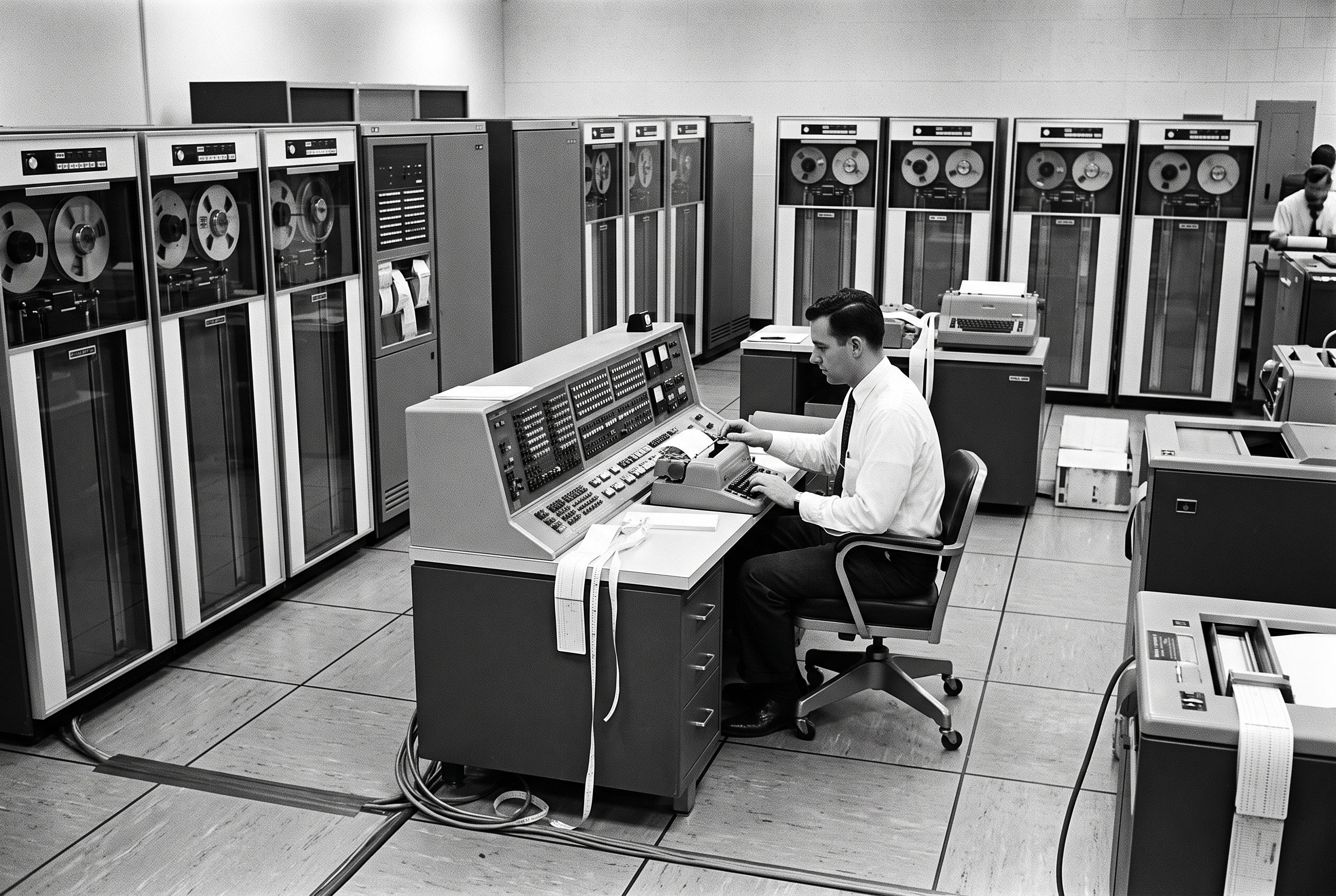
Foundations of the field include the mathematical modeling
of neurons by Warren McCulloch and Walter Pitts in 1943, and Alan Turing's
1950 paper "Computing Machinery and Intelligence," which discussed
the idea of machines that learn. In 1958, Frank Rosenblatt introduced
the perceptron, an early trainable neural network model. Samuel's
checkers program, developed in the 1950s, is often cited as an early
demonstration of a program improving through experience.
Setbacks and revival (1969–1990s)
In 1969, Marvin Minsky and Seymour Papert published Perceptrons,
which analyzed the limitations of single-layer networks. Many historians link
this work to reduced funding and interest in neural network research during the
following years, although the extent of its influence is debated. Interest
recovered in the 1980s, notably after a 1986 paper by David Rumelhart,
Geoffrey Hinton, and Ronald Williams popularized the backpropagation
algorithm for training multi-layer networks. In 1995, Corinna Cortes and
Vladimir Vapnik published work on support vector machines, which became
a leading method for many tasks.
Deep learning era (2010s–present)
Growth in computing power, particularly graphics processing
units (GPUs), and the availability of large datasets enabled deep learning,
which uses neural networks with many layers. A frequently cited milestone is
the 2012 victory of the AlexNet model in the ImageNet
image-classification competition. In 2016, DeepMind's AlphaGo defeated
professional Go player Lee Sedol, using a combination of deep neural networks
and reinforcement learning. In 2017, researchers at Google introduced the transformer
architecture in the paper "Attention Is All You Need," which
underlies many subsequent large language models.
Types of machine learning
|
Type |
Training data |
Typical goal |
Example task |
|
Supervised learning |
Labeled examples |
Predict a known output |
Classifying emails as spam or not spam |
|
Unsupervised learning |
Unlabeled data |
Find structure |
Grouping customers by behavior (clustering) |
|
Semi-supervised learning |
Small labeled set plus large unlabeled set |
Improve with limited labels |
Medical image classification with few annotations |
|
Self-supervised learning |
Labels derived from the data itself |
Learn general representations |
Predicting masked words in text |
|
Reinforcement learning |
Rewards from interaction |
Learn a decision policy |
Game-playing agents, robotic control |
Supervised learning
In supervised learning, each training example pairs an input
with a desired output. Problems fall into two main groups: classification,
where the output is a category, and regression, where the output is a
numerical value, such as a house price estimate.
Unsupervised and self-supervised learning
Unsupervised methods look for patterns without labeled
answers. Common tasks include clustering, dimensionality reduction, and anomaly
detection. Self-supervised learning, which generates its own training signal
from raw data, has become prominent in training large language and vision
models.
Reinforcement learning
In reinforcement learning, an agent takes actions in
an environment and receives rewards or penalties. Over many trials, it learns a
strategy that maximizes cumulative reward.
Common methods
- Linear
and logistic regression: Statistical models that predict a value or a
probability from weighted input features.
- Decision
trees and random forests: Models that split data through a series of
rules; forests combine many trees to improve accuracy.
- Gradient
boosting: An ensemble technique that builds models sequentially, each
correcting errors of the previous ones. It is widely used on structured,
tabular data.
- Support
vector machines: Methods that find a boundary separating classes with
the largest possible margin.
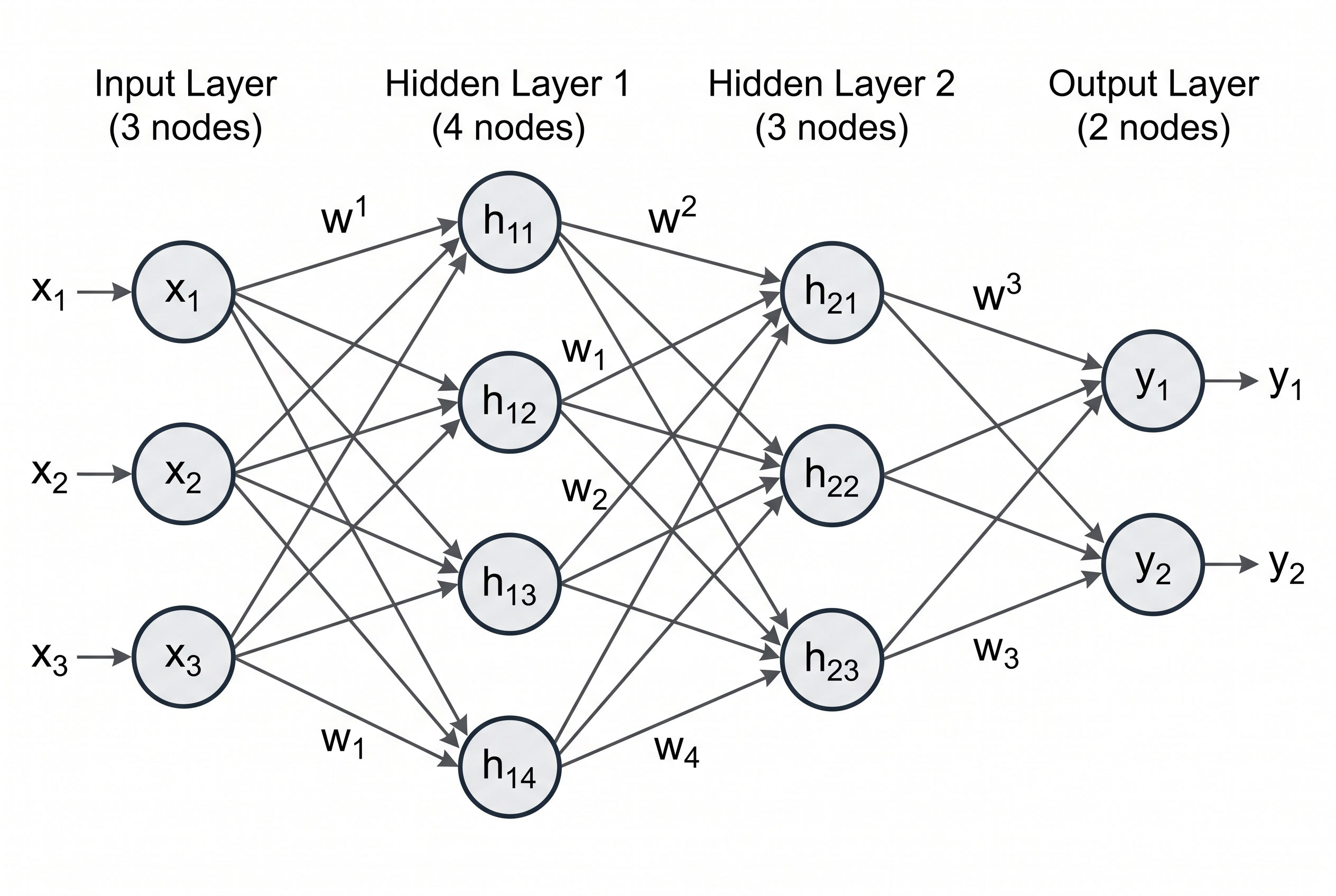
- Artificial
neural networks: Layered models loosely inspired by biological
neurons. Variants include convolutional networks (images), recurrent
networks (sequences), and transformers (language and other data).
Machine learning, artificial intelligence, and deep
learning
The three terms are nested. Artificial intelligence
is the broadest, covering any technique that enables machines to perform tasks
associated with human intelligence. Machine learning is the subset that
learns from data. Deep learning is a subset of machine learning built on
multi-layer neural networks. Machine learning also differs from traditional data
mining, which emphasizes discovering previously unknown patterns, whereas
machine learning often emphasizes prediction on new data. In practice, the two
overlap heavily.
Applications
Machine learning is applied across many sectors. Documented
uses include:
- Healthcare:
analysis of medical images and prediction of patient risk, typically as
decision support under clinical oversight.
- Finance:
credit scoring and detection of fraudulent transactions.
- Language
technology: machine translation, speech recognition, and text
generation.
- Transportation:
perception systems in driver-assistance and autonomous-vehicle research.
- Science:
protein structure prediction, notably DeepMind's AlphaFold, and analysis
of astronomical or particle-physics data.
- Commerce
and media: product and content recommendation.
Limitations and criticism
Researchers, regulators, and civil society groups have
raised several concerns, which are active areas of study and debate.
- Bias
and fairness. Models trained on historical data can reproduce or
amplify existing biases. Studies of facial-analysis and hiring systems
have documented performance differences across demographic groups.
- Interpretability.
Complex models, especially deep neural networks, are often described as
"black boxes" because their internal reasoning is difficult to
explain. The field of explainable AI seeks to address this.
- Data
and privacy. Training can require large volumes of data, raising
questions about consent, copyright, and the exposure of personal
information.
- Robustness.
Models can fail on inputs that differ from training data, and adversarial
examples, which are small deliberate changes to input, can cause incorrect
outputs.
- Resource
use. Training large models can require significant computing power and
energy. Estimates vary widely by model and method.
Governments have begun to regulate certain uses. The
European Union's AI Act, adopted in 2024, is one widely discussed
example, with obligations phasing in over several years. Provisions and
timelines may change, so current official sources should be consulted.
Current status
Machine learning remains an active research and engineering
field. Much recent attention has focused on large pretrained models, often
called foundation models, and on questions of safety, evaluation, and
governance. Methods and benchmarks change quickly, so figures about model size,
performance, and adoption date rapidly.