

A chatbot is a software application that conducts a
conversation with a human user through text or speech, simulating aspects of
human dialogue. Chatbots range from simple programs that match keywords to
scripted replies to systems built on large language models that generate
original responses. They are used in customer service, information retrieval,
education, entertainment, and personal assistance.
The earliest widely known chatbot, ELIZA, dates to the
mid-1960s. Public use expanded with messaging platforms in the 2010s and again
after the release of ChatGPT on 30 November 2022. Chatbots differ
greatly in capability, so the term describes a broad category rather than a
single technology.
|
Field |
Details |
|
Type |
Conversational software application |
|
Also known as |
Chatterbot, conversational agent, dialogue system |
|
Interfaces |
Text, voice, or both |
|
Early notable example |
ELIZA (described in 1966) |
|
Common approaches |
Rule-based, retrieval-based, machine-learning intent
classification, generative language models |
|
Typical deployment |
Websites, messaging apps, smart speakers, mobile apps |
Terminology
The word “chatbot” is a contraction of “chat robot.” An
earlier term, chatterbot, was introduced in 1994 by Michael Mauldin to
describe a program named Julia, and it remains in use in some technical
writing. Related terms include conversational agent and dialogue
system, which are common in academic literature and cover both text and
voice systems.
Note: “Chatbot” is often used interchangeably with
“virtual assistant” and “AI assistant.” The terms overlap, but they are not
identical; see Comparison with
related systems.
History
Early experiments
In 1950, the mathematician Alan Turing proposed an
“imitation game” in the paper “Computing Machinery and Intelligence,” published
in the journal Mind. The test, later called the Turing test, asks
whether a machine’s conversational replies can be distinguished from a human’s.
It became a frequent reference point for chatbot research, although researchers
disagree on whether it measures intelligence.
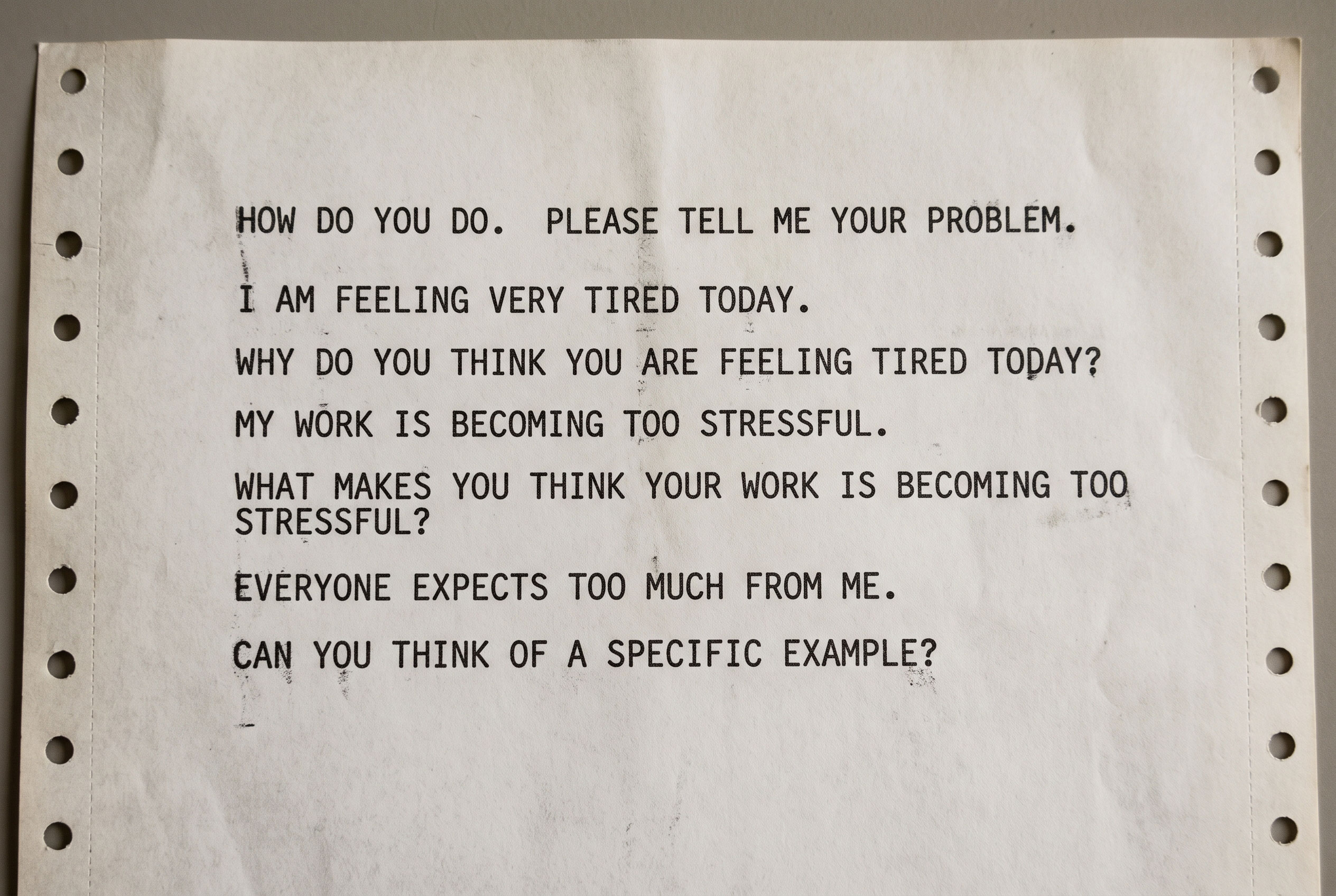
ELIZA was developed by Joseph Weizenbaum at
the Massachusetts Institute of Technology and described in a 1966 article in Communications
of the ACM. Its best-known script, DOCTOR, imitated a psychotherapist by
rephrasing user statements as questions. Weizenbaum reported that some users
attributed understanding to the program, which he found troubling. The behavior
later became known as the “ELIZA effect.”
Scripted and pattern-based systems
PARRY, created by psychiatrist Kenneth Colby
in the early 1970s, simulated a person with paranoid schizophrenia. In 1995,
Richard Wallace created A.L.I.C.E., which used AIML
(Artificial Intelligence Markup Language), an XML-based format for
pattern-response rules. The Loebner Prize, a competition based on the
Turing test, began in 1991 and drew many such systems.
Messaging and voice assistants
Chatbots reached large audiences through instant messaging
in the early 2000s, for example SmarterChild, which operated on AOL
Instant Messenger and MSN Messenger. Voice-based assistants followed: Siri
(introduced with the iPhone 4S in 2011), Google Now (2012), Alexa
(2014), and Google Assistant (2016). In 2016, several companies opened their
messaging platforms to third-party bots. That year, Microsoft’s Tay, a
chatbot on Twitter, was taken offline within roughly a day after users
manipulated it into producing offensive content.
Neural and generative models
The Transformer architecture, introduced in the 2017
paper “Attention Is All You Need,” became the basis for most modern language
models. Chatbots built on large language models can produce fluent, open-ended
text and handle a wide range of topics. ChatGPT’s public launch in late 2022
was followed by competing products from other companies, and the technology has
since been integrated into search engines, productivity software, and
customer-support tools.
|
Year |
Event |
|
1950 |
Turing proposes the imitation game |
|
1966 |
ELIZA described by Weizenbaum |
|
1995 |
A.L.I.C.E. created by Richard Wallace |
|
2011 |
Siri released |
|
2014 |
Alexa released |
|
2016 |
Tay withdrawn after misuse |
|
2017 |
Transformer architecture published |
|
2022 |
ChatGPT released (30 November) |
How chatbots work
Chatbots generally follow a pipeline: receive input,
interpret it, decide on a response, and deliver it. The methods for
interpretation and response selection define the main types.
Rule-based chatbots
These follow predefined scripts, decision trees, or
pattern-matching rules. They are predictable and easy to audit, but they fail
when a user’s wording falls outside the rules. Many simple support bots with
menu buttons work this way.
Retrieval-based and intent-based chatbots
These use natural language understanding to classify
a message into an intent (such as “reset password”) and extract details
called entities (such as a date or product name). The system then
returns a prepared answer or triggers an action. The set of answers is limited
to what developers have written.
Generative chatbots
These produce responses word by word using a trained
language model. A model learns statistical patterns from large text collections
and is often refined with human feedback. Generative chatbots handle varied
questions, but their outputs are not guaranteed to be accurate.
Hybrid systems
Many deployed systems combine approaches. A common design
uses a generative model to draft replies while retrieving documents from a verified
knowledge base, a technique called retrieval-augmented generation.
|
Type |
Response source |
Strengths |
Limitations |
|
Rule-based |
Fixed scripts |
Predictable, low cost |
Rigid, narrow scope |
|
Intent-based |
Prepared answers |
Reliable within domain |
Needs ongoing curation |
|
Generative |
Model-produced text |
Flexible, broad coverage |
Possible errors and inconsistency |
|
Hybrid |
Model plus retrieved sources |
Balances accuracy and flexibility |
More complex to build |
Applications
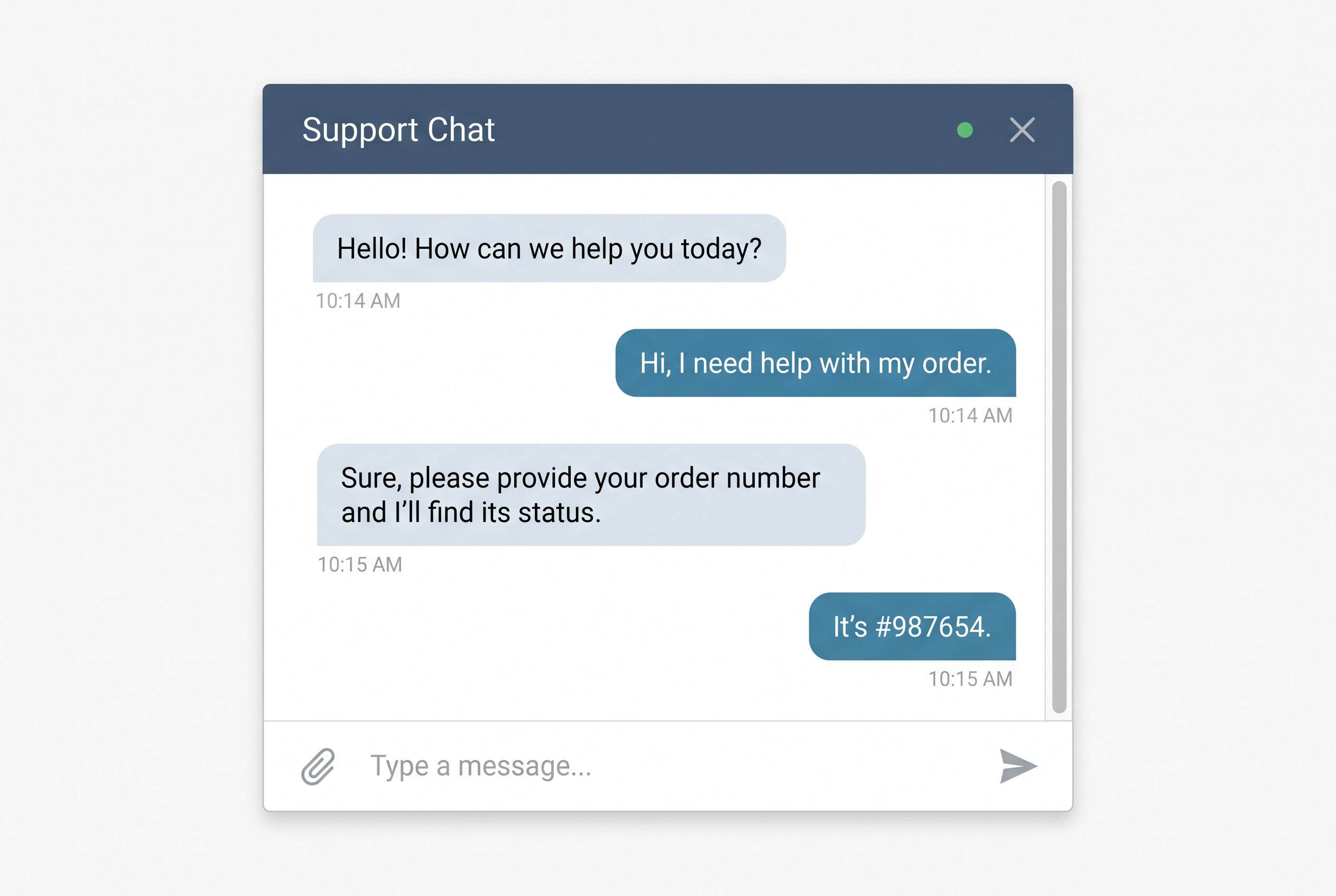
- Customer
service: answering common questions, tracking orders, and routing
complex cases to human staff.
- Healthcare
administration: appointment scheduling and symptom-information tools,
which typically state that they do not replace professional advice.
- Education:
tutoring, language practice, and question answering.
- Business
operations: internal help desks, human-resources queries, and software
coding assistance.
- Companionship
and entertainment: social chatbots designed for open-ended
conversation.
Reported effectiveness varies by deployment and domain, and
published figures on cost savings or customer satisfaction often come from
vendors, so they should be read with that context in mind.
Limitations and concerns
- Inaccurate
output: generative systems can state false information confidently, a
behavior often called hallucination.
- Bias:
models can reflect biases present in their training data.
- Privacy:
conversations may be stored or used for improvement, depending on the
provider’s policies, and data-protection rules such as the EU’s General
Data Protection Regulation can apply.
- Misuse:
chatbots can be used to generate spam, disinformation, or phishing text.
- Emotional
reliance: researchers and clinicians have debated the effects of
companion chatbots on wellbeing, and evidence remains limited and mixed.
- Employment:
observers disagree on how far chatbots will replace or change jobs.
Comparison with related systems
|
Term |
Typical meaning |
Relationship to chatbots |
|
Virtual assistant |
Software performing tasks (alarms, calls, smart-home
control) via voice or text |
Often includes a chatbot interface |
|
Voice assistant |
Assistant operated mainly by speech |
A voice-based subset |
|
AI agent |
System that takes actions toward goals, sometimes autonomously |
May use a chatbot as its interface |
|
Search engine |
Returns ranked links |
Increasingly combined with chatbots |
Common misconceptions
Chatbots do not necessarily use artificial intelligence;
many rely only on fixed rules. Passing for human in a short conversation does
not establish understanding or consciousness. A claim in 2014 that a chatbot
named “Eugene Goostman” passed the Turing test was widely disputed because of
the test conditions.
Current status
Chatbots are now common in consumer and enterprise software,
and regulation, accuracy standards, and disclosure requirements are active
areas of development. Readers should verify current capabilities and policies,
which change quickly.