
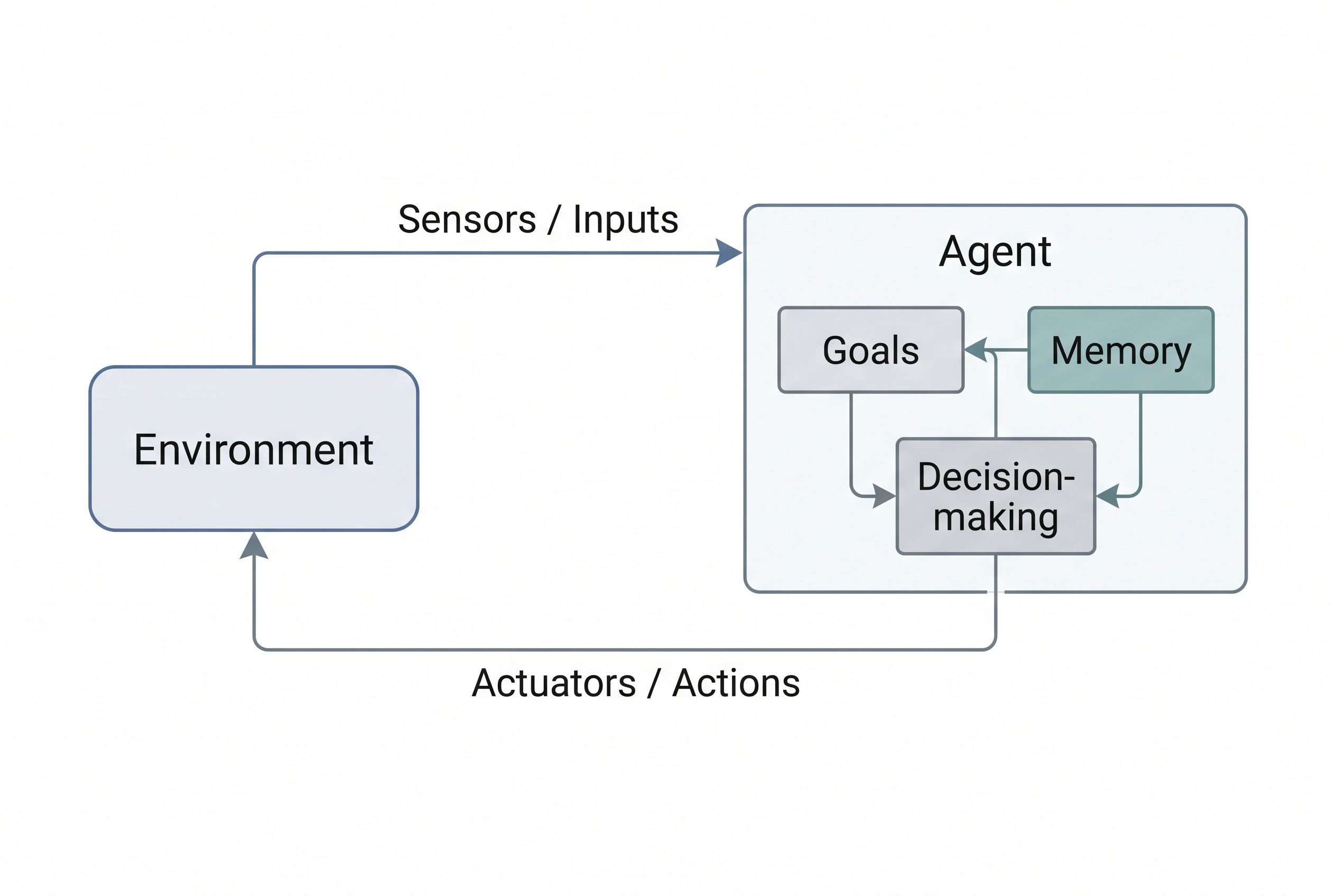
An AI agent is a software system that perceives its
environment, makes decisions, and takes actions to pursue goals with some
degree of autonomy. In the broad sense used in artificial intelligence research
since the mid-20th century, the term covers everything from a rule-based
thermostat controller to a learning robot. Since about 2023, it has also
commonly referred to systems built on large language models (LLMs) that
plan multi-step tasks, use external tools, and act on software or the web with
limited human input. Definitions differ among researchers, companies, and
standards bodies, and the boundary between an AI agent, a chatbot, and an
automation script remains contested.
Quick answer: An AI agent is a computer system that
observes its surroundings, decides what to do, and acts to achieve a goal,
usually with limited human supervision. Agents range from simple rule-based
programs to learning systems and, more recently, language-model-based
assistants that use tools to complete multi-step tasks.
|
Field |
Details |
|
Field |
Artificial intelligence |
|
Also known as |
Intelligent agent, autonomous agent, software agent |
|
Standard textbook formulation |
An entity that perceives through sensors and acts through
actuators (Russell and Norvig) |
|
Core cycle |
Perceive, decide, act, repeat |
|
Classical types |
Simple reflex, model-based, goal-based, utility-based,
learning |
|
Related concept |
Multi-agent system |
|
Recent usage |
LLM-based and “agentic” AI systems (from about 2023) |
Definition and core concepts
The classical agent model
The most widely cited textbook definition, from Stuart
Russell and Peter Norvig’s Artificial Intelligence: A Modern Approach,
describes an agent as anything that perceives its environment through sensors
and acts on it through actuators. A software agent’s sensors may be data
inputs such as messages or files, and its actuators may be outputs such as
commands or database changes. A rational agent, in this framework, selects the
action expected to maximize its performance measure given what it has observed.
Commonly cited properties
In a 1995 survey, Michael Wooldridge and Nicholas Jennings
described agents using four properties:
- Autonomy:
operating without direct, continuous human control
- Reactivity:
responding to changes in the environment
- Pro-activeness:
taking initiative toward goals rather than only responding
- Social
ability: interacting with other agents or humans
Not every system called an agent meets all four, and the
degree of autonomy is a continuum rather than a binary property.
History
Ideas about autonomous goal-directed machines appeared in
early cybernetics and AI work of the 1940s and 1950s. The agent concept became a
central organizing framework for AI in the 1990s, when textbooks began
presenting the field as the study of agents rather than of isolated techniques.
Research on multi-agent systems and agent architectures such as
belief–desire–intention (BDI), which draws on philosopher Michael Bratman’s
theory of intention, grew during the same period.
|
Period |
Development |
|
1980s–1990s |
Multi-agent systems and BDI architectures emerge as
research areas |
|
1995 |
Wooldridge and Jennings publish a widely cited survey on
intelligent agents; the first edition of Russell and Norvig’s textbook
appears |
|
2013–2016 |
Deep reinforcement learning agents gain attention,
including DeepMind’s Atari-playing system and AlphaGo |
|
2022 |
The ReAct method, which interleaves reasoning steps with
tool actions in language models, is published |
|
2023 |
Open-source projects such as AutoGPT popularize LLM-driven
autonomous task loops; major providers add function-calling features |
|
2024 |
Anthropic introduces the Model Context Protocol (MCP), an
open standard for connecting models to tools and data, and demonstrates
computer-use capabilities |
Types of agents
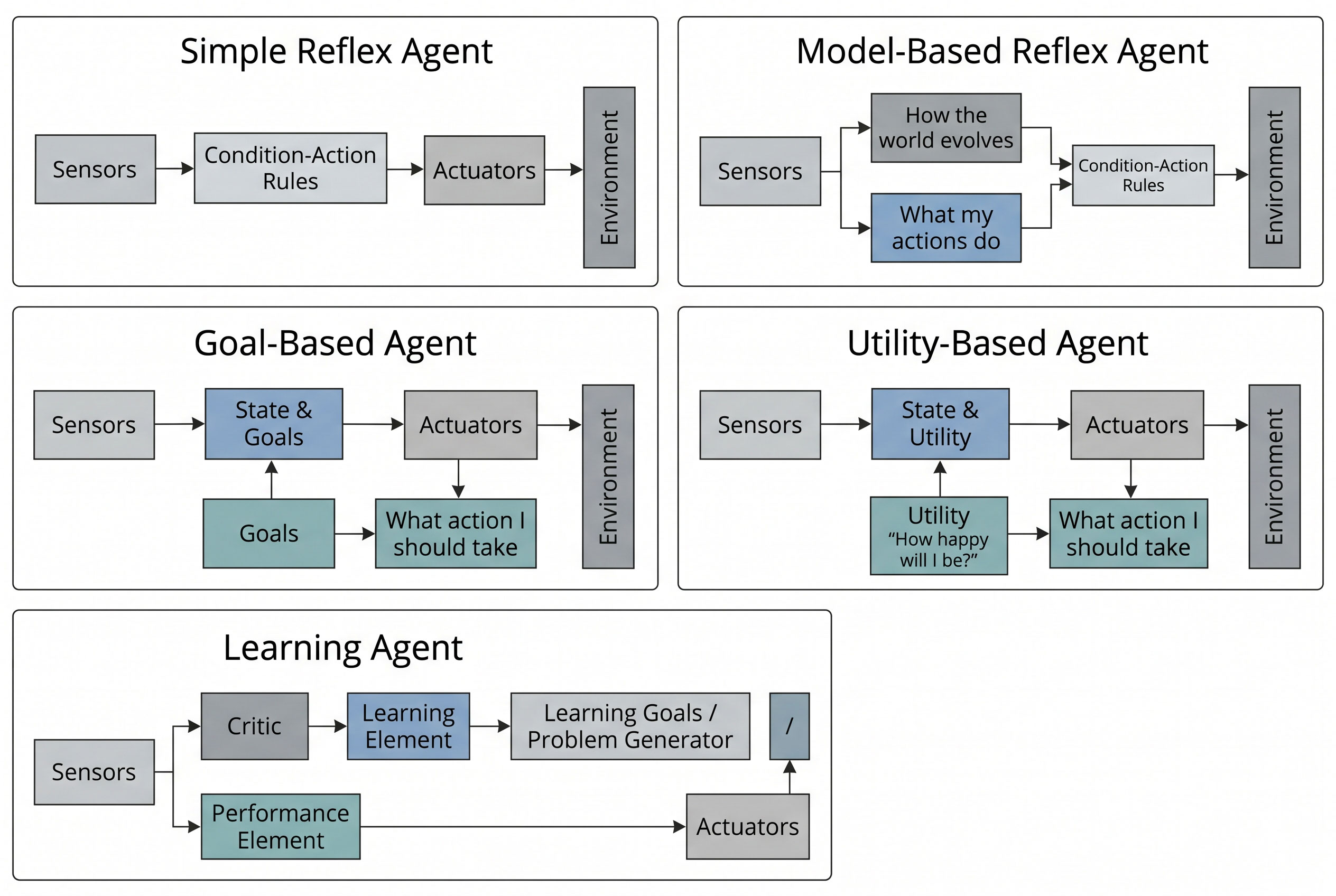
Russell and Norvig classify agents by internal design, from
least to most capable:
- Simple
reflex agents act on current input using condition–action rules. A
basic thermostat is a common example.
- Model-based
reflex agents maintain an internal representation of the world to
handle partially observable situations.
- Goal-based
agents choose actions by considering whether they lead toward a
defined goal.
- Utility-based
agents weigh multiple possible outcomes using a measure of preference,
which helps when goals conflict.
- Learning
agents improve their behavior over time based on feedback.
Reinforcement learning agents, which learn through trial,
error, and reward signals, are a prominent form of learning agent.
LLM-based agents
Typical components
Systems described as LLM agents generally combine a language
model with additional elements. Descriptions vary by vendor, but commonly
include:
- A
reasoning model that interprets instructions and decides the next step
- Tools
such as web search, code execution, databases, or application interfaces
- Memory,
meaning short-term context and sometimes stored information persisted
across sessions
- A
control loop in which the model plans, acts, observes the result, and
revises
Protocols and interfaces
Connecting models to tools has led to standardization
efforts. MCP, released by Anthropic in November 2024, is one example, and other
organizations have proposed their own conventions for agent-to-tool and
agent-to-agent communication. No single standard is universally adopted, and
the landscape continues to change.
Comparison with related concepts
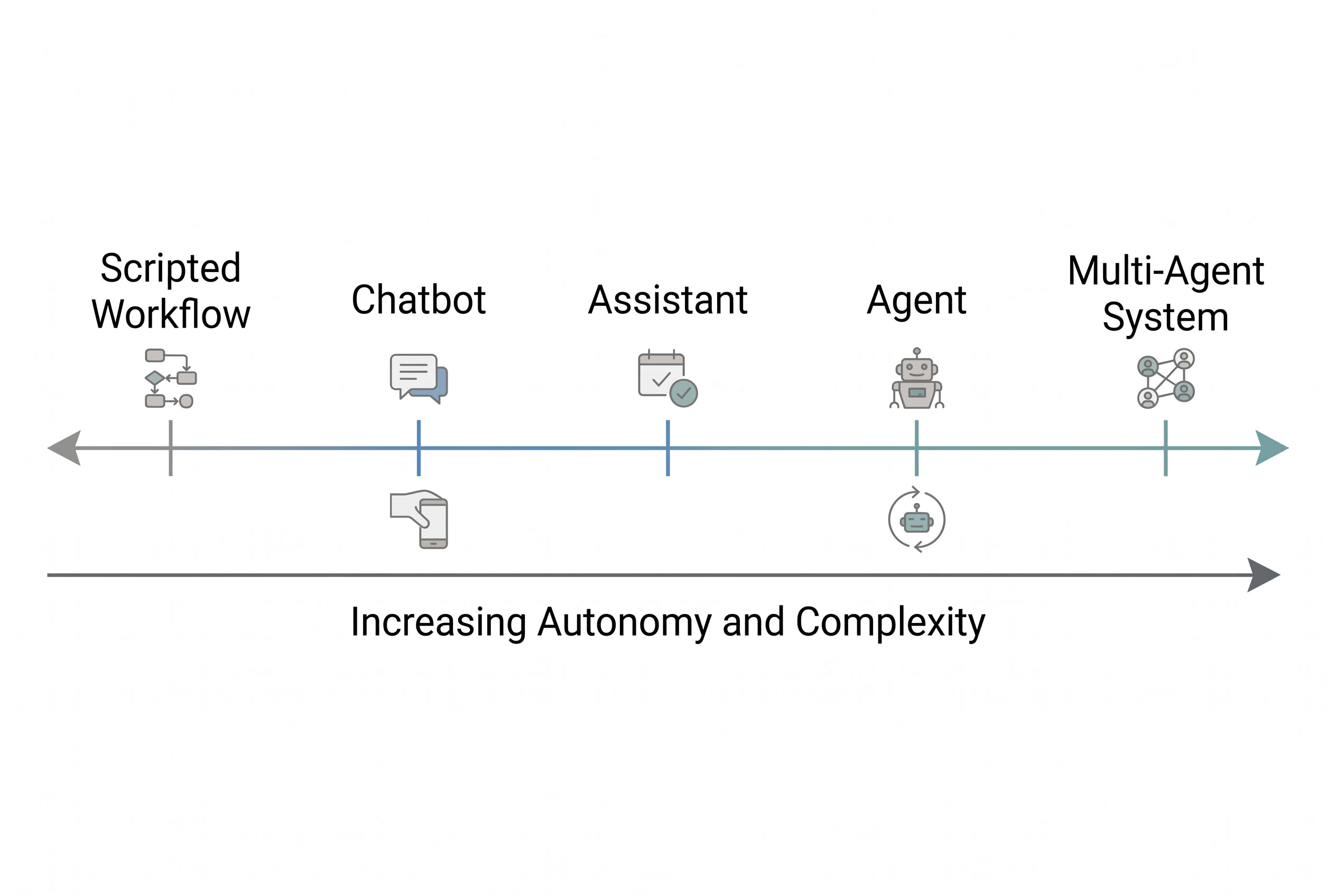
The term “AI agent” is often used interchangeably with
neighboring terms. The table below summarizes typical distinctions, though
usage varies.
|
Concept |
Typical characteristic |
Autonomy level |
|
Chatbot |
Responds to messages in a conversation; may not take
actions outside the chat |
Low |
|
Workflow automation |
Follows a fixed, predefined sequence of steps |
Low to moderate |
|
AI assistant |
Responds to requests and may use tools when asked |
Moderate |
|
AI agent |
Pursues a goal by choosing its own steps and tools |
Moderate to high |
|
Multi-agent system |
Several agents coordinating or competing |
Varies |
The word agentic is used informally for systems with
agent-like behavior. Some sources treat it as a spectrum, while others reserve
it for systems that plan and act across many steps without per-step approval.
Applications
Documented or commonly reported uses include:
- Software
development: agents that read codebases, run tests, and propose or
apply changes
- Customer
service: systems that look up account information and complete routine
requests
- Research
and information gathering: agents that search sources and compile
findings
- Robotics
and control systems: physical agents operating in factories,
warehouses, or vehicles
- Games
and simulation: reinforcement learning agents trained in virtual
environments
Reported performance varies widely between tasks, and
published benchmark results do not always reflect real-world reliability.
Limitations, risks, and criticism
Researchers and practitioners cite several recurring
concerns:
- Reliability:
LLM agents can make errors that compound across multi-step tasks, and they
sometimes produce incorrect or fabricated information.
- Security:
Agents that read untrusted content may be vulnerable to prompt
injection, where embedded instructions redirect their behavior.
- Accountability:
Questions remain about who is responsible when an agent takes a harmful or
mistaken action.
- Oversight:
Greater autonomy reduces the opportunity for human review, which has led
to proposals for approval checkpoints and permission limits.
- Definitional
disagreement: Critics note that “agent” is sometimes applied as a
marketing label to products that are essentially scripted workflows or
chatbots, a practice sometimes called “agent washing.”
Supporters respond that tool use and planning represent a
meaningful capability beyond text generation. The balance between these views
is still debated.
Common misconceptions
- Misconception:
AI agents are a new invention. The concept dates back decades in AI
research; what changed recently is the use of language models as the
decision-making component.
- Misconception:
Agents are fully autonomous. Most deployed systems operate within defined
permissions and often involve human approval for significant actions.
- Misconception:
Any chatbot is an agent. A system that only produces conversational
replies without pursuing goals through actions generally does not meet
agent definitions.
Current status
As of late 2026, the term remains in active use across
research, industry, and regulatory discussions, and its meaning continues to
shift as capabilities and products change. Readers seeking current details on
specific products, standards, or regulations should consult primary sources,
since this area develops quickly.