
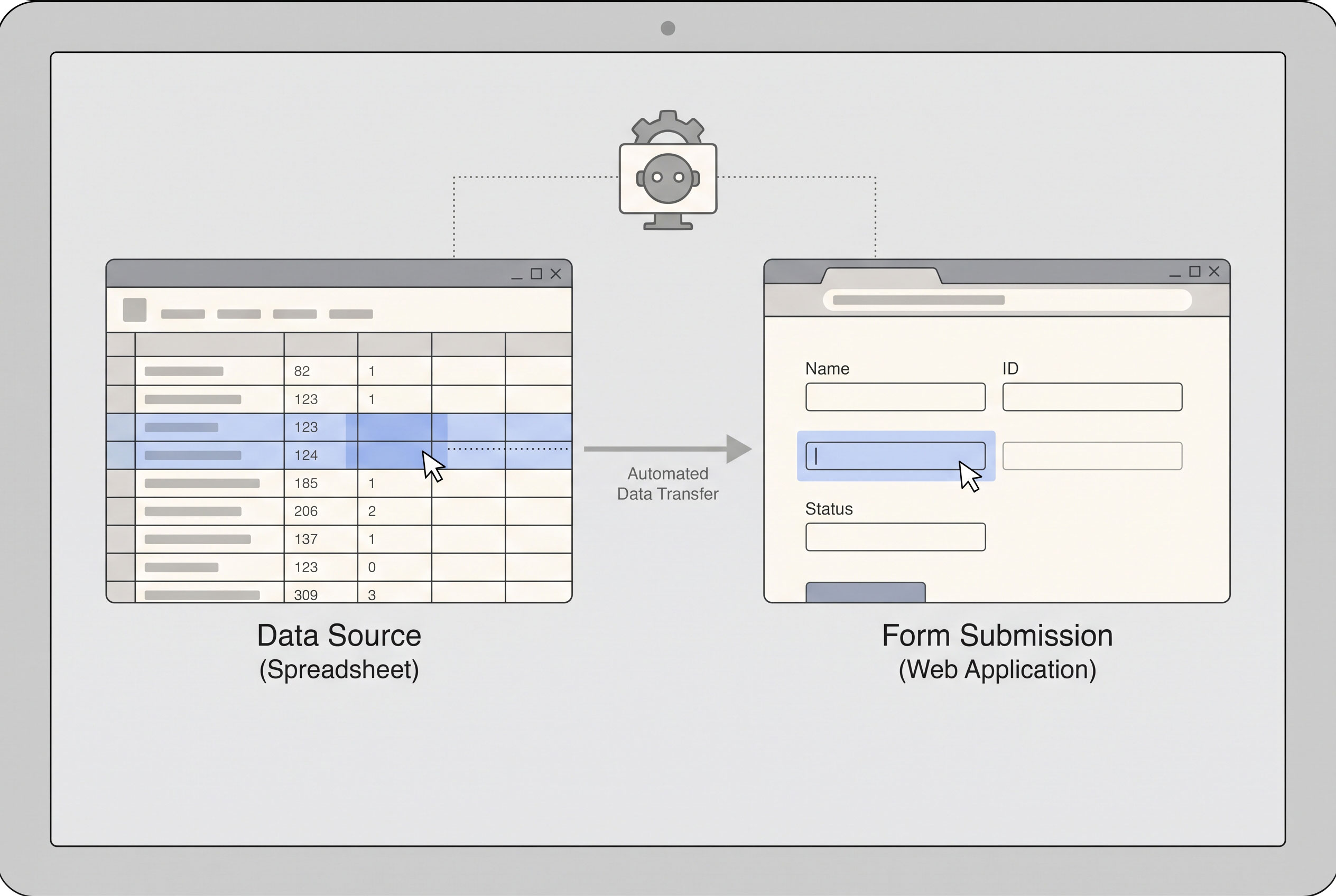
Robotic process automation (RPA) is a category
of software technology that uses configurable "software robots"
(bots) to carry out repetitive, rule-based digital tasks by imitating how a
person interacts with computer applications. Bots can log in to systems, copy
and paste data, fill in forms, move files, and trigger actions in other
programs. The term refers to software, not physical machines. RPA is used
mainly in finance, insurance, healthcare, telecommunications, and public
administration to reduce manual data handling.
|
Infobox |
|
|
Type |
Software automation technology |
|
Also known as |
RPA, software robotics |
|
Term popularized |
Early 2000s |
|
Typical tasks |
Data entry, data transfer, report generation, form
processing |
|
Common variants |
Attended, unattended, hybrid |
|
Related fields |
Business process management, workflow automation,
artificial intelligence |
|
Notable vendors |
UiPath, Automation Anywhere, Blue Prism, Microsoft (Power
Automate) |
|
Relevant standard |
IEEE 2755 series (intelligent process automation
terminology) |
Note: RPA is distinct from robotics in the
mechanical sense. No physical hardware is involved, and the "robot"
is a program that runs on a computer or server.
Overview
RPA works at the presentation layer of an application,
meaning the screens and controls that a human user sees. Instead of requiring
changes to the underlying system, a bot reads and manipulates the interface
much as an employee would. This is the main reason organizations adopt it for
older systems that lack modern interfaces for integration.
Bots follow predefined rules, so RPA suits processes that
are structured, high in volume, and stable. Inputs must be predictable, such as
standardized forms or consistently formatted spreadsheets. Tasks that require
judgment, interpretation of ambiguous content, or frequent changes in procedure
are generally harder to automate with RPA alone.
History
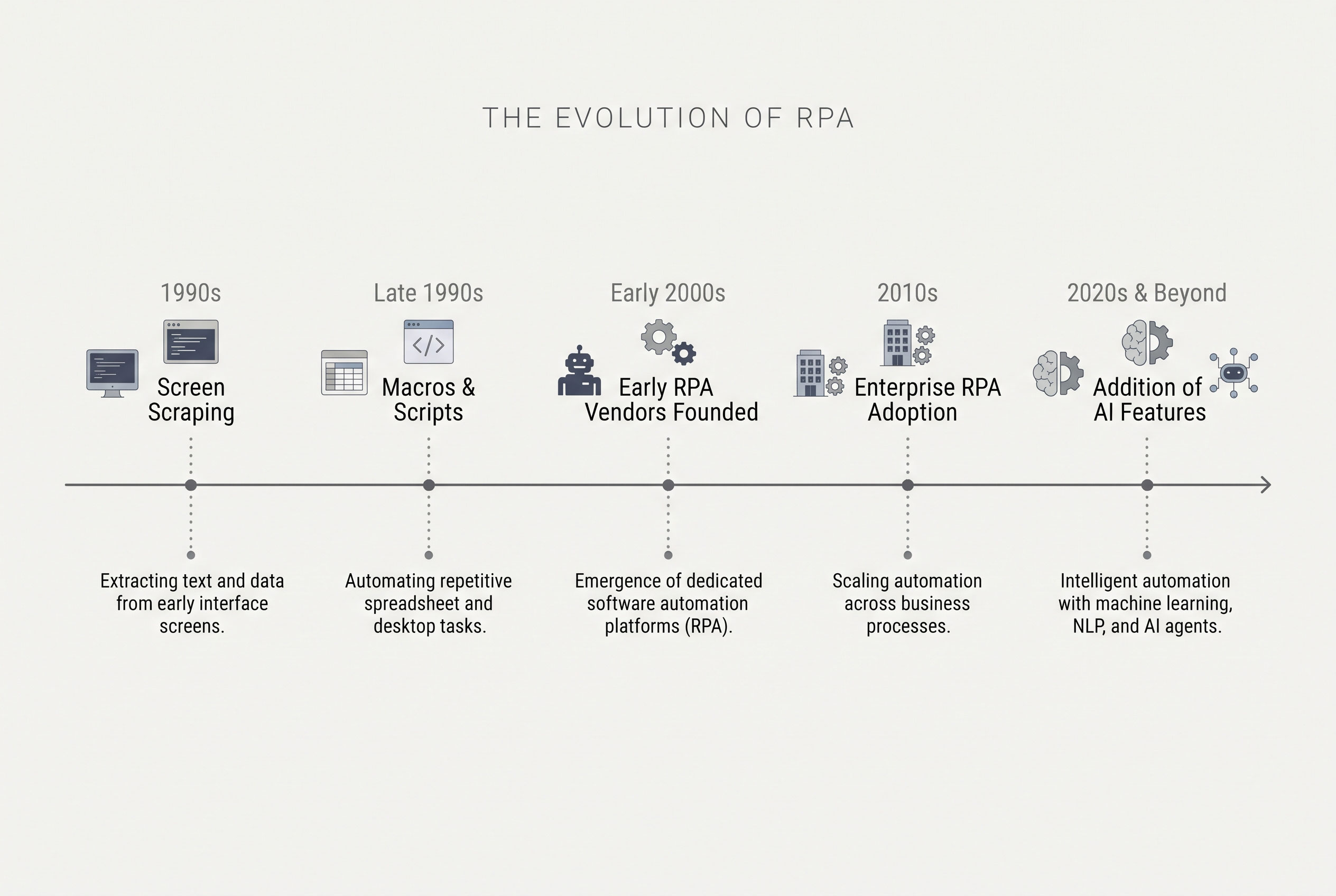
RPA developed from several earlier technologies rather than
appearing as a single invention.
Precursors
Three antecedents are commonly identified:
- Screen
scraping, which extracted data from the text displays of legacy
terminals.
- Macros
and scripting tools, which recorded and replayed user actions inside
applications.
- Workflow
automation, which routed documents and tasks between people and
systems.
Testing tools that simulated user input in graphical
interfaces also contributed techniques, particularly element recognition and
playback of recorded actions.
Commercial emergence
The phrase "robotic process automation" is
commonly attributed to the UK company Blue Prism, founded in 2001,
though accounts of who first used it vary. Other early vendors include Automation
Anywhere, founded in 2003 in the United States, and UiPath, which
originated in Romania in 2005 and adopted its current name in 2015. UiPath
listed on the New York Stock Exchange in April 2021. SS&C Technologies
acquired Blue Prism in 2022.
Industry analysts began tracking RPA as a distinct software
market in the mid-2010s, and adoption grew rapidly in the second half of that
decade. Market-size figures differ considerably between research firms, and
sources disagree on exact values.
Convergence with artificial intelligence
From the late 2010s, vendors added machine learning, optical
character recognition, and natural language processing to bots. The resulting
combinations are marketed under terms such as intelligent process automation
and hyperautomation. Definitions of these terms vary between vendors and
analysts, and the IEEE 2755 series of documents was developed in part to
standardize terminology.
How It Works
Core components
Most RPA platforms contain three main parts:
- Designer
or studio: a development environment where workflows are built, often
with a visual drag-and-drop editor or a recorder that captures user
actions.
- Bot
runtime: the agent that executes the workflow on a desktop or virtual
machine.
- Orchestrator
or control room: a management server that schedules jobs, assigns
bots, stores credentials, and logs activity.
Interaction methods
Bots locate interface elements using selectors, which
are attributes identifying a button, field, or window. When selectors are
unavailable, bots may rely on image recognition or screen coordinates, which
are generally less stable. Many platforms also call application programming
interfaces (APIs) and read documents through optical character recognition. In
practice, mature deployments often combine interface automation with API calls.
Types
|
Type |
Operation |
Typical use |
|
Attended |
Runs on a user's workstation and is triggered by that user |
Assisting call-center staff with data lookup |
|
Unattended |
Runs on servers without human involvement, often on a
schedule |
Overnight batch processing of invoices |
|
Hybrid |
Combines both, passing work between a person and a bot |
Processes with automated steps and human approvals |
Common Applications
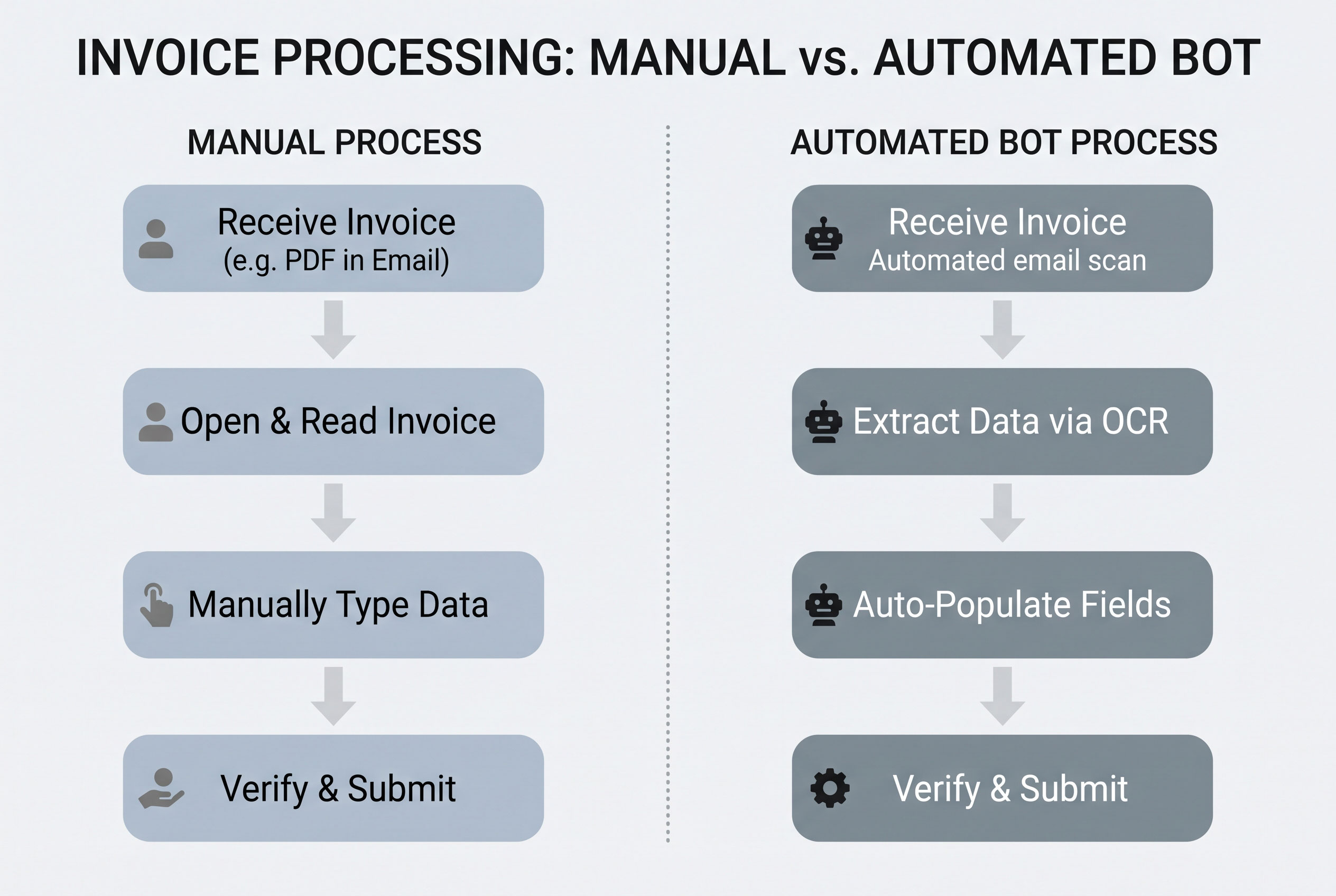
Frequently cited uses include:
- Accounts
payable and receivable processing
- Customer
onboarding and identity data entry
- Insurance
claims intake
- Payroll
and human resources record updates
- Reconciliation
of records between systems
- Generating
routine regulatory or management reports
Applications cluster in functions with large volumes of
structured, repetitive work. Reported savings in time and error rates come
largely from vendor and consultancy case studies, which may not be
representative of all deployments.
Comparison with Related Technologies
|
Technology |
Relationship to RPA |
|
Business process management (BPM) |
Redesigns and manages entire processes; RPA automates
individual tasks within them |
|
API integration |
Connects systems directly at the data layer; generally
more robust than interface automation but requires system support |
|
Macros |
Record actions inside a single application; RPA typically
spans multiple applications and offers centralized management |
|
Machine learning and AI |
Handle unstructured or variable inputs; RPA follows fixed
rules unless combined with these methods |
A common misconception is that RPA itself is a form of
artificial intelligence. Conventional RPA does not learn or adapt, and it
executes explicit instructions. AI components are additions layered onto bots
rather than part of the basic technique.
Criticism and Limitations
Commentators and practitioners have raised several concerns:
- Fragility:
Bots that depend on interface layout can fail when an application is
updated, leading to ongoing maintenance costs.
- Scalability:
Some organizations report difficulty moving from pilot projects to large
deployments, though reported rates vary by source.
- Workaround
status: Critics argue that automating the interface of a legacy system
postpones needed modernization. Proponents counter that it provides a
practical, lower-cost interim step.
- Security
and governance: Bots hold credentials and access sensitive data, so
identity management, audit logging, and access control require deliberate
design.
- Workforce
effects: Debate continues over whether RPA mainly shifts employees toward
other tasks or displaces jobs. Empirical evidence is mixed and depends on
the organization and sector.
Current Status
RPA continues to be offered both as standalone products and
as features within broader automation and productivity suites. Market emphasis
has shifted toward combining bots with AI services and API-based integration.
Vendor names, ownership, and market positions have changed repeatedly since
2015 and may differ from the descriptions above.