

UX design, short for user experience design,
is the practice of shaping how people interact with a product, service, or
system so that it is useful, usable, and satisfying. It draws on research,
information architecture, interaction design, content planning, and usability
testing. It is applied to websites, mobile apps, software, physical products,
and services.
The term "user experience" was popularized in the
1990s by cognitive scientist Don Norman. UX design now spans many
industries and is practiced by dedicated specialists and by multidisciplinary
product teams. Its main concern is the whole of a person's interaction with a
product, not only its visual appearance.
|
Field |
Detail |
|
Type |
Design discipline |
|
Also known as |
User experience design, UX |
|
Emerged |
Late 20th century (term popularized in the 1990s) |
|
Related fields |
Human–computer interaction, interaction design, usability
engineering, service design |
|
Common roles |
UX designer, UX researcher, information architect,
interaction designer |
|
Common outputs |
Personas, user flows, wireframes, prototypes, usability
reports |
|
International standard |
ISO 9241-210 (human-centred design for interactive
systems) |
Definition and scope
The International Organization for Standardization (ISO)
defines user experience in ISO 9241-210 as a person's perceptions and responses
resulting from the use or anticipated use of a product, system, or service.
This definition covers emotions, preferences, and behaviors before, during, and
after use. UX design is the work of influencing those outcomes through
deliberate design decisions.
Scope varies by organization. Some treat UX design narrowly
as the design of screens and interactions in digital products. Others apply it
to the full journey a customer has with a company, including support,
packaging, and delivery. Usage of the term is not fully standardized, and job
descriptions labeled "UX designer" differ widely.
Note: UX design is often confused with UI design.
User interface (UI) design focuses on the visual and interactive elements of a
product, such as layout, typography, and controls. UX design is broader and
includes how the product is structured and how well it supports users' goals.
History
Precursors
UX design grew from several earlier fields. Ergonomics
and human factors research, which developed substantially during and after the
Second World War, studied how equipment could be designed around human
capabilities. In the 1980s, human–computer interaction (HCI) emerged as
an academic field studying how people use computers. Usability engineering
followed, with a focus on measurable ease of use.
Popularization of the term
Norman worked at Apple in the early 1990s. He has said that
he adopted the title "user experience architect" there to describe a
scope broader than the interface, and he is widely credited with popularizing
the term. The exact date of first use is commonly given as 1993, though
accounts vary. In 1994, researcher Jakob Nielsen published ten usability
heuristics, which remain widely taught. In 1998, Norman and Nielsen co-founded
the consultancy Nielsen Norman Group.
Web and mobile growth
The expansion of the World Wide Web in the late 1990s and
the spread of smartphones after 2007 greatly increased demand for UX
specialists. Organizations began hiring dedicated design and research staff,
and professional communities, conferences, and degree programs formed around
the field.
Core components
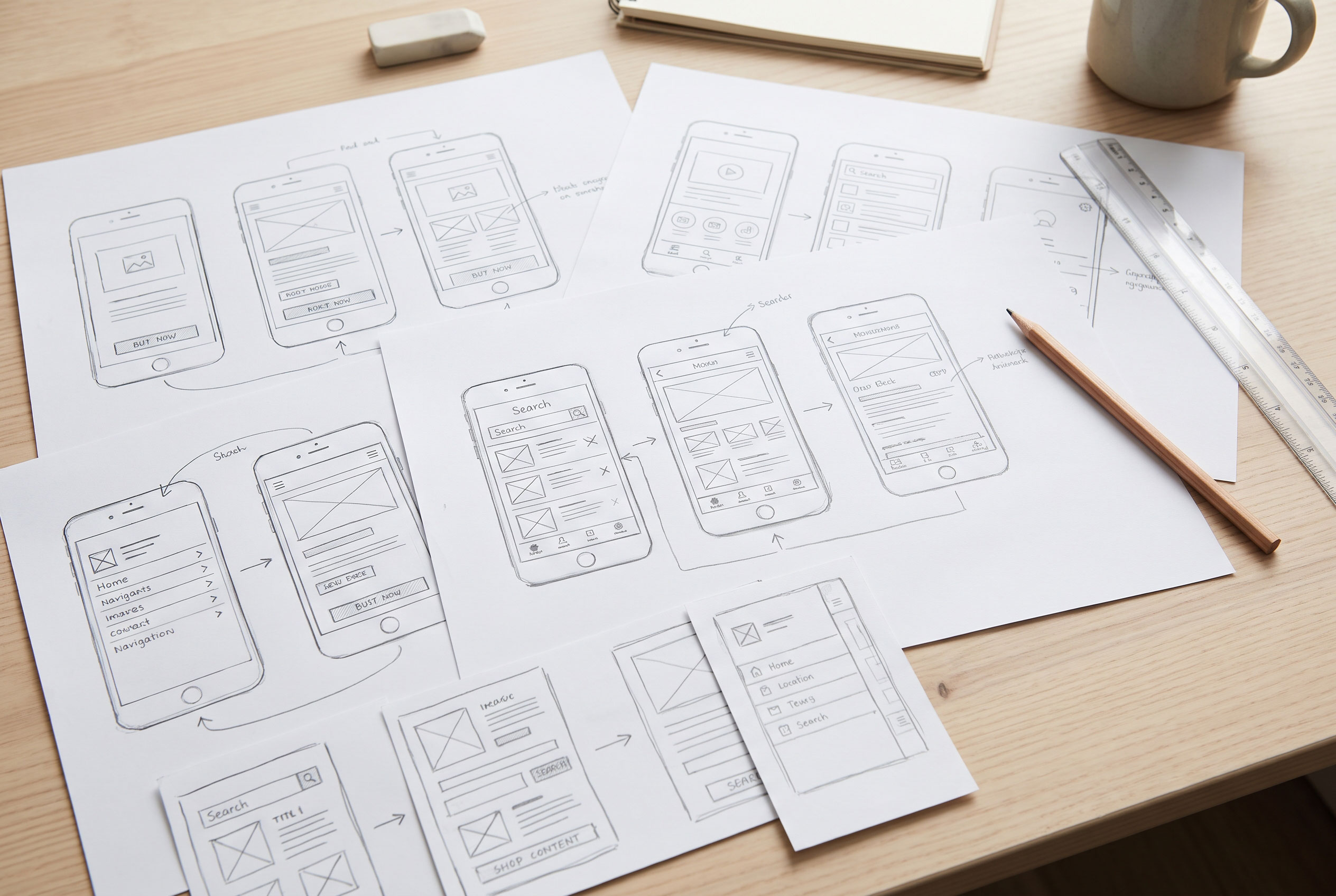
UX design is usually described as a combination of
overlapping activities:
- User
research: Interviews, surveys, field studies, and analytics used to
understand users' needs, context, and behavior.
- Information
architecture: The organization and labeling of content so that people
can find it.
- Interaction
design: The definition of how a product responds to user actions,
including navigation, feedback, and error handling.
- Content
strategy: Planning the wording, structure, and tone of text within a
product.
- Usability
testing: Observing representative users attempting tasks to find
problems.
- Accessibility:
Designing for people with disabilities. For the web, this is commonly
guided by the Web Content Accessibility Guidelines (WCAG) published
by the World Wide Web Consortium (W3C).
Process
No single process is universal, but many teams follow an
iterative cycle based on human-centered design principles. A common sequence
is:
- Research:
Gather information about users, goals, and constraints.
- Definition:
Summarize findings as problem statements, personas, or user journeys.
- Ideation:
Generate possible solutions through sketching and workshops.
- Prototyping:
Build low- or high-fidelity models, from paper sketches to interactive
simulations.
- Testing:
Evaluate prototypes with users and record findings.
- Implementation
and iteration: Hand designs to developers, then refine after release
using feedback and data.
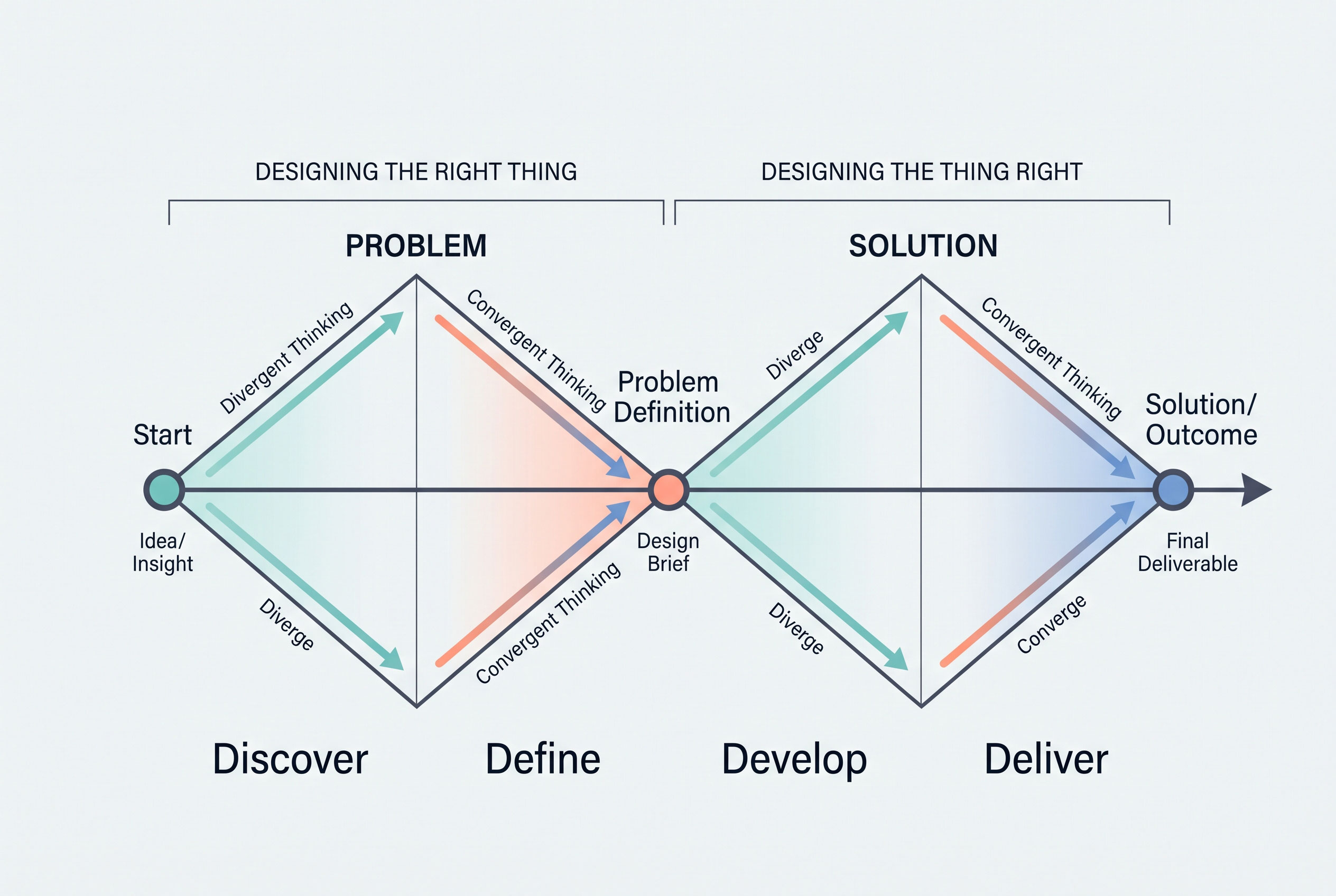
The Double Diamond model, published by the British
Design Council in 2005, describes a related pattern of alternating divergent
and convergent thinking across four phases: discover, define, develop, and
deliver. Agile and Lean UX approaches compress these stages into shorter cycles
that run alongside software development.
Principles and heuristics
Several frameworks guide evaluation. Nielsen's heuristics
include visibility of system status, consistency, error prevention, and
recognition rather than recall. Norman's concepts of affordances (cues
about how an object can be used) and feedback are also widely cited.
These are rules of thumb rather than laws, and practitioners sometimes weigh
them differently depending on context.
Related fields compared
|
Field |
Primary focus |
Typical question |
|
UX design |
Overall experience and usefulness |
Does this help users achieve their goals? |
|
UI design |
Visual and interactive elements |
How should this screen look and behave? |
|
Interaction design |
Behavior of controls and responses |
What happens when a user acts? |
|
Service design |
End-to-end service delivery |
How do people, processes, and touchpoints fit together? |
|
Product design |
Product strategy and features |
What should be built, and why? |
These boundaries overlap, and organizations assign the work
differently.
Measurement
Teams evaluate UX using both qualitative and quantitative
methods. Qualitative methods include observation and interviews. Quantitative
measures include task completion rate, time on task, error rate, and conversion
rate. Standardized questionnaires such as the System Usability Scale
(SUS), developed in the 1980s, and the Net Promoter Score are also used, though
the latter is a general customer-loyalty metric rather than a
usability-specific one.
Criticism and limitations
Critics note that the term "UX" is applied
inconsistently, which can make the profession difficult to define. Some
practitioners argue that small-sample usability tests cannot support broad
conclusions. Others raise concern about dark patterns, interface designs
that steer users toward choices that benefit the organization at the user's
expense. Regulators in several jurisdictions have begun to address such
practices. Within the profession, there is ongoing discussion of ethical
responsibilities, including privacy and inclusivity.
Current status
UX design is an established discipline with dedicated roles,
professional associations, and academic programs. Tools and expectations
continue to change, notably with the growing use of artificial intelligence in
research and design workflows. Readers should verify current standards, such as
the latest version of WCAG, against official sources.