
Conversion rate optimization (CRO) is the
systematic practice of increasing the proportion of visitors to a website, app,
or other digital interface who complete a defined goal, known as a conversion.
Conversions may include purchases, form submissions, account registrations,
newsletter sign-ups, or downloads. CRO combines quantitative analytics,
qualitative user research, and controlled experiments to identify obstacles and
test changes.
CRO is used primarily in e-commerce, software-as-a-service,
publishing, and lead-generation businesses. It is related to, but distinct
from, traffic acquisition: rather than attracting more visitors, it seeks to
improve the outcome from existing visitors. The discipline draws on web
analytics, behavioral psychology, user experience (UX) design, and statistics.
|
Conversion Rate Optimization |
|
|
Field |
Digital marketing, web analytics, user experience |
|
Goal |
Increase the share of visitors completing a target action |
|
Core methods |
A/B testing, multivariate testing, user research, funnel
analysis |
|
Key metric |
Conversion rate |
|
Common applications |
E-commerce, SaaS, lead generation, media subscriptions |
|
Related fields |
Search engine optimization, UX design, product analytics |
Note: CRO is sometimes used interchangeably with
"website optimization" or "A/B testing," but A/B testing is
one method used within CRO rather than a synonym for it.
Quick Definition
Conversion rate optimization is the process of improving the
percentage of users who take a desired action on a digital property. It relies
on measuring current behavior, forming hypotheses about barriers, and running
controlled tests to determine whether specific changes produce a measurable
improvement.
Background and Origins
The underlying logic of CRO has roots in direct-response
marketing, where advertisers in the early twentieth century tracked
responses to mailed offers and compared variants of copy and layout. Claude
Hopkins's 1923 book Scientific Advertising is frequently cited as an
early statement of measuring advertising by its results, although it did not
use the term CRO.
The practice took its modern form with the growth of commercial
websites in the late 1990s and early 2000s. Web analytics tools made visitor
behavior measurable, and online experimentation became practical at scale.
Large technology companies, including Google, Amazon, and Microsoft, have
publicly described running controlled experiments on their sites. The phrase
"conversion rate optimization" became common in industry usage during
the 2000s, and dedicated testing software and agencies emerged in the same
period.
How Conversion Rate Is Calculated
The conversion rate is the number of conversions
divided by the number of visitors (or sessions), expressed as a percentage.
For example, if a page receives 5,000 visitors and 150 of
them complete a purchase, the conversion rate is 3%. The denominator
varies by organization; some use unique visitors, others use sessions, and the
choice affects comparability.
Typical figures differ widely by industry, device type,
traffic source, and price of the product. Published benchmark figures vary
between sources and methodologies, so they are best treated as rough context
rather than targets.
Macro and Micro Conversions
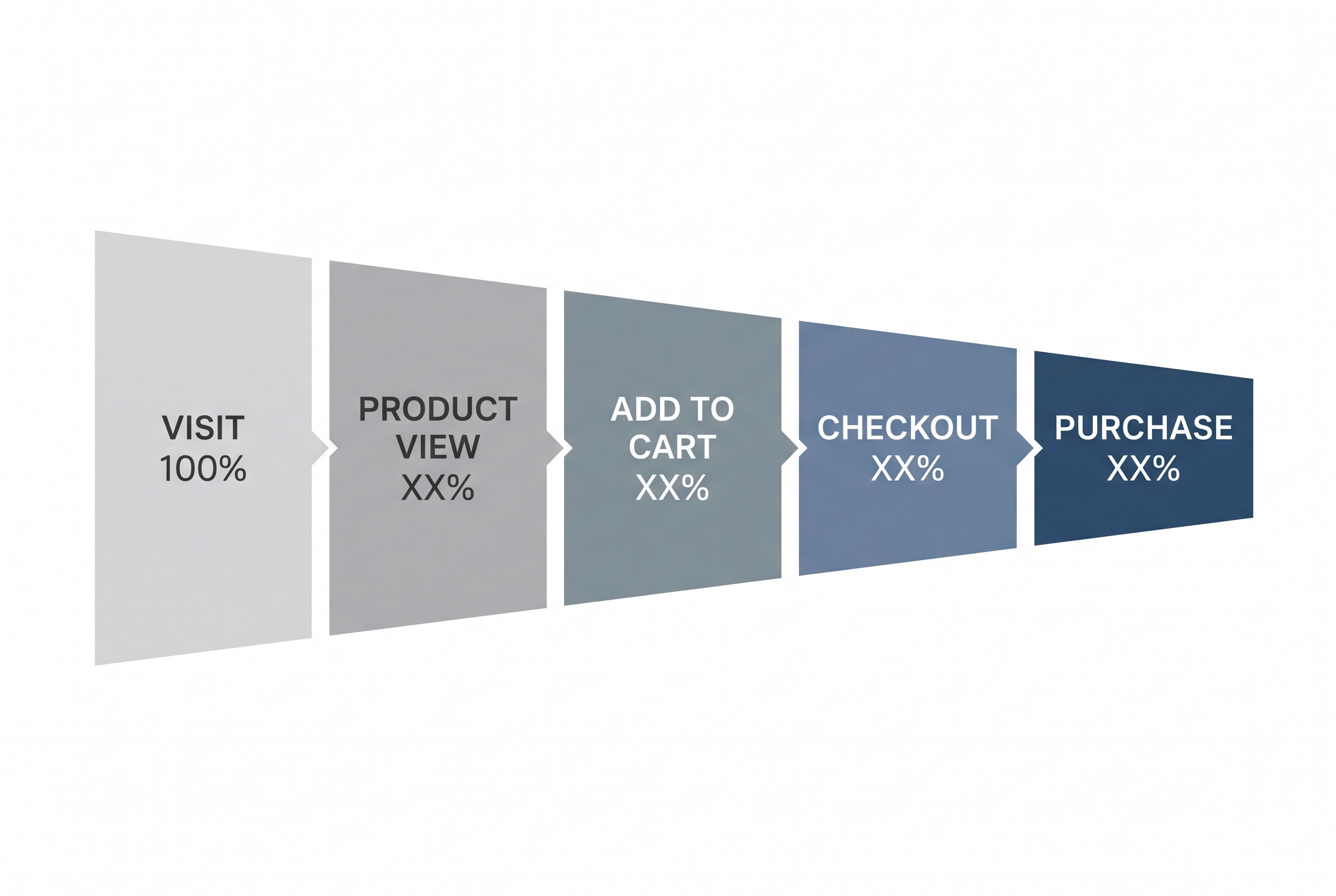
Analysts often distinguish two categories of conversion:
- Macro
conversions: primary business goals, such as completing a purchase or
submitting a sales inquiry.
- Micro
conversions: smaller steps that indicate progress toward a macro
conversion, such as adding an item to a cart, watching a product video, or
creating an account.
Tracking both allows analysts to locate the stage at which
visitors leave a process.
Core Methods
Research and Analysis
CRO programs typically begin with diagnosis. Quantitative
research uses analytics data to identify pages or steps with unusually high
drop-off. Qualitative research examines why users behave as they do,
using methods such as:
- Session
recordings and heatmaps
- On-site
surveys and exit-intent surveys
- Usability
testing with participants
- Customer
interviews and support-ticket review
Hypothesis Formation
Findings are converted into a hypothesis, a testable
statement linking a proposed change to an expected outcome. A common structure
states the observed problem, the intended change, and the metric expected to
move. Hypotheses are often prioritized using scoring frameworks that weigh
potential impact, confidence, and implementation effort; examples include the
ICE and PIE models.
Experimentation
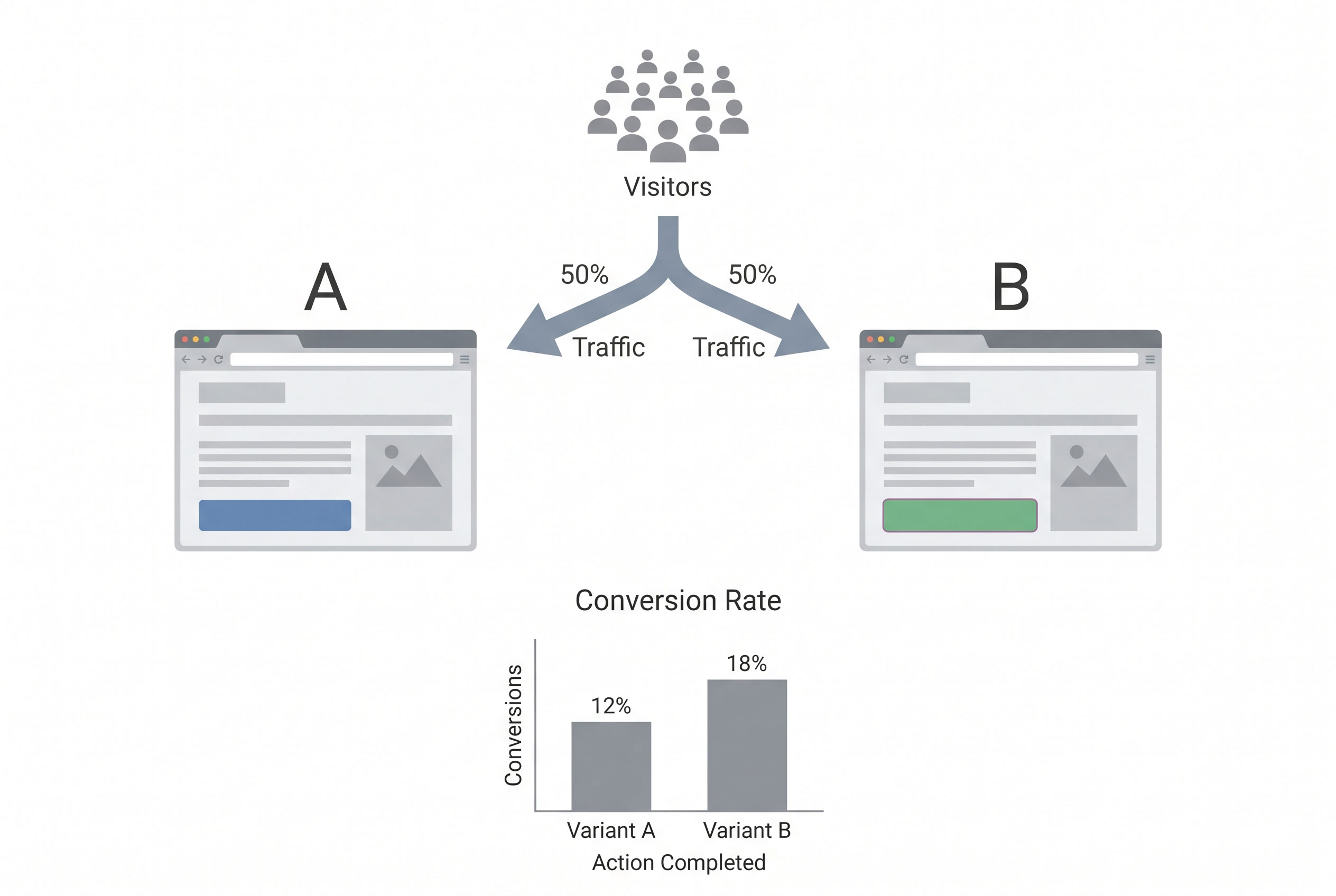
Controlled experiments are the primary means of verifying
whether a change causes an improvement. The main formats are compared below.
|
Method |
Description |
Typical use |
|
A/B test |
Visitors are randomly split between a control and one
variant |
Testing a single change, such as a headline or button |
|
A/B/n test |
Several variants tested against a control at once |
Comparing multiple alternatives |
|
Multivariate test |
Multiple elements varied in combination to estimate each
one's effect |
High-traffic pages with several candidate changes |
|
Split URL test |
Visitors are directed to entirely different pages |
Testing major redesigns |
|
Bandit algorithms |
Traffic is shifted dynamically toward better-performing
variants |
Short-lived campaigns where speed matters |
Statistical Considerations
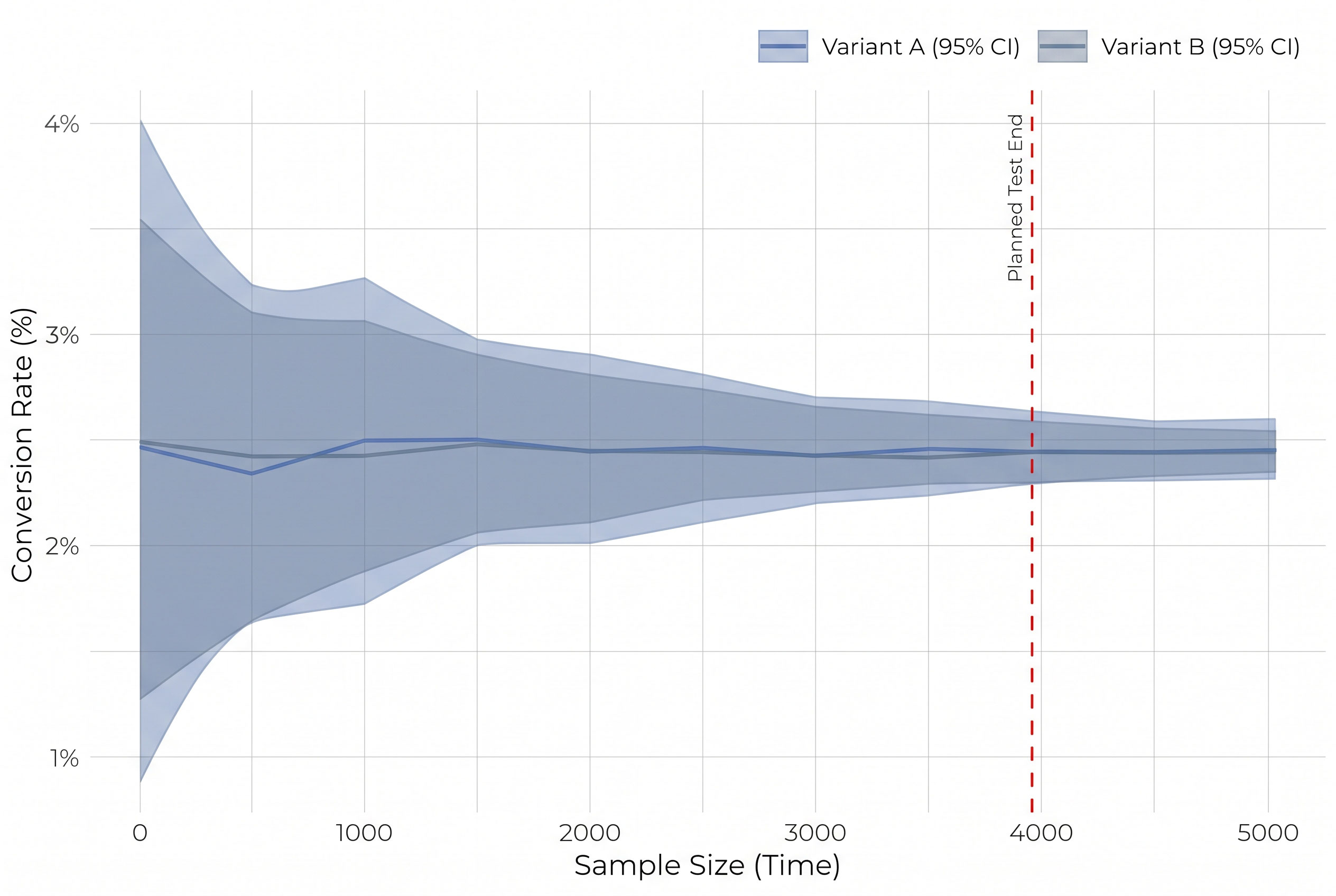
Experiment results are assessed using statistical methods,
most commonly frequentist hypothesis testing or Bayesian inference.
Practitioners generally specify a significance level (often 5%) and a
minimum sample size before a test begins. Ending a test early because an
interim result looks favorable is widely described as a source of false
positives, a problem sometimes called "peeking."
Low-traffic sites may be unable to reach adequate sample
sizes for small expected effects, which limits the usefulness of formal
testing.
Common Areas of Focus
CRO work typically examines elements that influence a
visitor's decision or ability to proceed:
- Messaging:
headlines, value statements, and product descriptions.
- Page
layout and design: visual hierarchy, placement of calls to action, and
clarity of navigation.
- Forms
and checkout: the number of fields, required account creation, and
available payment options.
- Trust
signals: reviews, security indicators, and return policies.
- Page
speed and performance: research from several technology companies has
associated slower load times with higher abandonment, though the size of
the effect varies by context.
- Mobile
experience: layout and interaction adapted to smaller screens.
Relationship to Other Disciplines
CRO overlaps with several fields but has a distinct
emphasis.
|
Discipline |
Primary focus |
Relationship to CRO |
|
Search engine optimization (SEO) |
Increasing organic search visibility and traffic |
Supplies visitors; CRO improves what they do after
arriving |
|
User experience (UX) design |
Overall usability and satisfaction |
Provides research methods and design practice |
|
Paid advertising |
Acquiring traffic through purchased placements |
CRO can raise the return on advertising spend |
|
Product analytics |
Understanding in-product behavior |
Supplies behavioral data for hypotheses |
Criticism and Limitations
Commentators have raised several concerns about CRO
practice:
- Local
optimization: Testing small changes may improve a single metric
without improving overall customer experience or long-term value.
- Short-term
metrics: A change that increases immediate conversions may reduce
retention, satisfaction, or average order value.
- Dark
patterns: Some tactics, such as false urgency or hidden opt-outs, may
raise conversions through deception. Regulators in several jurisdictions,
including the European Union and the United States, have examined such
practices.
- Statistical
misuse: Underpowered tests, repeated peeking, and testing many
variants without correction can produce unreliable conclusions.
- Privacy:
Behavioral tracking used in CRO research is subject to data protection
laws such as the EU's General Data Protection Regulation (GDPR), which
affects how analytics and session recording tools may be used.
Practitioners disagree on how heavily to rely on testing
versus qualitative judgment, particularly for sites with limited traffic.
Current Status
CRO is now a recognized specialty within digital marketing
and product teams, supported by commercial experimentation platforms and
professional communities. Increasing use of machine learning for
personalization and automated experimentation has changed some workflows,
though the core principle of validating changes against measured outcomes
remains central. Tools, regulations, and industry practices continue to change,
and readers should consult current sources for specific figures.