
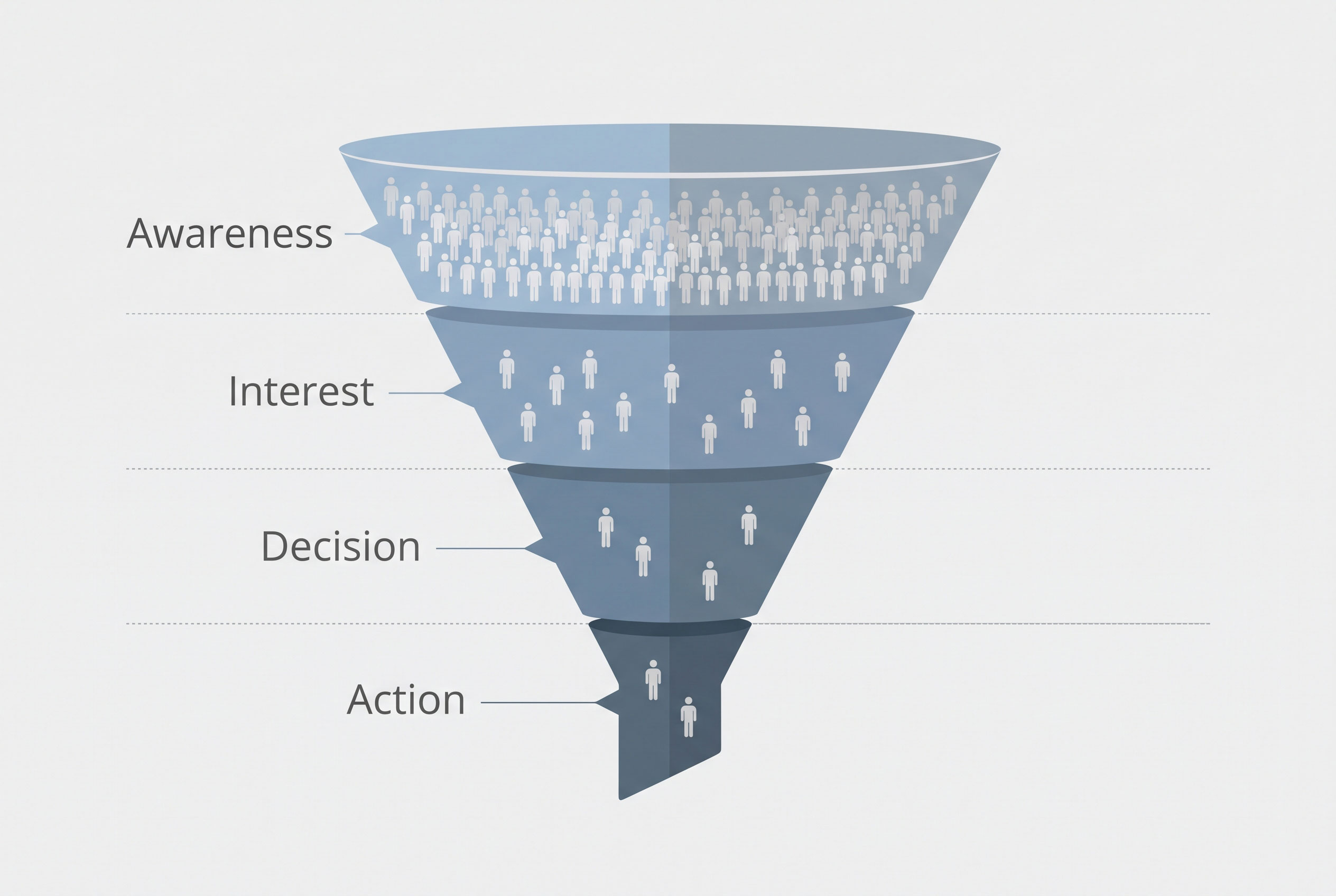
A marketing funnel is a conceptual model that
describes the stages a prospective customer passes through, from first learning
that a product or organization exists to completing a purchase or other desired
action. It is called a funnel because the number of people usually decreases at
each successive stage. Marketers use the model to plan communication, assign
measurement points, and identify where prospects stop progressing.
The model is commonly traced to the late 19th century, when
advertising pioneer Elias St. Elmo Lewis is generally credited with an
early formulation of a sequence of attention, interest, and desire, later
extended to action (AIDA). The funnel shape itself became a popular visual
metaphor during the 20th century. The model is widely taught but also
criticized for presenting a linear path that may not match actual consumer behavior.
Note: “Marketing funnel” and “sales funnel” are often
used interchangeably. Some practitioners reserve “sales funnel” for the later,
sales-team-managed stages, and “marketing funnel” for the earlier stages that
generate interest.
|
Marketing funnel |
|
|
Type |
Conceptual model in marketing and sales |
|
Also known as |
Sales funnel, purchase funnel, conversion funnel |
|
Early related model |
AIDA (attention, interest, desire, action) |
|
Commonly credited to |
Elias St. Elmo Lewis (1890s–1900s, per most accounts) |
|
Typical stages |
Awareness, interest, consideration/decision, action |
|
Primary use |
Planning, segmenting, and measuring customer acquisition |
Overview
The funnel organizes the relationship between an
organization and a prospect into ordered stages. Each stage corresponds to a
different level of familiarity and intent, and each is associated with
different kinds of content, channels, and measurements. A person who has only
seen an advertisement is treated differently from one who has requested a price
quote.
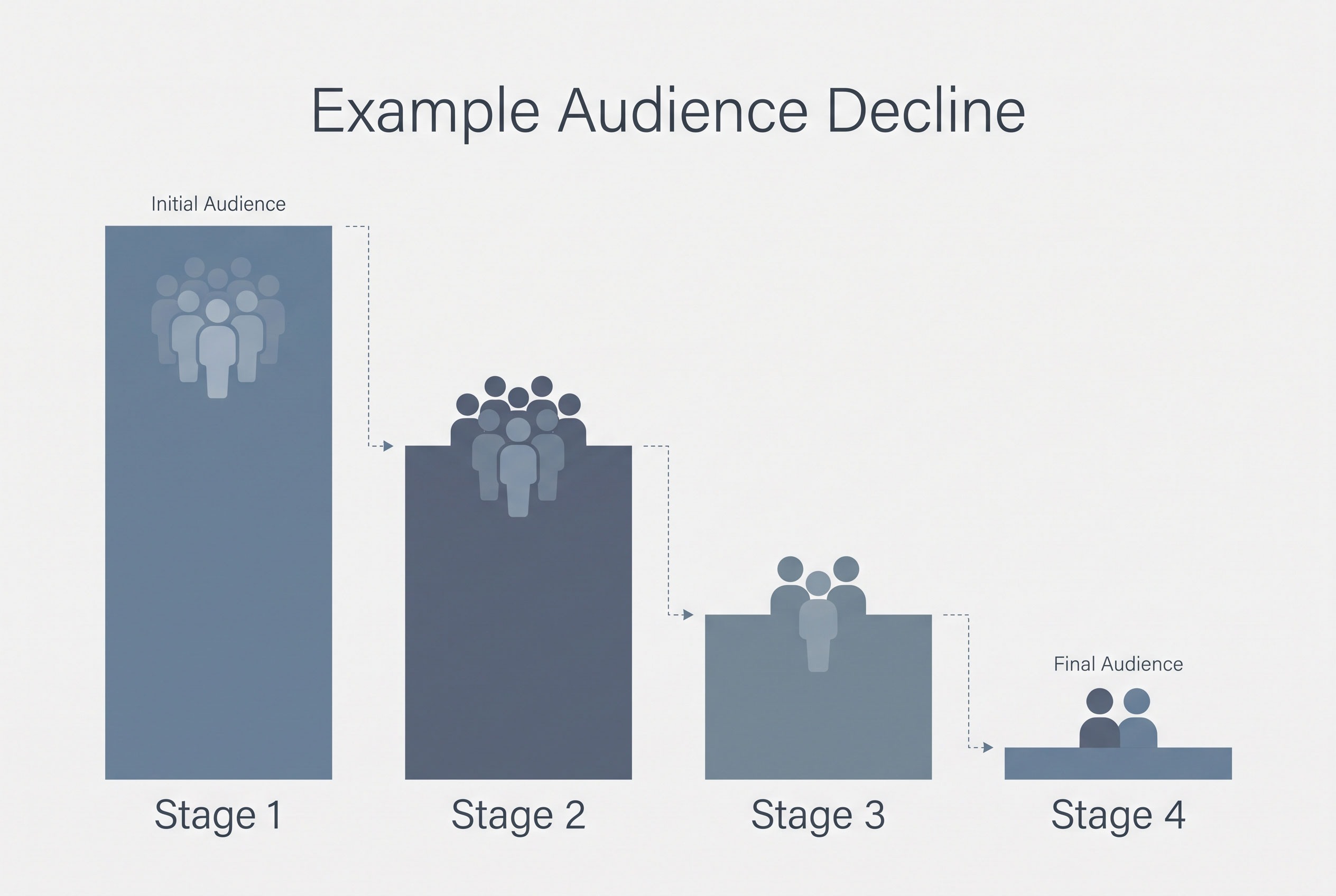
The narrowing shape reflects attrition. Of all the people
who become aware of an offer, only a fraction research it, a smaller fraction
compare alternatives, and a smaller fraction still buy. Conversion rates
between stages vary widely by industry, price, and channel, and no single
figure applies universally.
Origins and development
AIDA and early advertising theory
The earliest widely cited ancestor of the funnel is the AIDA
model. Accounts commonly attribute it to Elias St. Elmo Lewis, who wrote about
personal selling and advertising in the early 1900s. His sequence described the
mental steps a customer was said to move through: capturing attention, arousing
interest, creating desire, and obtaining action. Later authors added stages
such as satisfaction or conviction, producing variants like AIDAS.
Emergence of the funnel metaphor
The funnel image appears in business literature in the
mid-20th century, when sales training materials described selling as a process
in which many leads enter and few become customers. Exact first uses of the
term are not firmly established in sources, and several authors are credited in
different accounts.
Digital era
From the late 1990s, web analytics allowed organizations to
count visitors at each step of an online process, such as viewing a product
page, adding an item to a cart, and completing checkout. This made the funnel
measurable in a way that offline marketing rarely allowed. The term conversion
funnel is especially associated with this use.
Stages
Terminology differs between organizations and textbooks. The
following four-stage version is among the most common.
|
Stage |
Prospect’s state |
Typical activities |
Common measures |
|
Awareness (top of funnel) |
Learns the offer exists |
Advertising, search visibility, social media, public
relations |
Impressions, reach, site visits |
|
Interest |
Seeks more information |
Blog content, videos, newsletters, webinars |
Email sign-ups, time on page, content downloads |
|
Consideration / Decision (middle to bottom) |
Compares options |
Case studies, demos, trials, pricing information |
Leads qualified, demo requests, trial starts |
|
Action (bottom of funnel) |
Purchases or commits |
Checkout, contract, sales contact |
Conversion rate, revenue, cost per acquisition |
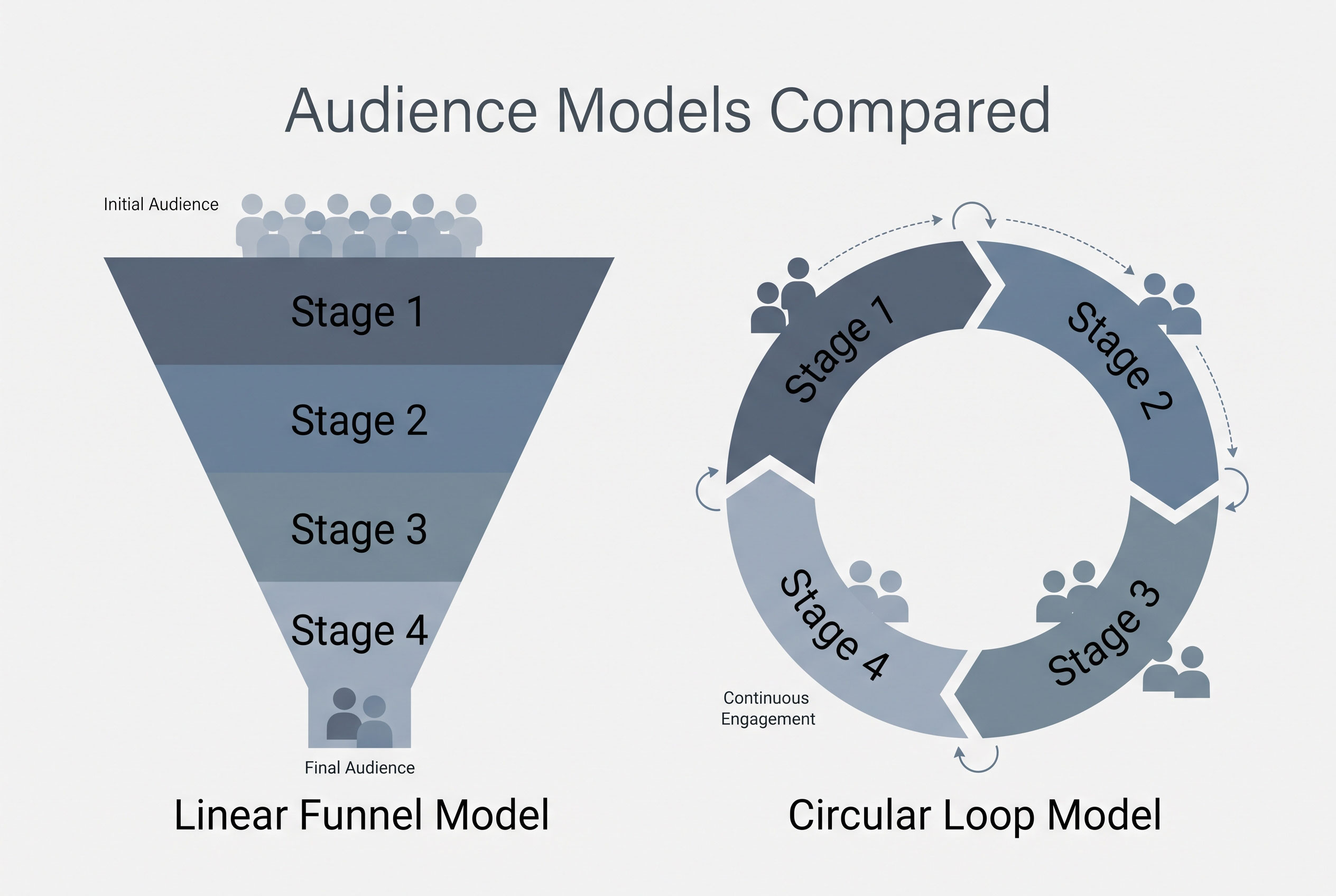
Some versions add a post-purchase stage covering
retention, loyalty, and advocacy. These versions are often drawn as an
hourglass or as a loop rather than a pure funnel.
Top, middle, and bottom of the funnel
Practitioners frequently abbreviate the stages as TOFU,
MOFU, and BOFU, referring to the top, middle, and bottom. Content
intended for the top tends to be broad and educational, while content for the
bottom tends to address specific purchase questions such as price,
implementation, or terms.
How organizations use funnels
Planning and content mapping
Teams often assign content types and channels to stages so
that messages match the prospect’s likely level of knowledge. A person
searching for a general definition is typically served different material from
one searching for a specific product comparison.
Measurement and optimization
Because the funnel defines stages, it also defines drop-off
points. A common method is to calculate the proportion of people who move from
one stage to the next and then examine the largest losses. In e-commerce, for
instance, a large decline between cart and payment may lead to a review of
shipping costs or checkout design. Changes are often tested with controlled
experiments such as A/B tests.
Lead scoring and handoff
In business-to-business settings, marketing departments may
assign scores to prospects based on behavior and company characteristics. When
a score passes a threshold, the lead is passed to sales staff. The terms marketing
qualified lead (MQL) and sales qualified lead (SQL) describe the two
sides of this handoff, though definitions differ between companies.
Related and alternative models
|
Model |
Key difference from the funnel |
|
Sales pipeline |
Tracks individual deals through stages in a customer
relationship management system, rather than describing an audience in
aggregate |
|
Customer journey map |
Diagrams touchpoints, emotions, and experiences, and does
not assume a single narrowing path |
|
Flywheel model |
Presents customers as a source of momentum through
referrals and repeat purchases, with no endpoint |
|
Pirate metrics (AARRR) |
Names acquisition, activation, retention, referral, and
revenue as stages, mainly used in software products |
|
Customer decision journey |
Described in a 2009 McKinsey publication as a loop with
evaluation and loyalty phases, in response to perceived limits of the funnel |
Criticism and limitations
Critics argue that the funnel presents the buying process as
linear and sequential, whereas consumers may move back and forth, skip stages,
or research and buy almost simultaneously. Research on consumer behavior has
repeatedly described non-linear paths, particularly for online purchasing and
for products involving multiple decision-makers.
A second criticism concerns scope. The traditional funnel
ends at purchase, which gives limited attention to existing customers, although
retention is a major driver of revenue in many businesses. Proponents of loop
and flywheel models cite this as a reason for alternatives.
Defenders note that the funnel is a simplification intended
for planning and reporting rather than a literal description of behavior. They
argue that stage-based measurement remains useful even when real paths vary.
Both views are present in the marketing literature, and neither has produced a
consensus replacement.
Common misconceptions
- The
funnel describes every purchase equally. Low-cost, impulse purchases
may compress all stages into one visit, while high-value or business
purchases can last months.
- Every
prospect must pass through each stage. Prospects can enter at any
stage, for example through a direct recommendation.
- The
funnel and the sales pipeline are the same. The funnel describes
audiences in aggregate; a pipeline tracks named opportunities.
Current status
The marketing funnel remains a standard framework in
marketing education and in analytics tools, where “funnel” reports are a common
feature. Many organizations combine it with journey mapping and
retention-focused models rather than relying on it alone.