
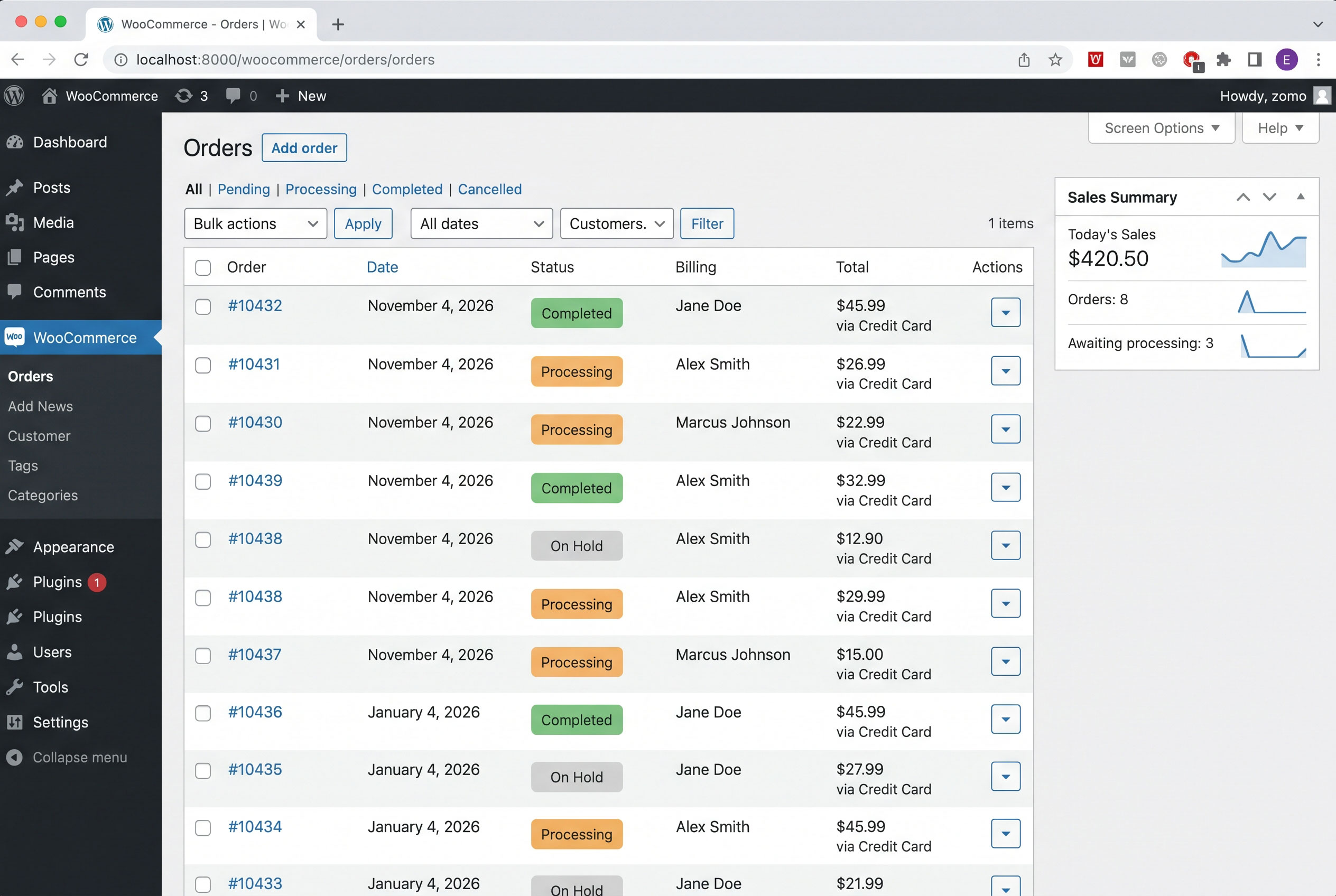
WooCommerce is a free, open-source e-commerce plugin
for the WordPress content management system. It adds online store
functions to a WordPress site, including product catalogs, shopping carts,
checkout, tax and shipping calculation, and order management. It is released
under the GNU General Public License and developed by Automattic, which
acquired it in 2015.
Developers released WooCommerce in 2011, and it is
among the most widely installed e-commerce systems on the web. Measurements of
its market share differ considerably depending on the source and method used
(see Market share and usage). Merchants
can extend it with a large ecosystem of paid and free extensions and themes.
|
Field |
Detail |
|
Original developers |
WooThemes (Mike Jolley, James Koster) |
|
Initial release |
September 2011 |
|
Current developer |
Automattic |
|
Written in |
PHP, JavaScript |
|
Platform |
WordPress |
|
License |
GPL v3 or later |
|
Type |
E-commerce plugin |
Background
WordPress was created in 2003 as a blogging tool and later
grew into a general-purpose content management system. E-commerce on WordPress
initially depended on third-party plugins of varying quality. WooCommerce
entered this space as a plugin intended to turn a WordPress site into a store
without a separate platform.
Unlike hosted services, where a vendor runs the software and
charges a subscription, WooCommerce is self-hosted. The store owner (or
a hosting provider) installs it on a web server alongside WordPress. This
arrangement gives the owner control over code, data, and hosting, but also
responsibility for maintenance, security, and performance.
History
Origins
WooCommerce was created by WooThemes, a company known
for selling WordPress themes. The company’s developers, including Mike
Jolley and James Koster, built the plugin on the foundation of an
earlier open-source project, Jigoshop, which had itself been designed
for WordPress. WooCommerce launched publicly in September 2011.
Acquisition by Automattic
Automattic, the company behind WordPress.com,
acquired WooThemes in May 2015. The acquisition brought WooCommerce
under the same corporate umbrella as several other WordPress-related services.
The terms were not publicly detailed in a way that allows verification here,
and figures reported elsewhere are not confirmed.
Later development
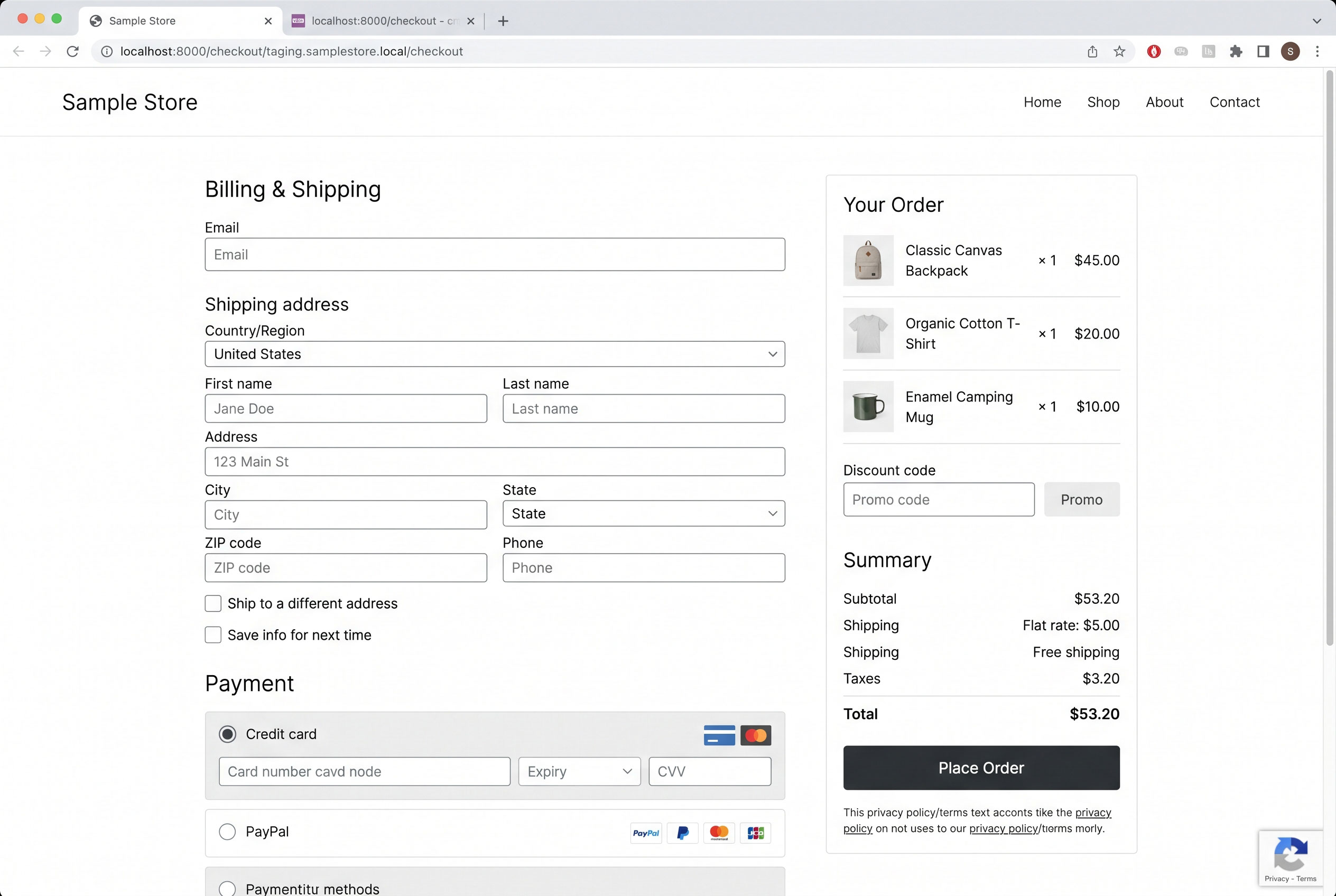
WooCommerce has since followed a regular release schedule.
Notable technical changes include:
- High-Performance
Order Storage (HPOS): introduced in the 8.x series, it stores orders
in dedicated database tables instead of the general WordPress posts
tables. It became the default for new stores in late 2023.
- Block-based
checkout and cart: WooCommerce moved toward WordPress block editor
components for its cart and checkout pages, which have been the default
for new installations since late 2023.
- WooPayments:
a payment solution built into the plugin, introduced around 2020 under the
earlier name WooCommerce Payments and operated with Stripe infrastructure.
Release numbering reached the 10.x series by 2026, according
to developer-community reports. Readers who need the current version should
consult the official release notes, since this changes frequently.
Features and architecture
Core features
A default WooCommerce installation supports:
- Physical,
digital, and downloadable products
- Variable
products (for example, different sizes or colors)
- Shopping
cart and checkout flows
- Tax
configuration, including regional rates
- Shipping
zones and methods
- Coupon
codes and discounts
- Order,
customer, and inventory management
- Basic
sales reporting and analytics
How it works
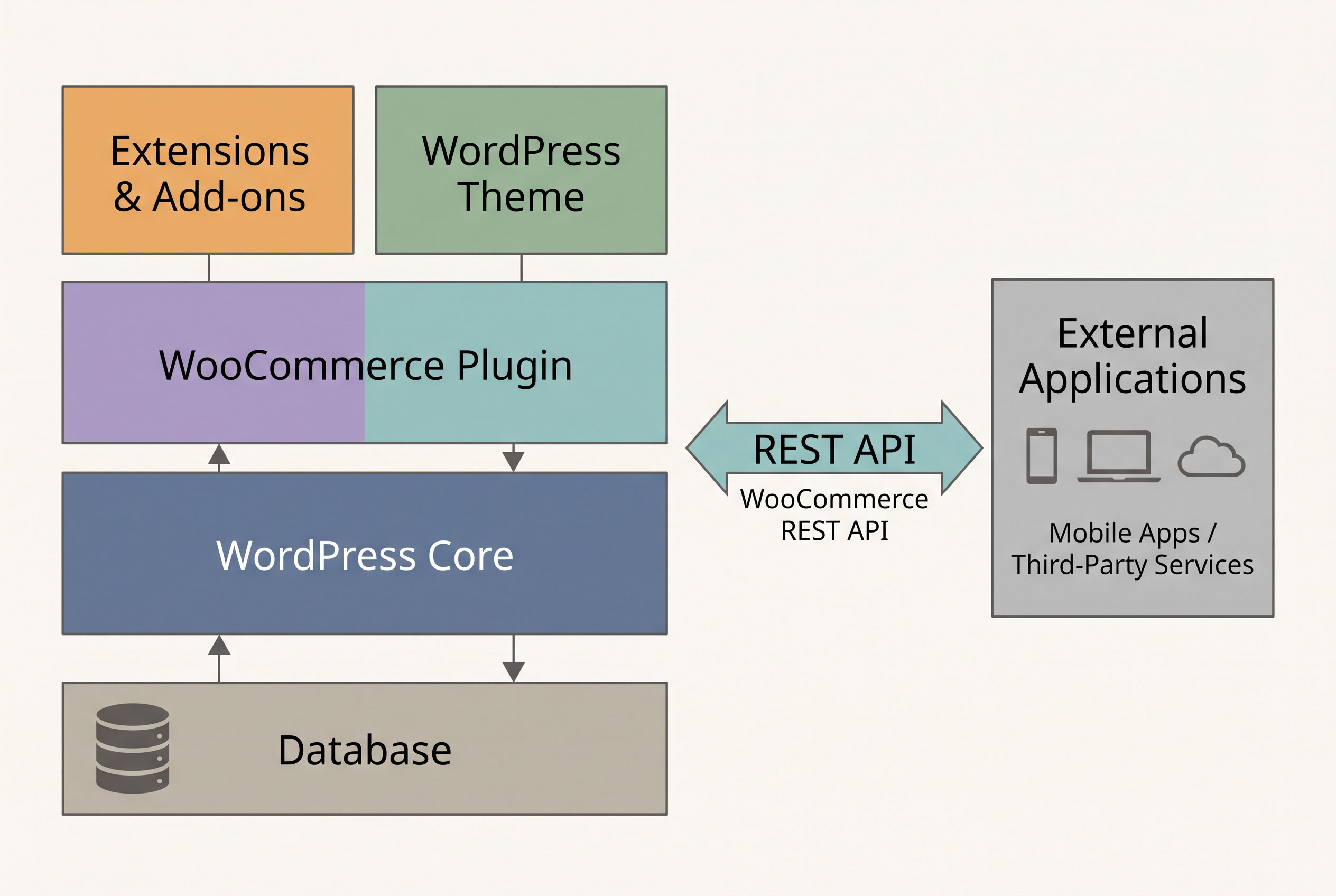
WooCommerce functions as a plugin within WordPress’s
existing structure. It registers custom content types (such as products and
orders), adds administration screens, and uses WordPress’s hook system, known
as actions and filters, to let other code modify its behavior. Store
pages are rendered through WordPress themes, so the appearance of a store
depends on the active theme and the page builder or block editor in use.
The plugin exposes a REST API, allowing external
applications such as inventory systems, mobile apps, and accounting software to
read and write store data. This interface supports “headless” setups, in which
a separate front end retrieves data from a WooCommerce back end.
Extensions and themes
Functionality beyond the core is added through extensions,
which are additional plugins. These cover payment gateways, subscriptions,
bookings, shipping carriers, marketing integrations, and more. Extensions are
distributed through the official WooCommerce marketplace, the WordPress.org
plugin directory, and independent developers. Reported marketplace counts vary
by source and date, ranging from several hundred to over a thousand listed
products.
Market share and usage
Published statistics on WooCommerce adoption disagree
because each tracking service uses different methods.
- One
2026 compilation reports about 4.05 million live WooCommerce stores in
September 2026, based on Store Leads data, and more than 7 million active
installations according to WordPress.org. colorlib
- Several
aggregator articles report shares between roughly 20% and 39% of all
e-commerce websites, depending on the dataset.
- Among
the top one million e-commerce sites by traffic, Shopify is reported to
lead WooCommerce (28.8% versus 18.2% in one 2026 summary). podbase
Note: “Installed” and “active” counts differ from
“live stores.” A plugin installation may belong to a site that never opened for
sales, so install counts tend to exceed store counts.
WooCommerce is generally reported to be stronger among small
and medium-sized merchants, while Shopify is commonly reported to be stronger
among high-traffic sites. These characterizations come from third-party
trackers and should be treated as estimates.
Comparison with other platforms
|
Aspect |
WooCommerce |
Hosted SaaS platforms (e.g., Shopify) |
|
Software cost |
Free core; paid extensions optional |
Monthly subscription |
|
Hosting |
Provided by the merchant or a host |
Provided by the vendor |
|
Code access |
Full, open source |
Limited to platform tools |
|
Maintenance |
Merchant responsibility |
Largely vendor responsibility |
|
Prerequisite |
WordPress |
None |
Total cost differs by store. Hosting, themes, extensions,
payment fees, and developer time all contribute, so neither model is uniformly
cheaper.
Criticism and controversy
Maintenance and performance
Because stores are self-hosted, performance and security
depend on the hosting environment, the number of installed plugins, and how
consistently updates are applied. Critics note that poorly configured stores
can load slowly or become vulnerable if plugins are neglected. Supporters
respond that these are typical of any self-managed software.
Extension costs
Many commonly needed features require paid extensions,
sometimes with annual renewals. Some merchants describe this as raising the
real cost beyond the free core. The developer’s position is that the modular
design lets merchants pay only for what they need.
Ecosystem disputes
WooCommerce shares an ecosystem with WordPress, which has
been affected by legal and community disputes involving Automattic. For
instance, litigation between WP Engine and Automattic remained ongoing in late
October 2026, with both sides preparing summary judgment arguments. The extent
to which such disputes affect WooCommerce users is a matter of debate and is
not settled. therepository
Current status
As of late 2026, WooCommerce remains under active
development by Automattic and a community of contributors. Its direction
continues to emphasize block-based editing, order data performance, and
integrated payments.