

Shopify is a Canadian commerce company and the name
of its software platform for building and operating online and physical retail
businesses. The platform lets merchants create a storefront, accept payments,
manage inventory and orders, and sell across websites, social media,
marketplaces, mobile apps and in-person point-of-sale systems. Shopify Inc. was
founded in 2006 and is headquartered in Ottawa, Ontario. Its
shares trade on Nasdaq and the Toronto Stock Exchange under the symbol SHOP.
Note: "Shopify" refers both to the company
and to its main product. The platform is a hosted, subscription-based service
and differs from self-hosted ecommerce software, which the merchant installs
and maintains on its own servers.
Quick answer: Shopify is a subscription-based
ecommerce platform that provides the tools merchants need to sell products: a
storefront builder, payment processing, checkout, inventory and order
management, and a marketplace of third-party apps. It runs as a hosted service,
so Shopify manages the underlying servers, security and software updates rather
than the merchant.
|
Infobox |
|
|
Type |
Public company |
|
Industry |
Ecommerce software and commerce services |
|
Founded |
2006 |
|
Founders |
Tobias Lütke, Daniel Weinand, Scott Lake |
|
Headquarters |
Ottawa, Ontario, Canada |
|
Key people |
Tobias Lütke (CEO) |
|
Products |
Shopify platform, Shopify Plus, Shopify Payments, Shop
Pay, Shopify POS, Shop app |
|
Revenue (FY2025) |
About US$11.6 billion |
|
Traded as |
Nasdaq and TSX: SHOP |
History
Origins
Shopify grew out of an online snowboard shop. According to
commonly reported accounts, programmer Tobias Lütke and business
partners Daniel Weinand and Scott Lake set out to sell
snowboarding equipment online around 2004. Unsatisfied with existing ecommerce
software, Lütke built his own store system using the Ruby on Rails framework.
The founders then shifted focus from selling snowboards to licensing the
software itself, and the company launched under the Shopify name in 2006.

Expansion of the platform
Several milestones shaped the platform's development. Dates
below are those commonly cited in company histories and press coverage.
|
Year |
Development |
|
2006 |
Shopify founded in Ottawa |
|
2009 |
App Store and application programming interface (API)
opened to outside developers |
|
2013 |
Shopify Payments and a point-of-sale product introduced |
|
2014 |
Shopify Plus launched for larger merchants |
|
2015 |
Initial public offering, initially on the New York Stock
Exchange and Toronto Stock Exchange |
|
2016 |
Shopify Capital, a merchant financing product, introduced |
|
2017 |
Shop Pay, an accelerated checkout service, launched |
|
2019 |
Shopify Fulfillment Network announced |
|
2023 |
Logistics business sold to Flexport |
In 2020, the company adopted a remote-first model, with
employees no longer required to work from a central office.
How the Platform Works
Hosted model
Merchants subscribe to a plan and receive a hosted
storefront and administration panel. Shopify operates the infrastructure,
handles software updates and maintains checkout security. This contrasts with
self-hosted systems, such as plugins for open-source content management
software, where the merchant arranges hosting and maintenance.
Core components
- Storefront
and themes: Merchants select and customize templates to design an
online shop.
- Checkout:
A built-in checkout handles carts, shipping options, taxes and payment.
- Admin
tools: Dashboards track products, inventory, customers, orders and
discounts.
- Sales
channels: Products can be listed on the online store, social
platforms, marketplaces and in physical locations.
- App
Store: Third-party developers offer extensions for marketing,
shipping, accounting and other functions.
- Developer
tools: APIs and a templating language allow custom themes and
integrations.
Payments
Shopify Payments is the company's integrated payment
processor. Merchants who use outside payment gateways have historically been
charged an additional transaction fee, a point of recurring discussion among merchants
(see Criticism). Shop Pay stores customer details to speed up repeat checkouts,
and Shopify reported that it processed more than 50% of Shopify's U.S. gross
payments volume in the fourth quarter of 2025.
Plans and tiers
Shopify offers tiered monthly subscriptions for small and
mid-sized merchants and a separate enterprise tier, Shopify Plus, aimed
at high-volume businesses. Prices and plan features change over time, so
current figures should be checked on Shopify's official pricing pages.
Business Model
Shopify earns revenue from two segments: subscription
solutions (plan fees and app and theme sales) and merchant solutions
(payments processing, shipping, capital and related services). In 2025,
subscription solutions revenue totalled $2.75bn while merchant solutions
revenue rose to $8.80bn. Merchant solutions therefore make up the larger share
of revenue, and that revenue grows with merchant sales volume. Yahoo Finance
Shopify uses two common performance measures:
- Gross
merchandise volume (GMV): The total dollar value of orders facilitated
through the platform, net of refunds. shopify
- Monthly
recurring revenue (MRR): The aggregate value of all subscription
plans, excluding variable platform fees, in effect on the last day of a
period. shopify
Scale and Financial Results
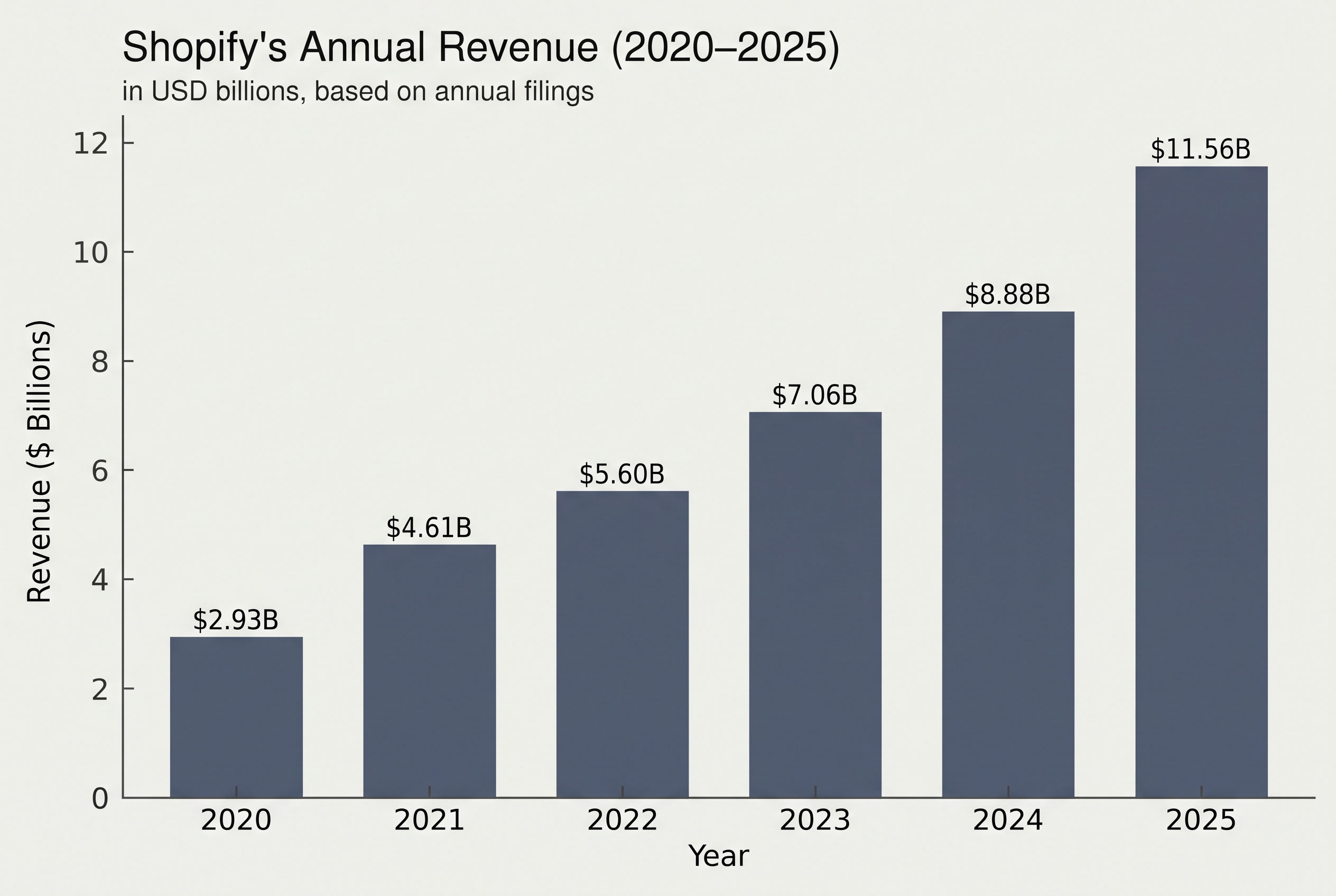
For the year ending 31 December 2025, Shopify reported
revenue of $11.55bn, a 30% increase, and GMV of $378.44bn, up from $292.27bn in
2024. Operating income reached $1.46bn and free cash flow $2bn. Annual revenue
topped $10 billion for the first time that year. Shopify posts 30% revenue growth and launches $2bn buyback +2
The company stated that it held more than 14% of the U.S.
ecommerce market, a figure based on a combination of U.S. Census Bureau data
and internal estimates. Because it relies partly on internal estimates, it
should be treated as a company-reported measure. Figures are for fiscal 2025
and change with each reporting period. barchart
Position in the Ecommerce Market
Shopify competes with several categories of software.
Comparisons depend on merchant size and needs, and no single option suits all
businesses.
|
Category |
Examples |
Typical difference from Shopify |
|
Self-hosted open-source |
WooCommerce, Magento (Adobe Commerce) |
Greater control over code and hosting, with more
maintenance responsibility |
|
Hosted website builders |
Wix, Squarespace |
Often simpler for small catalogs, with varying ecommerce
depth |
|
Enterprise suites |
Salesforce Commerce Cloud, BigCommerce |
Different pricing structures and enterprise integrations |
|
Marketplaces |
Amazon, eBay, Etsy |
Sellers list on a shared platform rather than owning a
standalone store |
A common misconception is that Shopify is a marketplace.
Merchants on Shopify generally operate their own branded stores, although the
company's Shop app offers a shopping and discovery layer across participating
merchants.
Recent Developments
Shopify has expanded into artificial intelligence and
"agentic commerce," in which AI assistants help shoppers find and buy
products. The company announced a Universal Commerce Protocol (UCP),
co-developed with Google. It also offers Sidekick, an AI assistant for merchants.
The commercial results of these initiatives were still developing as of late
2026. digitalcommerce360pymnts
Criticism and Controversy
Criticism of Shopify is generally presented as merchant or
observer perspectives rather than settled findings.
- Fees:
Some merchants have criticized additional charges for using non-Shopify
payment gateways, as well as cumulative costs from paid apps. Supporters
note that integrated payments simplify setup.
- Platform
dependence: Because the service is hosted, merchants rely on Shopify's
terms, policies and uptime, and some commentators describe this as a form
of lock-in.
- Content
policy: In 2019, Shopify was publicly criticized over its decision to
continue hosting certain stores that critics considered objectionable. The
company stated that it enforced its policies against content promoting
violence and left other decisions to the legal process, according to news
reports at the time.
- Business
strategy: Shopify's logistics investments and subsequent sale to
Flexport in 2023, along with workforce reductions in 2022 and 2023
reported in the press, drew commentary on the pace of its expansion.
Current Status
As of November 2026, Shopify remains a publicly traded
company led by Tobias Lütke, with its most recent full-year results covering
fiscal 2025. Statistics, pricing and product names are updated regularly and
should be verified against current company filings.