
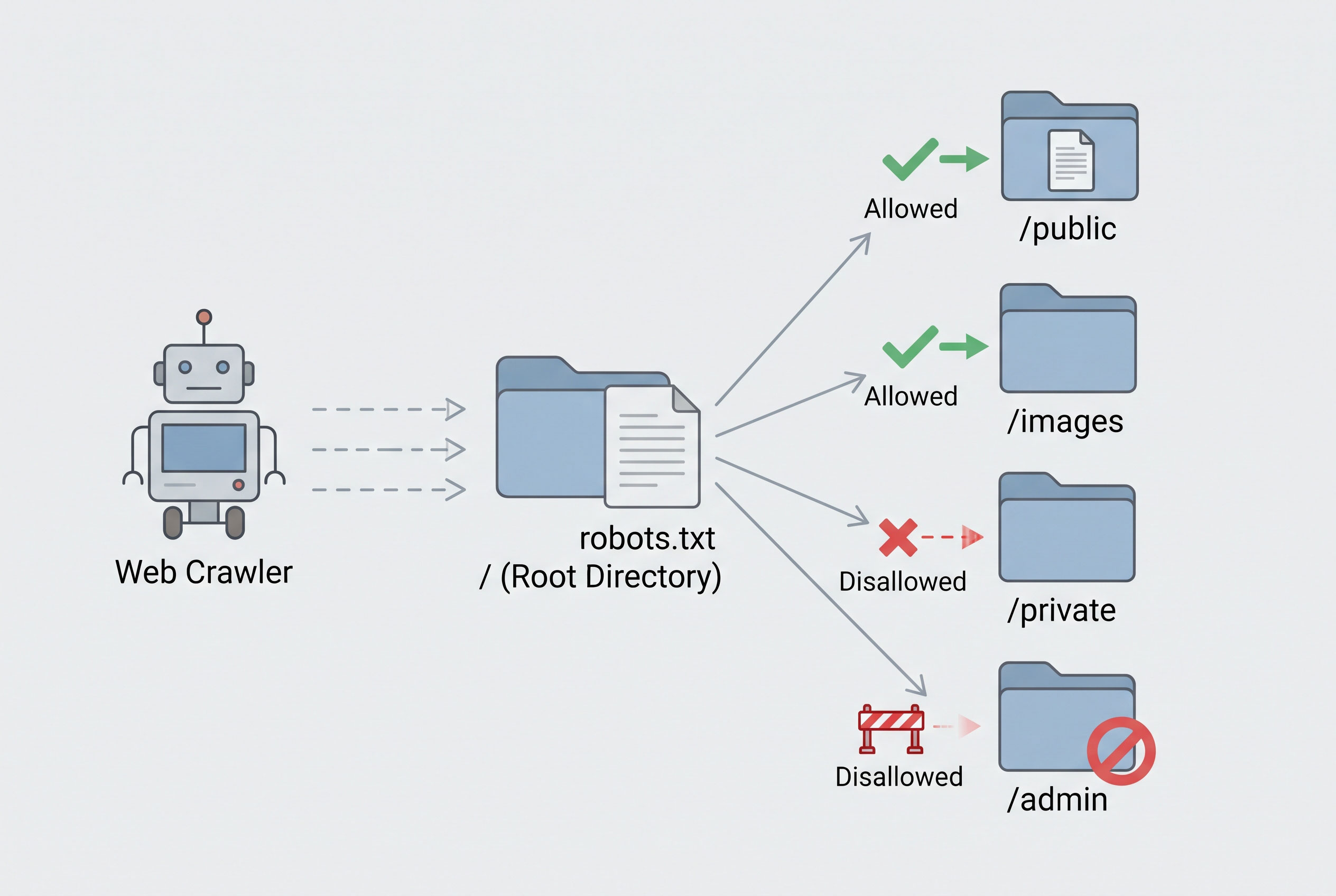
Robots.txt is a plain-text file placed at the root of
a website that tells automated clients, known as web crawlers or bots, which
parts of the site they are asked not to request. It implements the Robots
Exclusion Protocol (REP), a convention that compliant crawlers follow
voluntarily. The file is not an access-control or security mechanism.
The protocol was proposed in 1994 and operated for
nearly three decades as an informal standard. It was formalized as RFC 9309,
published by the Internet Engineering Task Force (IETF) in September 2022.
Major search engines read robots.txt before crawling a site, and the file is
also used to signal preferences to other automated systems, including crawlers
that collect data for AI training.
|
Infobox |
|
|
Type |
Web crawler access convention |
|
Also known as |
Robots Exclusion Protocol, Robots Exclusion Standard |
|
Proposed by |
Martijn Koster (1994) |
|
Formal standard |
RFC 9309 (IETF, September 2022) |
|
Location |
/robots.txt at the root of a host |
|
File format |
Plain text, UTF-8 |
|
Enforcement |
Voluntary compliance by crawlers |
Overview
A web crawler discovers pages by following links and
requests them in bulk. Site operators sometimes want to keep crawlers away from
certain areas, for example to reduce server load, avoid crawling duplicate or
infinite URL spaces, or keep low-value pages out of crawl queues. Robots.txt
gives operators a standard place to state these preferences.
Before requesting other URLs on a host, a compliant crawler
first fetches /robots.txt from that host. It then applies the rules matching
its own name. Each combination of protocol, host, and port has its own file, so
https://example.com/robots.txt does not govern https://blog.example.com/.
Note: Robots.txt controls crawling (requesting
URLs), not indexing (appearing in search results). The two are often
confused and are covered under Common Misconceptions.
History
Origins
The Robots Exclusion Protocol is generally credited to Martijn
Koster, who proposed it in 1994 on a mailing list for web robot developers.
According to commonly cited accounts, the proposal followed incidents in which
poorly behaved crawlers overloaded web servers. The convention spread quickly
because it required no central authority and was easy for both site owners and
crawler authors to adopt.
Informal standard period
From 1994 to 2022, robots.txt had no official standards-body
status. Behavior was documented in a 1996 internet draft and in guidance from
search engine operators, and implementations differed in details such as
wildcard support and handling of errors. Extensions such as Allow, Sitemap, and
pattern matching with * and $ were introduced by individual vendors and became
widely, though not universally, supported.
Formalization
In July 2019, Google announced that it was working to
turn the protocol into an internet standard and released its robots.txt parser
as open-source software. The IETF later published the specification as RFC
9309 in September 2022, with the status of Proposed Standard. The
document codified existing practice rather than introducing a new design.
File Format and Syntax
A robots.txt file consists of groups of rules. Each group
begins with one or more User-agent lines naming the crawler(s) it
applies to, followed by rules specifying which paths are disallowed or allowed.
Lines beginning with # are comments.
Core directives
|
Directive |
Purpose |
Status |
|
User-agent |
Names the crawler(s) a group applies to; * matches any
crawler |
Defined in RFC 9309 |
|
Disallow |
Path prefix the crawler is asked not to request |
Defined in RFC 9309 |
|
Allow |
Path prefix explicitly permitted, often as an exception
within a disallowed path |
Defined in RFC 9309 |
|
Sitemap |
Location of an XML sitemap |
Widely supported extension, not part of the core RFC rules |
|
Crawl-delay |
Requested pause between requests |
Non-standard; supported by some crawlers, ignored by
others, including Google |
Example
User-agent: *
Disallow: /private/
Allow: /private/public-report.html
User-agent: ExampleBot
Disallow: /
Sitemap: https://example.com/sitemap.xml
In this example, all crawlers are asked to avoid /private/
except one named page, while a crawler identifying as ExampleBot is asked to
avoid the entire site.
Matching rules
RFC 9309 specifies that rules match as URL path prefixes and
that the most specific (longest) matching rule takes precedence. When an Allow
and a Disallow rule are equally specific, the less restrictive Allow applies.
The RFC also supports the * wildcard (any sequence of characters) and the $
anchor (end of URL) in paths. Matching is case-sensitive for paths, while
crawler names in User-agent lines are matched case-insensitively.
A crawler follows only the single group that best matches
its name; rules from other groups, including the * group, are not combined with
it.
Crawler Behavior
Retrieval and caching
Crawlers fetch the file via HTTP(S) and may cache it. The
RFC recommends that caches generally not be kept longer than 24 hours unless
the file is unreachable. The specification also requires crawlers to parse at
least 500 kibibytes of the file and allows them to ignore content beyond that
limit.
Handling of HTTP status codes
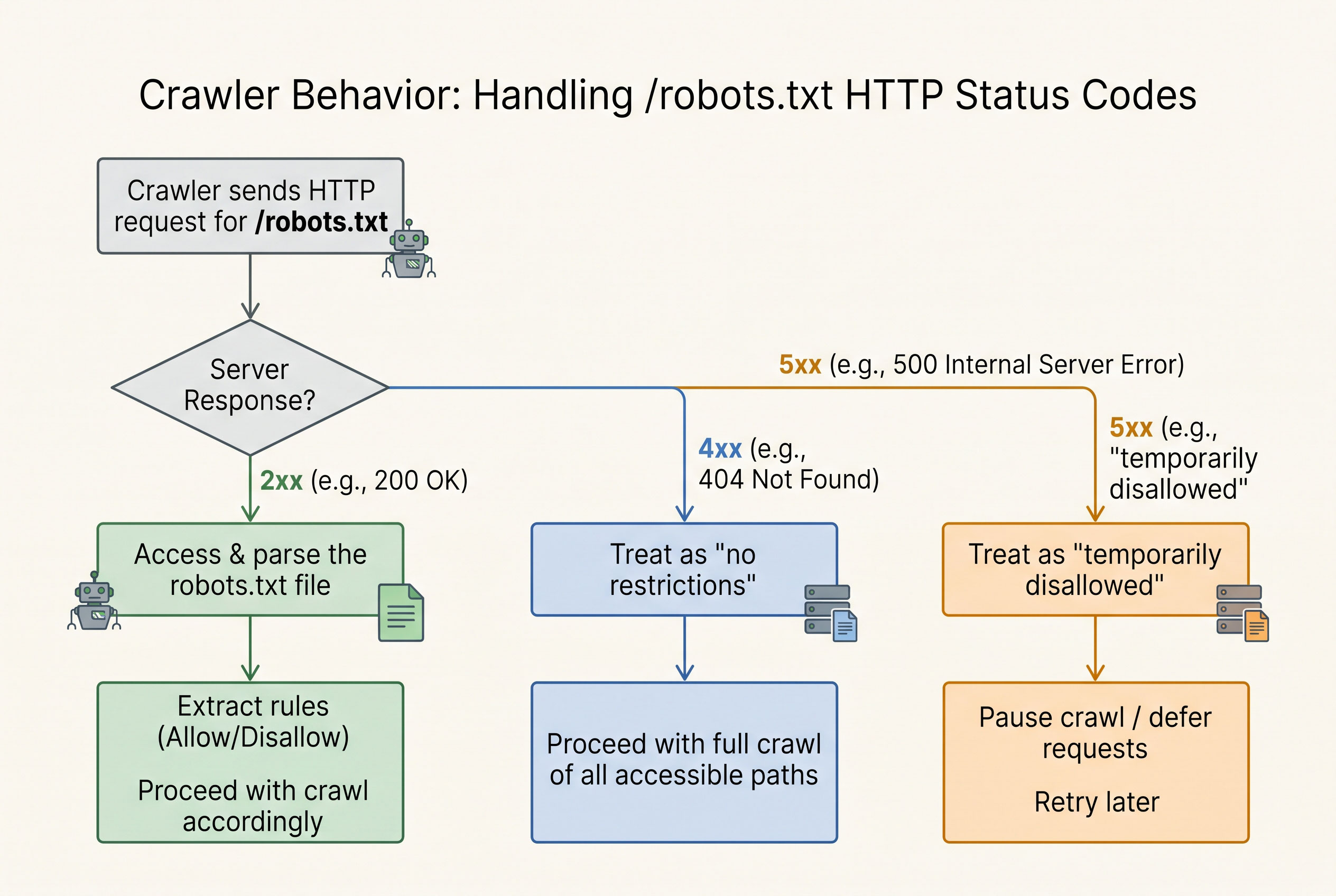
The treatment of fetch results is defined in RFC 9309:
- 2xx
(success): the file is parsed and its rules applied.
- 4xx
(client error, such as 404): the file is treated as unavailable, and
crawlers may access any path.
- 5xx
(server error) or network failure: the crawler should assume complete
disallowance temporarily; if the failure persists, behavior may vary by
crawler.
A missing robots.txt file therefore generally means no
restrictions apply.
Limitations and Common Misconceptions
Not a security measure. Robots.txt is publicly
readable, and compliance is voluntary. Malicious or careless bots can ignore
it, and the file can reveal the existence of paths the operator would prefer
not to advertise. Content requiring protection is normally secured with
authentication or server-side access controls.
Blocking is not the same as de-indexing. A URL
disallowed in robots.txt can still appear in search results, typically without
a description, if other pages link to it. Because the crawler cannot fetch a
blocked page, it also cannot see a noindex instruction placed on that page.
The noindex directive in robots.txt is unsupported by
Google. Google ended support for it on 1 September 2019. Other
engines have varied in their handling, so it is generally not relied upon.
Crawler names must match. A rule applies only if the
crawler’s declared User-agent token matches. Operators typically consult each
crawler operator’s documentation for the exact token.
Related Mechanisms
Several mechanisms address crawler and indexing behavior at
different levels:
|
Mechanism |
Scope |
Controls |
|
Robots.txt |
Site or path prefix |
Crawling |
|
Robots meta tag |
Individual HTML page |
Indexing and snippet behavior |
|
X-Robots-Tag HTTP header |
Individual response, including non-HTML files |
Indexing and snippet behavior |
|
Authentication or IP restrictions |
Server level |
Actual access |
Use with AI and Data-Collection Crawlers
Since the early 2020s, operators of large language models
and other data-collection systems have published crawler names that site owners
can address in robots.txt. Examples reported in public documentation include
Google’s Google-Extended token and OpenAI’s GPTBot. Adherence depends on each
operator, and robots.txt provides no technical enforcement. Debate continues
among publishers, technology companies, and policymakers about whether
robots.txt is an adequate mechanism for expressing preferences about AI
training, and proposals for additional signals have been discussed. Because
this area changes quickly, current crawler names and policies are best verified
against operator documentation.
Current Status
Robots.txt remains the primary convention for communicating
crawler preferences on the web. RFC 9309 provides a common reference for
implementers, though vendor-specific extensions and behaviors persist.