

Copywriting is the practice of writing text, known as
copy, whose purpose is to promote a product, service, person,
organization, or idea, or to prompt a reader to take a specific action. It is
used in advertising, marketing, public relations, and digital communication. A
person who does this work is called a copywriter. Copy appears in print
advertisements, websites, emails, packaging, catalogs, social media posts,
scripts, and product descriptions. Copywriting is generally treated as a form
of persuasive or commercial writing, separate from journalism, fiction, and
technical documentation.
|
Infobox |
|
|
Field |
Advertising, marketing, communications |
|
Practitioner |
Copywriter |
|
Output |
Promotional and persuasive text |
|
Common formats |
Advertisements, web pages, emails, slogans, scripts |
|
Employment settings |
Agencies, in-house teams, freelance work |
|
Related fields |
Content writing, UX writing, public relations |
Definition and scope
In its narrowest sense, copywriting is writing intended to
produce a measurable response, such as a purchase, a sign-up, or a click. In a
broader sense, it includes any text that builds awareness or shapes how an
audience perceives a brand. Practitioners and educators sometimes disagree on
where the boundary lies, particularly between copywriting and content writing.
A single piece of copy usually combines several elements:
- Headline:
the opening line meant to attract attention.
- Body
copy: the main explanatory text.
- Call
to action (CTA): an instruction such as “subscribe” or “request a
quote.”
- Tagline
or slogan: a short, memorable phrase attached to a brand or campaign.
History
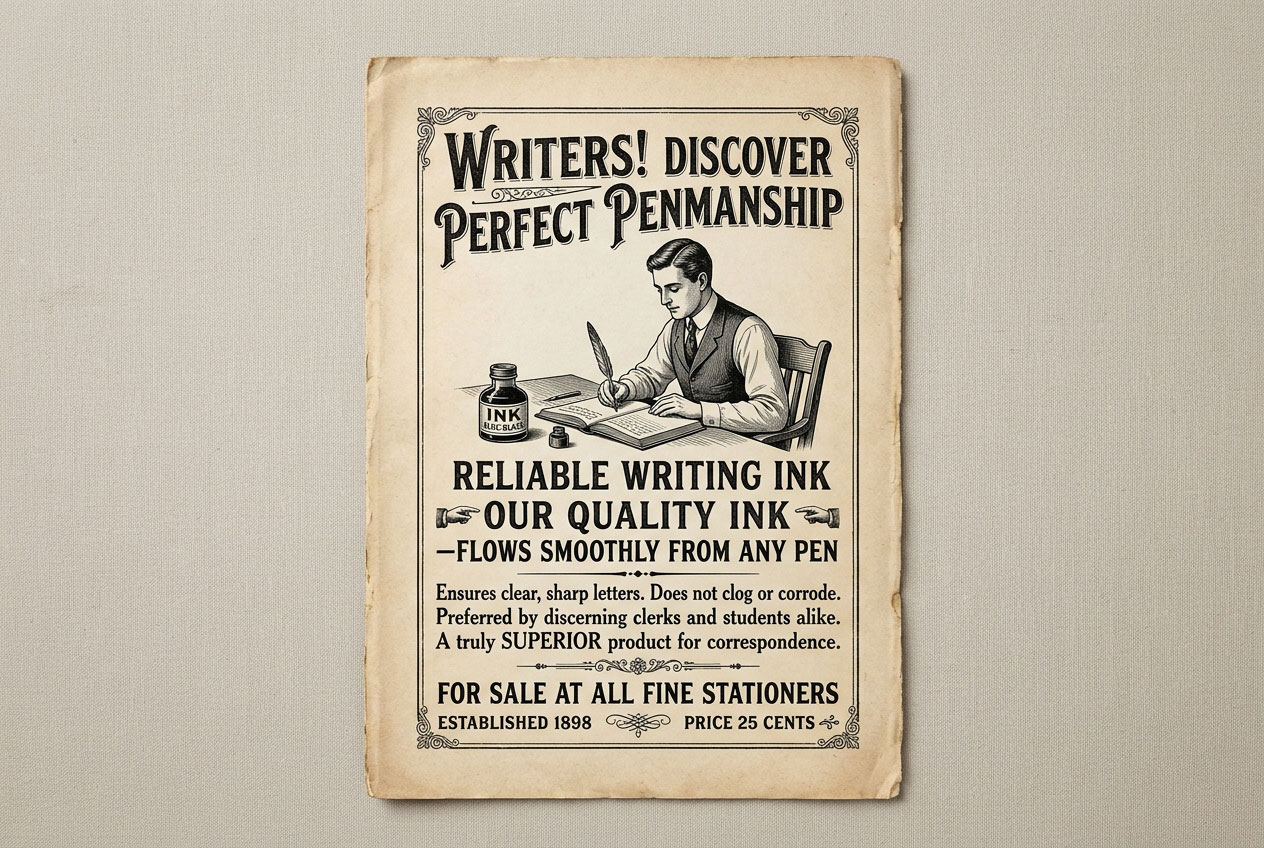
Promotional writing is far older than the profession.
Written advertisements are known from ancient commercial societies, and printed
handbills and newspaper advertisements became common after the spread of the
printing press in Europe. A distinct occupation of advertising writer is
generally associated with the growth of mass-circulation newspapers and
magazines in the late 19th and early 20th centuries, when firms and agencies
began employing writers specifically to prepare advertisements.
Several figures from this period are commonly cited in
histories of the field. John E. Kennedy, a Canadian advertising
theorist, is often credited with describing advertising as “salesmanship in
print” in the early 1900s, a view that treated an advertisement as a reasoned
argument for buying. Claude Hopkins published Scientific Advertising
in 1923, which advocated testing advertisements and tracking responses. His
work became a foundation of what is now called direct-response marketing.
In the mid-20th century, agency creative departments paired
copywriters with art directors. David Ogilvy published Confessions of
an Advertising Man in 1963, and William Bernbach of Doyle Dane
Bernbach is often cited for promoting a creative approach that integrated words
and visuals. Sources differ on how much influence each figure had, and
attributions in popular accounts are sometimes simplified.
From the 1990s onward, the growth of the web, search
engines, email marketing, and social media greatly expanded the demand for copy
and introduced new constraints such as character limits and search visibility.
Types of copywriting
Copywriting is commonly divided by purpose and medium. The
categories overlap, and terminology varies by industry.
|
Type |
Primary purpose |
Typical formats |
|
Direct-response |
Prompt an immediate, measurable action |
Sales letters, landing pages, promotional emails |
|
Brand copywriting |
Establish tone, identity, and recognition |
Slogans, campaign text, “about” pages |
|
Advertising copy |
Promote a product in paid media |
Print, broadcast, outdoor, and online ads |
|
SEO copywriting |
Rank in search results while informing readers |
Web pages, category descriptions |
|
Technical or specialized copy |
Explain complex products to buyers |
White papers, product sheets |
|
Social media copy |
Engage audiences in short formats |
Posts, captions, short video scripts |
Process and techniques

Copywriters usually begin with a brief, a short
document supplied by a client or marketing team that describes the product, the
audience, the goal, and any constraints. Research into the audience and
competing products typically follows. Drafts are then written, reviewed,
revised, and sometimes tested.
Several frameworks are used to structure persuasive text.
The best known is AIDA (attention, interest, desire, action), often
attributed to the American advertising figure E. St. Elmo Lewis around the turn
of the 20th century, although accounts of its exact origin vary. Other commonly
taught patterns include problem–agitation–solution and the “features versus benefits”
distinction, which separates what a product is from what it does for the
customer.
Common practical techniques include:
- Writing
for a defined audience rather than a general one.
- Leading
with the most relevant point.
- Using
concrete detail in place of general claims.
- Maintaining
a consistent brand voice.
- Ending
with a clear call to action.
A/B testing, in which two versions of copy are shown
to different audience segments and compared, is widely used in digital contexts
to evaluate headlines, subject lines, and calls to action.
Comparison with related fields
Copywriting is frequently confused with neighboring
disciplines. The boundaries are conventional rather than strict, and job titles
often blend them.
- Content
writing: Produces informational or entertaining material, such as
articles and guides, aimed at building audience trust over time. Its aim
is typically less directly tied to a single action.
- UX
writing: Writes interface text such as button labels, error messages,
and onboarding instructions, with the goal of helping users complete
tasks.
- Technical
writing: Produces instructional or reference documentation, where
accuracy and clarity take priority over persuasion.
- Public
relations writing: Prepares press releases and statements intended for
the media rather than for direct consumers.
Regulation and ethics
Promotional text is subject to law and industry codes in
many jurisdictions. In the United States, the Federal Trade Commission
enforces rules against deceptive advertising and publishes guidance on
endorsements and disclosures. In the United Kingdom, the Advertising
Standards Authority administers the CAP Code, which covers claims,
comparisons, and disclosure. Other countries maintain comparable regimes, and
requirements differ by region and product category, with stricter rules
typically applying to areas such as health, finance, and children’s products.
Debate exists over the social role of persuasive writing.
Critics argue that some techniques exploit cognitive biases or create
artificial urgency. Defenders argue that persuasion is a normal part of
commerce and that rules against misleading claims already limit abuse.
Professional bodies and codes of practice generally emphasize truthful claims
and clear disclosure.
Common misconceptions
- Copywriting
is not copyright. One concerns writing; the other concerns legal
ownership.
- Copywriting
is not limited to sales. It also supports fundraising, public
information, and internal communication.
- Persuasive
text is not necessarily exaggerated. Many regulatory frameworks
require claims to be substantiated.
Current status
Digital channels now account for much of the demand for
copywriting. Generative AI tools capable of producing draft text have entered
many workflows since the early 2020s. Their effect on the profession is under
active discussion, with differing views on whether they will reduce, reshape,
or leave unchanged the demand for human copywriters. Reliable long-term data
remain limited.