
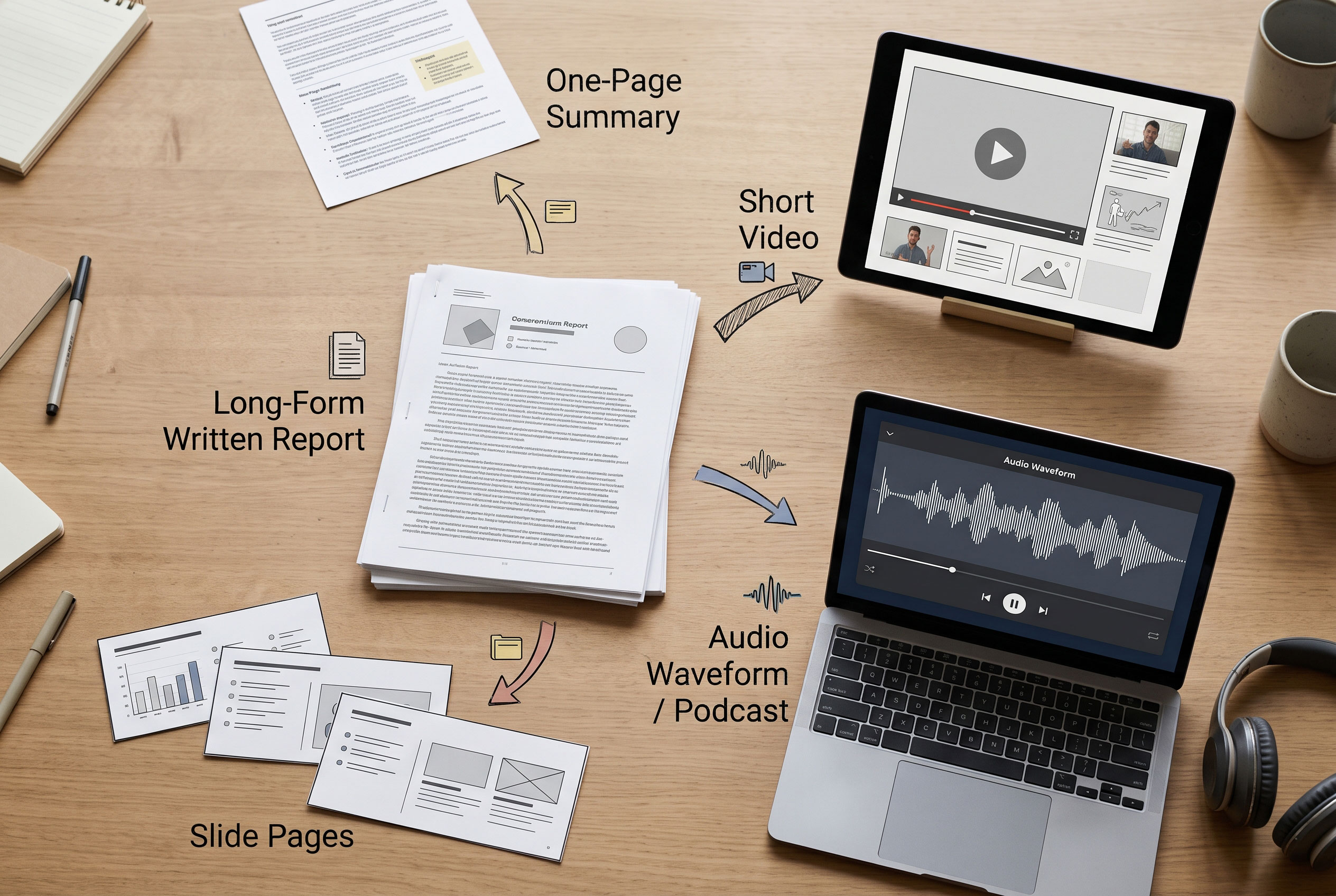
Content repurposing is the practice of adapting
existing content into a different format, length, or channel, or for a
different audience, instead of producing new material from scratch. A webinar,
for example, may be turned into a blog post, short video clips, and a
transcript. The practice is used by publishers, educators, marketers, and media
organizations to extend the reach and working life of material they have
already produced.
Repurposing differs from simple republishing. Republishing
posts the same material again, while repurposing changes its form, structure,
or presentation to suit a new context. The practice is closely associated with
digital publishing and content marketing, though adaptation of material across
media has a much longer history.
|
Field |
Detail |
|
Also known as |
Content recycling, content reuse, content transformation |
|
Field |
Publishing, communications, marketing, education |
|
Core idea |
Adapting existing material to new formats or audiences |
|
Related concepts |
Content syndication, evergreen content, COPE |
|
Typical source material |
Articles, webinars, podcasts, reports, interviews,
lectures |
Overview
Content repurposing starts from a source asset, often called
a pillar or anchor piece, which is a substantial item such as a
research report, interview, or long article. Derived items are then created
from it, each adjusted to the conventions of its medium.
The practice rests on a few assumptions: that audiences use
different formats and platforms, that much valuable material is seen by only
part of its potential audience, and that adapting existing work usually takes
less effort than creating new work. These assumptions are widely repeated in
practitioner literature, but reported efficiency gains vary and are rarely
measured under controlled conditions.
History and Development

Adapting material across media predates the internet. Novels
have been adapted into plays and films, lectures into published books, and
newspaper serials into collected volumes. Broadcasters have long reused archive
footage, and publishers have issued abridged, illustrated, or translated
editions of the same text.
Digital publishing changed the scale and speed of this
reuse. As organizations began distributing content across websites, mobile
apps, social platforms, and email, the cost of producing a separate version for
each channel became a practical concern.
One influential formulation was the COPE principle,
"Create Once, Publish Everywhere." It is commonly associated with the
work of Daniel Jacobson, then at NPR in the United States, around 2009. COPE
described structuring content in a channel-neutral way so that a single
editorial asset could feed many outputs through programming interfaces (APIs).
Its emphasis on content architecture differs from the more editorial, manual
repurposing often discussed in marketing contexts, though the two ideas are
frequently grouped together.
The growth of podcasting, video platforms, and short-form
social media in the 2010s and 2020s expanded the range of formats available as
targets. More recently, automated tools for transcription, summarization, and
translation have reduced the manual work involved in some conversions.
Common Methods
Format Conversion
Format conversion changes the medium while keeping the
substance largely intact. Typical conversions include:
- A
recorded webinar or podcast to a written transcript or article
- A
written report to a slide presentation or infographic
- A long
video to several short clips
- A
series of related articles to an e-book or guide
- A
lecture to a course module or study handout
Audience Adaptation
Audience adaptation keeps the subject but changes the level
of detail, vocabulary, or emphasis. A technical paper might be summarized for
general readers, or a corporate announcement rewritten for customers rather
than investors. Translation and localization belong here when they involve more
than literal word substitution.
Updating and Consolidation
Older material may be revised with current information and
republished, a process often called a content refresh. Related shorter
pieces may also be merged into a single comprehensive resource. Both approaches
aim to keep material accurate and to reduce overlap across a body of work.
Excerpting and Atomization
Content atomization breaks a larger item into small
units, such as quotations, statistics, diagrams, or short answers, which are
then distributed individually. The units typically link back to the original
source.
How the Process Typically Works
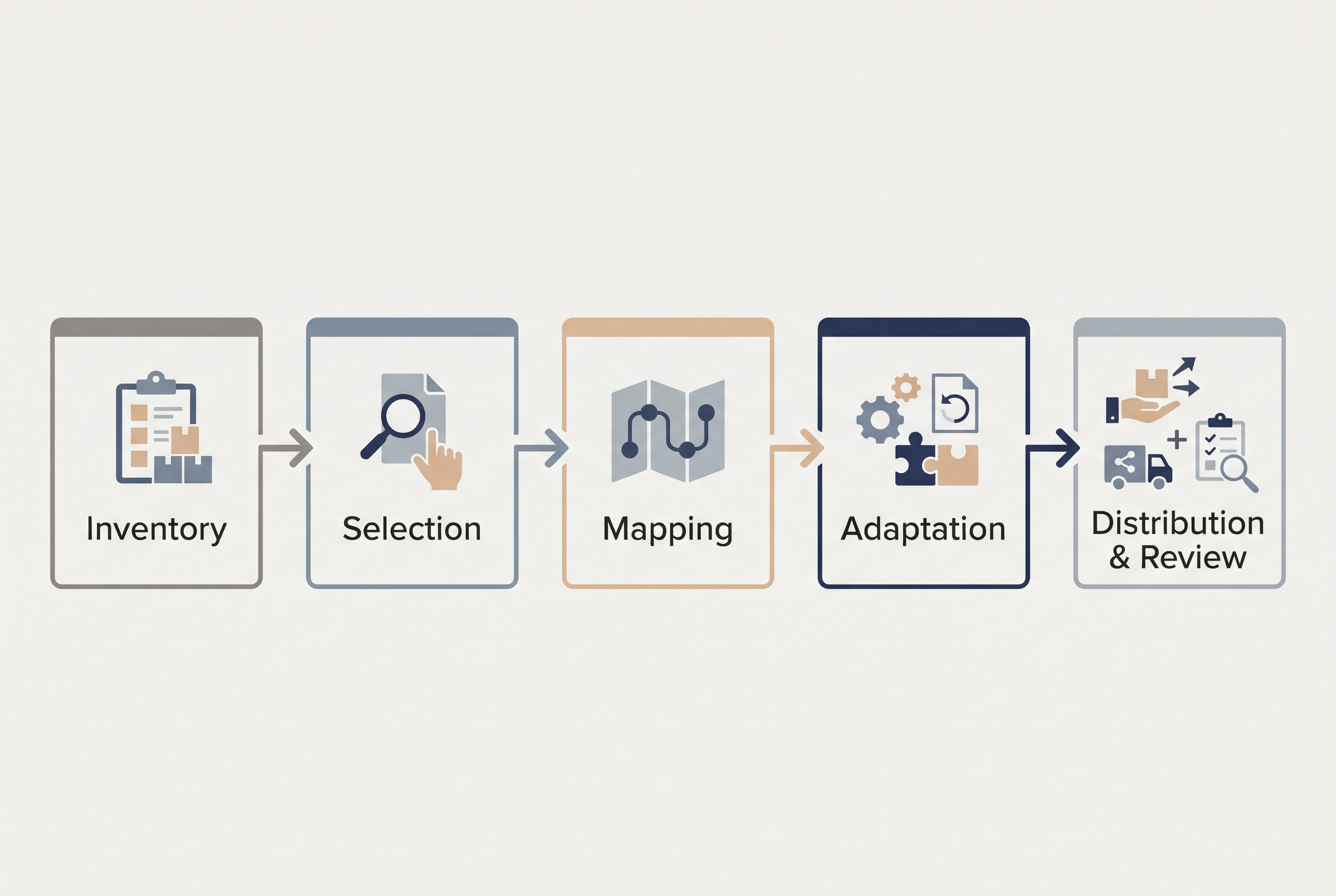
Descriptions of the workflow vary between organizations, but
they commonly include these stages:
- Inventory:
Existing material is catalogued, often with notes on topic, format, date,
and performance.
- Selection:
Items judged to have lasting relevance, strong engagement, or untapped
potential are chosen. Time-sensitive material is usually excluded.
- Mapping:
Target formats and channels are matched to the source and to the intended
audience.
- Adaptation:
The material is rewritten, edited, or reformatted to suit each target,
rather than copied directly.
- Distribution
and review: Derived items are published and, where measurement is
used, compared against results for the original.
Comparison With Related Practices
Repurposing is often confused with neighboring terms. The
table below summarizes common distinctions.
|
Practice |
Main characteristic |
Relation to repurposing |
|
Repurposing |
Existing content is transformed into a new form or for a
new audience |
Subject of this article |
|
Republishing |
The same content is posted again, often unchanged |
Does not alter the form |
|
Syndication |
Content is published on third-party sites, usually with
attribution |
Distributes content without necessarily changing it |
|
Content refresh |
An existing item is updated in place |
Overlaps when updates are substantial |
|
Curation |
Material from other sources is selected and presented |
Concerns others' work rather than one's own |
Applications
In journalism and broadcasting, reporting is often
adapted across print, web, radio, video, and newsletters. In education,
recorded lectures may be converted into transcripts, readings, or short
instructional clips. In marketing and corporate communications,
organizations adapt reports, case studies, and events into a range of
customer-facing materials. In research communication, academic findings
are sometimes summarized for policy audiences or the public.
Criticism and Limitations
Practitioners and commentators have raised several concerns,
which are summarized here without endorsing any single view.
- Duplication
risk: Material that is only lightly changed may be perceived as
redundant. Search engines have published guidance on duplicate content,
and publishers generally aim to ensure each version offers distinct value.
- Format
mismatch: Content that works well in one medium may not translate well
into another. A dense written analysis, for instance, may lose nuance when
compressed into a short clip.
- Quality
and accuracy: Automated conversion tools can introduce errors in
transcripts, summaries, or translations, and these may go unnoticed
without human review.
- Rights
and permissions: Reusing material created by others, such as guest
interviews or licensed images, may require additional permission or fall
outside the original agreement.
- Audience
overlap: Some audiences follow an organization on several channels and
may encounter the same message repeatedly.
Common Misconceptions
One common misconception is that repurposing means copying
content between platforms. In most definitions, it requires genuine adaptation.
Another is that all content is suitable; evergreen material is generally more
suitable than time-bound news or announcements, whose relevance expires
quickly. A third is that repurposing eliminates production effort. It generally
reduces some work, but editing, design, and review remain necessary.
Current Status
Content repurposing remains a standard topic in publishing
and marketing practice. Its methods continue to change as new formats,
platforms, and automated tools appear, and published guidance on best practice
differs between sources.