
Natural language processing (NLP) is a field of
computer science, artificial intelligence, and linguistics concerned with
enabling computers to analyze, interpret, and generate human language in
written or spoken form. It underlies applications such as machine translation,
web search, voice assistants, and text classification.
The field draws on linguistics, statistics, and machine
learning. Since the 2010s, neural networks, and especially the transformer
architecture introduced in 2017, have been the dominant approach. NLP is
closely related to computational linguistics; the terms overlap, though
computational linguistics is often associated with scientific study of language
and NLP with engineering of language technology.
|
Field |
Computer science, artificial intelligence, linguistics |
|
Focus |
Computational analysis and generation of human language |
|
Subfields |
Natural language understanding, natural language
generation, speech processing |
|
Common tasks |
Translation, summarization, question answering,
classification |
|
Dominant current approach |
Neural language models based on transformers |
History
Early foundations (1940s–1960s)
Interest in machine processing of language grew after the
Second World War, largely through machine translation research. In 1950,
Alan Turing published “Computing Machinery and Intelligence,” which
proposed a conversational test of machine intelligence. In 1954, the Georgetown–IBM
experiment demonstrated automatic translation of more than sixty Russian
sentences into English, and its organizers were optimistic about rapid
progress. That optimism proved premature.

In 1957, Noam Chomsky’s Syntactic
Structures promoted formal grammars, which strongly influenced early
rule-based systems. A 1966 report by the U.S. Automatic Language
Processing Advisory Committee (ALPAC) judged machine translation disappointing,
and funding for the area declined afterward. Also in 1966, Joseph Weizenbaum
at MIT described ELIZA, a program that simulated conversation through
pattern matching. Weizenbaum himself stressed that it did not understand
language.
Symbolic and statistical eras (1970s–2000s)
Systems of the 1970s, such as SHRDLU by Terry
Winograd, handled language within narrow, controlled domains using
hand-written rules. These approaches struggled to scale to open-ended text.
From the late 1980s, researchers increasingly adopted statistical
methods that learned patterns from large text collections, or corpora.
Hidden Markov models, probabilistic parsers, and statistical machine
translation became standard. This shift is often described as a move from
hand-written linguistic rules to data-driven learning.
Neural era (2010s–present)
In 2013, a Google team led by Tomas Mikolov
released word2vec, which popularized dense numerical word
representations known as embeddings. Recurrent networks, including long
short-term memory (LSTM) models first proposed in 1997, were widely applied to
translation and text tasks.
In 2017, Vaswani and colleagues published “Attention
Is All You Need,” introducing the transformer. In 2018, Google
released BERT and OpenAI released the first GPT model, both
demonstrating that large models pre-trained on unlabeled text could be adapted
to many tasks. Subsequent large language models (LLMs) with billions of
parameters expanded NLP into general-purpose text generation and conversational
systems.
|
Year |
Event |
|
1950 |
Turing proposes a conversational test of machine
intelligence |
|
1954 |
Georgetown–IBM translation demonstration |
|
1966 |
ELIZA described; ALPAC report published |
|
1997 |
LSTM networks proposed |
|
2013 |
word2vec released |
|
2017 |
Transformer architecture introduced |
|
2018 |
BERT and GPT released |
How It Works
Text preparation
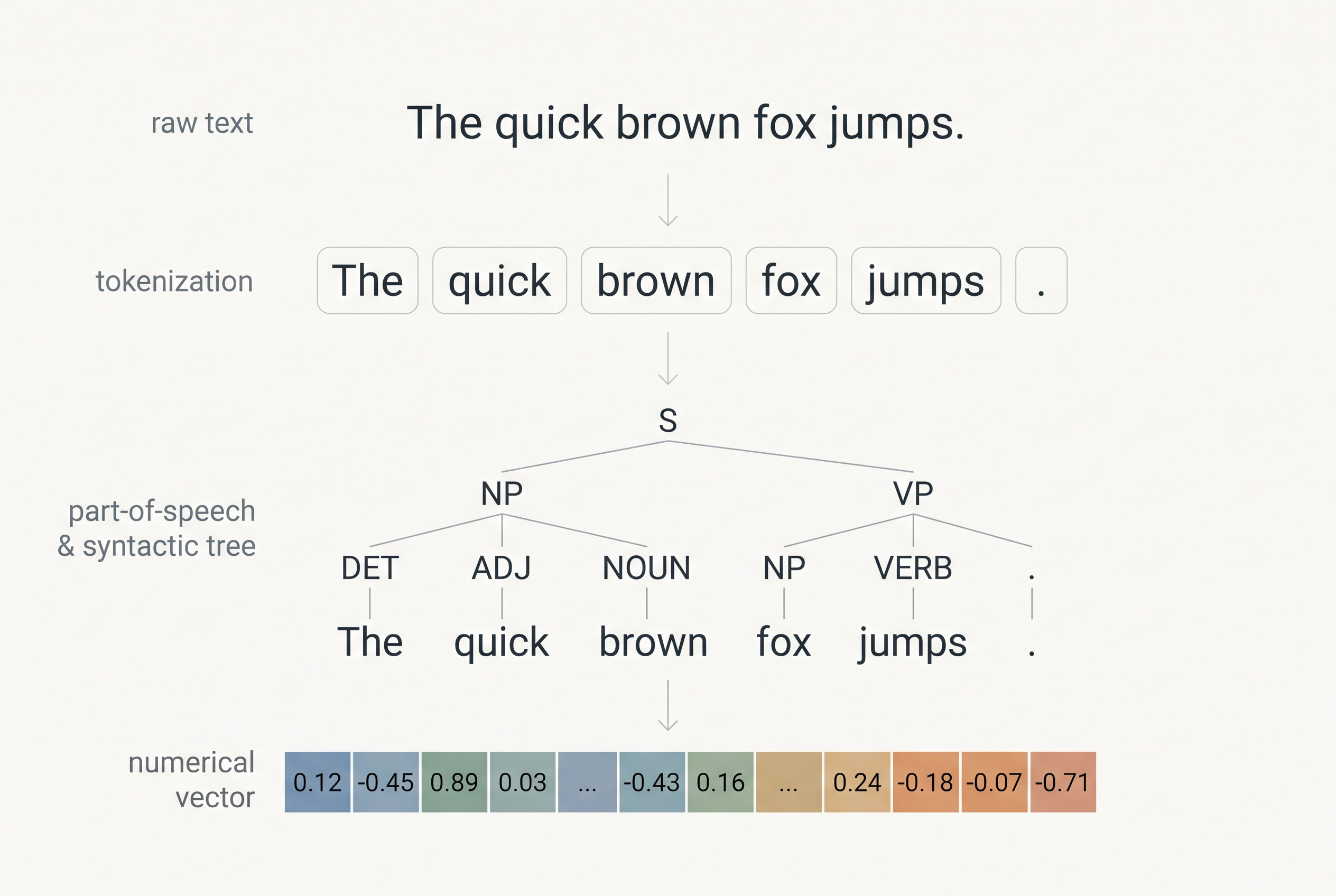
Computers process numbers rather than words, so text must
first be converted into a usable form. Tokenization splits text into
units such as words, subwords, or characters. Traditional pipelines also
applied steps like stemming (reducing words to roots), lemmatization
(reducing words to dictionary forms), and part-of-speech tagging. Modern
neural systems often rely on subword tokenization and perform less manual
preprocessing.
Representing meaning
Early statistical methods used counts of words, such as bag-of-words
models, which ignore word order. Embeddings instead place words in a
multi-dimensional space where words used in similar contexts tend to lie close
together. Contextual models go further, producing different representations for
the same word depending on surrounding text, which helps with ambiguous words
such as “bank.”
Model approaches
- Rule-based:
Hand-written grammars and patterns; transparent but labor-intensive and
brittle.
- Statistical:
Probabilistic models trained on corpora.
- Neural:
Deep networks, most recently transformers, trained on very large text
collections.
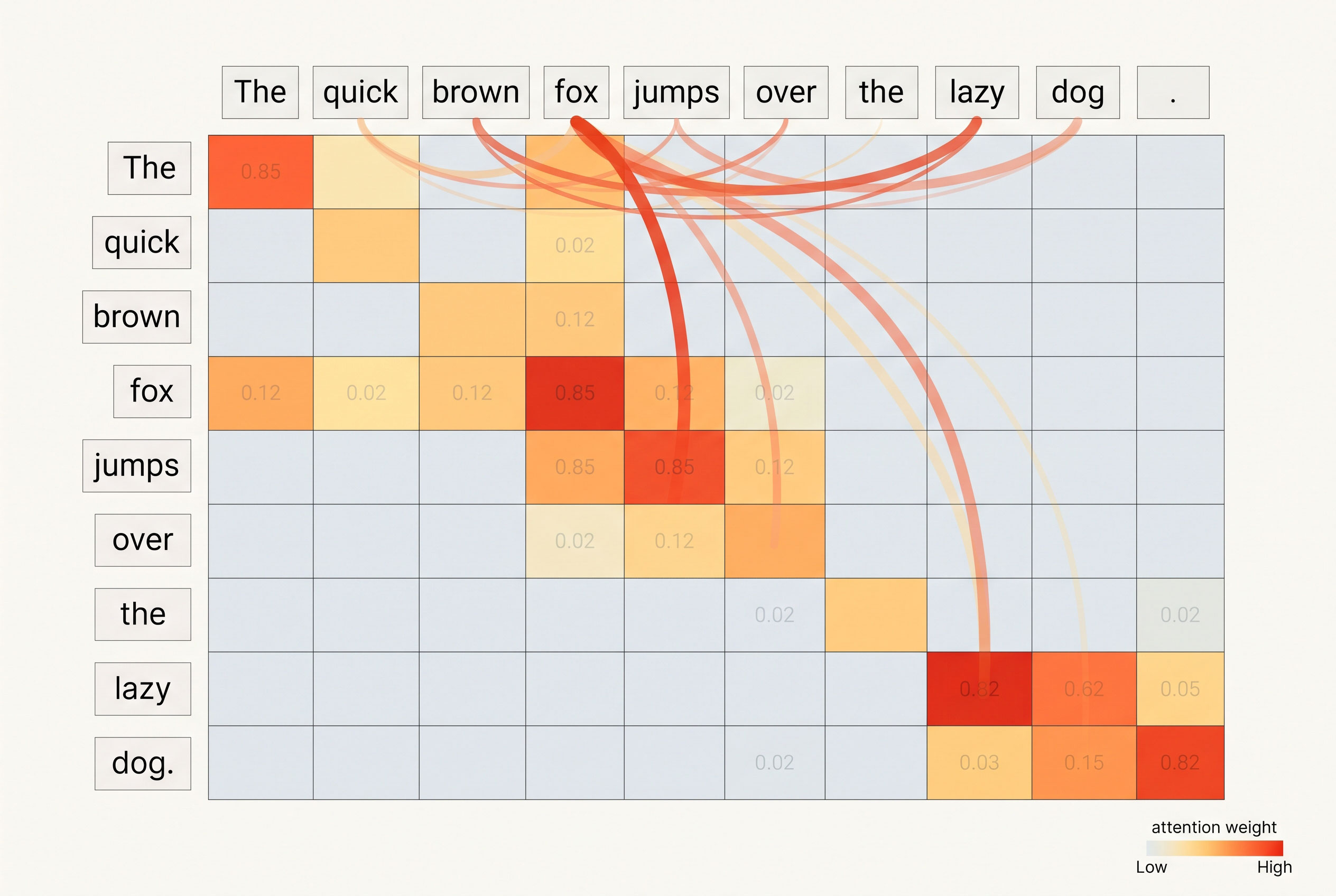
Transformers use an attention mechanism that lets a
model weigh relationships among all words in a passage, and they can be trained
in parallel more efficiently than earlier recurrent designs. Many current
systems are first pre-trained on broad text and then fine-tuned
or prompted for specific tasks.
Core Tasks
|
Task |
Description |
|
Machine translation |
Converting text between languages |
|
Sentiment analysis |
Identifying opinion or tone in text |
|
Named entity recognition |
Locating people, places, and organizations |
|
Summarization |
Condensing longer documents |
|
Question answering |
Producing answers to natural-language questions |
|
Speech recognition |
Converting spoken audio to text |
|
Text generation |
Producing new text from a prompt |
Natural language understanding (NLU) refers to tasks
centered on interpreting input, while natural language generation (NLG) refers
to producing output. Many modern systems perform both within one model.
Applications
NLP is used in search engines, email spam filtering,
automatic captioning, customer-service chatbots, and writing assistance. In
medicine, it is applied to extract information from clinical notes. In law and
finance, it supports document review and analysis of large text volumes.
Accessibility tools, including screen readers and dictation software, also
depend on language and speech technologies.
Challenges and Limitations
Human language is ambiguous: a single sentence can
have several valid interpretations depending on context, tone, or shared
knowledge. Sarcasm, idiom, and implied meaning remain difficult.
Performance varies considerably across languages. Most large
datasets are in English and a small number of other widely used languages, so low-resource
languages are often poorly served.
Models can reproduce biases present in training data,
and generative systems can produce fluent but incorrect statements, commonly
called hallucinations. Researchers also raise concerns about energy use
in training large models, privacy of training data, and misuse for
disinformation.
Debates
Researchers disagree about whether large language models
achieve genuine understanding of language or primarily reproduce statistical
patterns. Some argue that scale yields increasingly general capabilities, while
others contend that models lack grounding in the physical world and reasoning
that humans display. The question remains unresolved, and evaluation methods
are themselves a subject of ongoing research.
Current Status
As of the mid-2020s, NLP research and industry are dominated
by large pre-trained models, with active work on reliability, multilingual
coverage, efficiency, and evaluation. Details of leading systems change
quickly, so current figures should be checked against recent sources.