
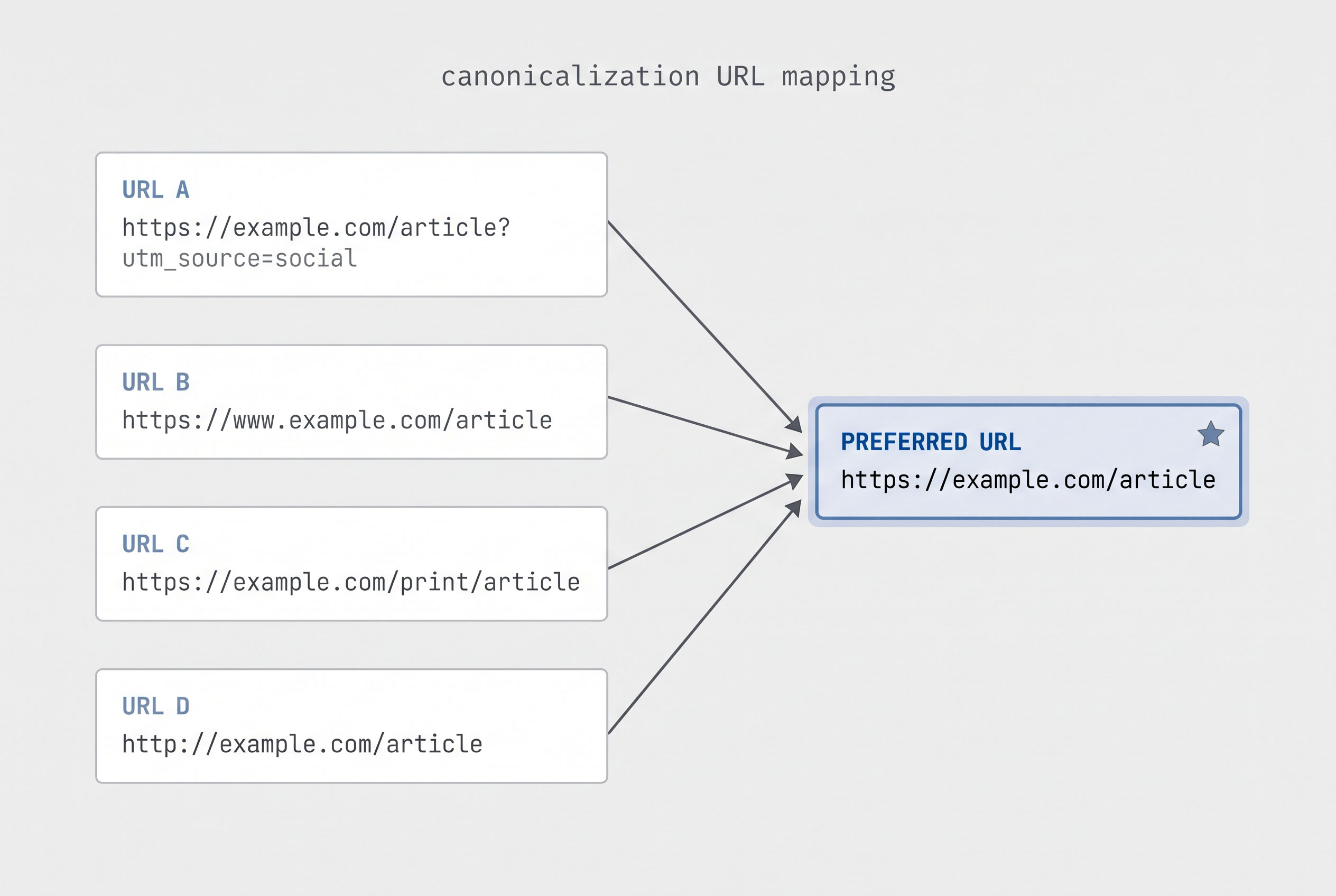
A canonical tag (also called the rel="canonical"
link element) is an HTML element placed in a web page's <head>
section that identifies the preferred, or "canonical," URL for that
page's content. Search engines use it as a signal when the same or very similar
content is reachable at more than one address. The tag helps consolidate
duplicate or near-duplicate pages under a single URL in search results.
The mechanism was announced in February 2009 by Google,
Yahoo, and Microsoft. It is now documented by major search engines and
described in an Internet Engineering Task Force specification. Search engines
treat it as a hint rather than a command, so the final choice of canonical URL
may differ from the one declared.
|
Infobox |
|
|
Type |
HTML link element and HTTP header |
|
Syntax |
<link rel="canonical"
href="URL"> |
|
Introduced |
February 2009 (Google, Yahoo, Microsoft) |
|
Formal specification |
RFC 6596 (April 2012) |
|
Placement |
<head> of an HTML document, or HTTP Link header |
|
Purpose |
Indicate the preferred URL among duplicate or similar
pages |
|
Enforcement |
Treated by search engines as a hint, not a directive |
Background
Web content can often be reached through several URLs. A
single product page might load at an address with a tracking parameter, a
sorting parameter, a "www" and non-"www" host, or an
"http" and "https" protocol. To a crawler, each variant is
a distinct address, even when the displayed content is identical.
This situation is commonly called duplicate content.
Search engines generally group such pages into a cluster and select one
representative URL to show in results. The selected URL is the canonical URL,
and the process is known as canonicalization. Without guidance, the
choice rests on the engine's own signals, which may not match what the site
owner prefers.
Note: Duplicate content is not generally described by
Google as a penalty trigger. Its documentation frames the issue mainly as one
of consolidation, with penalties associated with deceptive or manipulative
copying.
History
Before 2009, site owners relied on redirects, consistent
internal linking, and URL parameter settings to manage duplicate pages. On 12
February 2009, Google, Yahoo, and Microsoft jointly announced support for the
canonical link element, giving publishers a standard way to state a preference
without redirecting visitors.
The initial version applied to URLs within the same domain.
Later in 2009, Google announced support for cross-domain canonical references.
In 2011, Google added support for canonical declarations in HTTP headers, which
allowed non-HTML files such as PDFs to indicate a preferred URL.
The canonical link relation was registered formally through RFC
6596, published in April 2012. The document describes the relation as
designating the preferred version of a resource and notes that it is intended
to reduce duplicate content issues.
How It Works
Syntax
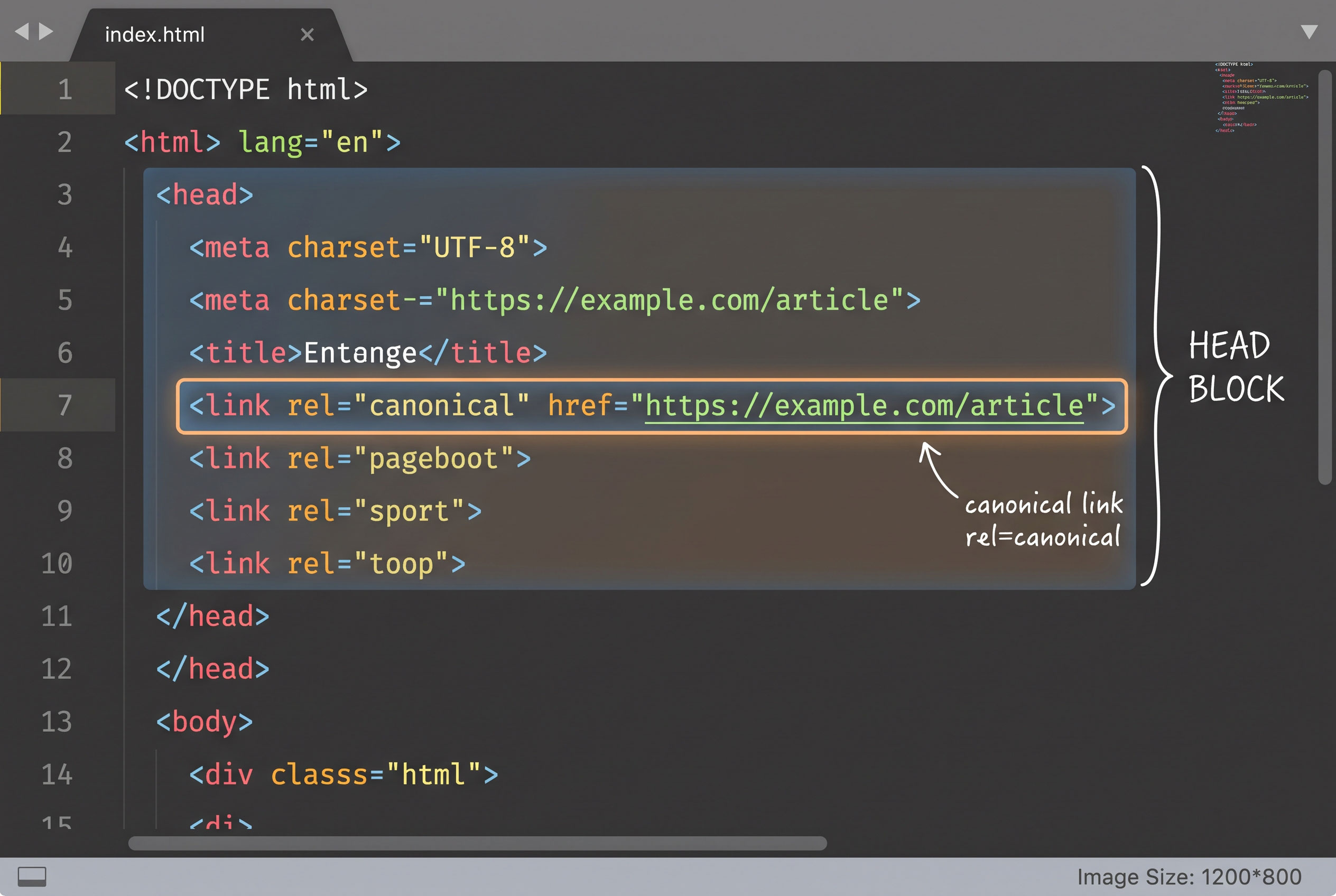
The tag is a link element with two attributes: rel set to canonical
and href set to the preferred URL. It belongs in the <head> of the HTML
document. Google's documentation advises that a canonical declaration placed in
the <body> is ignored.
HTTP header method
For files with no HTML head, a server can send a Link HTTP
header carrying the same relation. This approach applies to PDFs and other
documents delivered directly over HTTP.
Processing by search engines
When a crawler finds a canonical declaration, it treats the
stated URL as a candidate. The engine weighs this candidate against other
signals, then selects one URL as canonical. A pointer that conflicts with other
signals may be overridden.
Common Uses
- Parameter
variants: Pages differing only by tracking, session, or sorting
parameters point to the clean URL.
- Protocol
and host variants: Versions at "http" or "www"
address forms point to the chosen standard form.
- Syndicated
content: A republished article may point to the original publisher's
URL, though the engine is not obliged to follow this.
- Printer-friendly
or alternate-format pages: Secondary versions point to the main page.
- Self-referencing
canonicals: A page names its own URL as canonical, a practice commonly
recommended to guard against unintended variants.
Canonicalization Signals
The canonical tag is one of several signals search engines
use. Google's documentation lists, in descending order of strength as commonly
presented, redirects, the rel="canonical" annotation, and inclusion
of a URL in a sitemap. Other factors, such as internal links and HTTPS use, may
also contribute.
|
Method |
Effect on visitors |
Strength as a signal |
|
Server redirect (301/308) |
Visitor is sent to the target URL |
Strong |
|
rel="canonical" |
Visitor stays on the page |
Moderate (hint) |
|
Sitemap inclusion |
No visible effect |
Weaker |
Limitations and Common Errors
A canonical tag does not remove a page from the index, and
it does not redirect users. Several configurations can reduce its
effectiveness:
- Relative
or malformed URLs: Documentation generally recommends absolute URLs to
avoid misinterpretation.
- Multiple
canonical declarations: Conflicting tags on one page may cause all of
them to be ignored.
- Pointing
to blocked or error pages: A canonical target that is blocked from
crawling, returns an error, or redirects can undermine the signal.
- Combining
with noindex: Pairing the two sends contradictory instructions, and
search engines advise against it.
- Pointing
paginated pages to the first page: Pages containing different content
in a series are generally not treated as duplicates, so this may cause
content to be left out of the index.
- Chained
canonicals: Page A pointing to B, and B pointing to C, can lead to
unpredictable results.
Comparison With Related Concepts
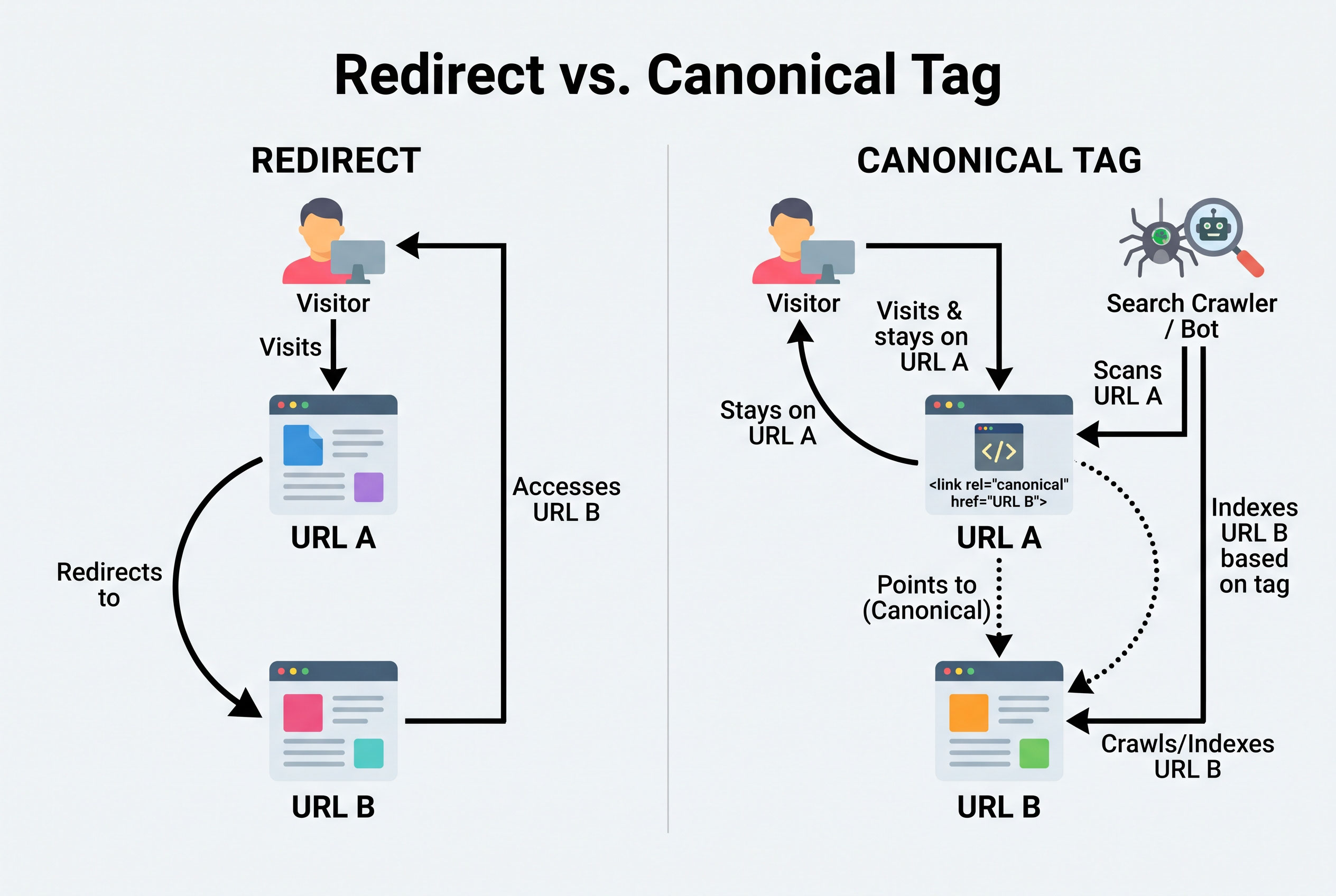
Canonical tag and 301 redirect
A redirect moves the visitor and the crawler to a new URL. A
canonical tag leaves the visitor on the original page and only informs the
crawler of a preference. Redirects are generally regarded as the stronger and
more definitive signal.
Canonical tag and noindex
The noindex directive asks that a page be excluded from
search results. A canonical tag asks that a page's signals be consolidated into
another URL. The two serve different goals.
Canonical tag and hreflang
The hreflang annotation connects language or regional
versions of a page. These versions are typically not duplicates, and each is
commonly given a self-referencing canonical.
Current Status
Canonical annotations remain a standard part of technical
search engine optimization and are supported by Google and Bing, among other
engines. Because search engines may update how they weigh signals, the behavior
described here reflects publicly available documentation and may change over
time.